Neighborhood Cycles: When to Hold, Improve, or Exit
Home / Neighborhood Cycles: When to Hold, Improve, or Exit
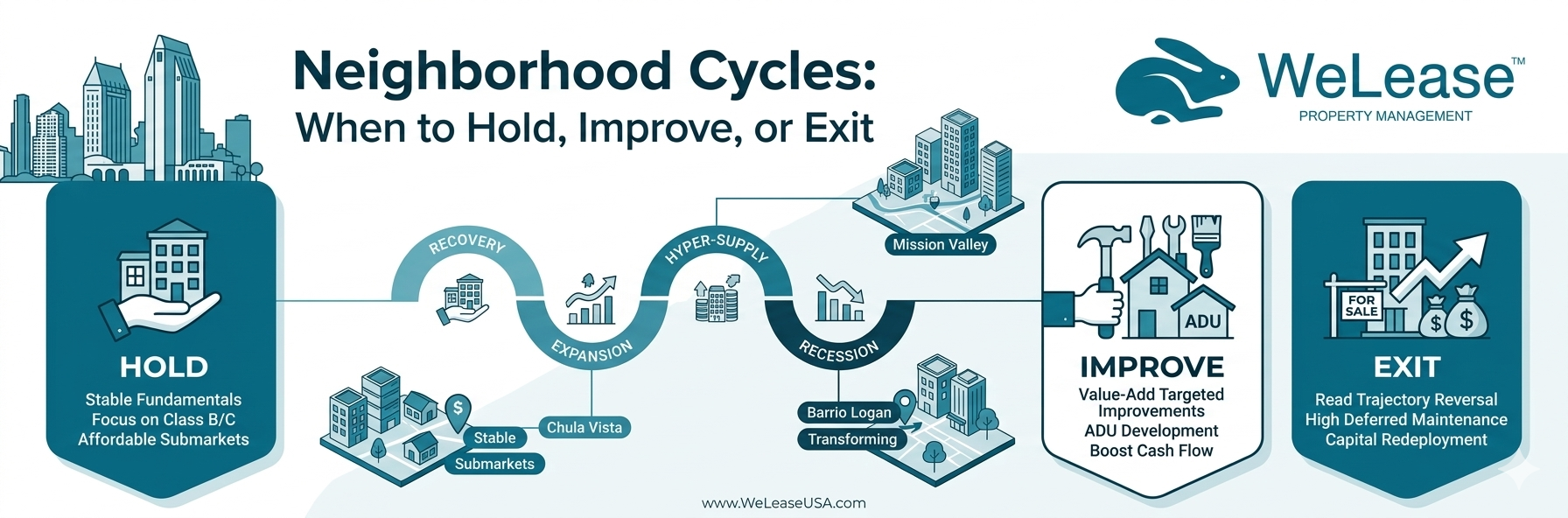
Neighborhood Cycles: When to Hold, Improve, or Exit
The most expensive mistake in rental property ownership is not a bad tenant or a failed renovation.
It is applying the right strategy to the wrong moment.
Holding a property through a cycle that is signaling exit. Selling just before a neighborhood turns. Pouring capital into improvements while comparable units down the street are offering free rent to attract tenants. Each of these decisions looks reasonable in the moment. In hindsight, each one is costly.
San Diego does not move as one market. It moves as a collection of neighborhoods, each on its own trajectory, often heading in different directions at the same time. What a landlord does with a property in 2026 should be driven by which part of the cycle that specific neighborhood is in.
Hold, improve, or exit. This article maps the framework for making that call.
The Four Phases Every San Diego Neighborhood Moves Through
Every real estate market follows the same pattern. The names and timing vary. The underlying logic does not.
Understanding which phase a neighborhood is in is the foundation of every hold, improve, or exit decision.
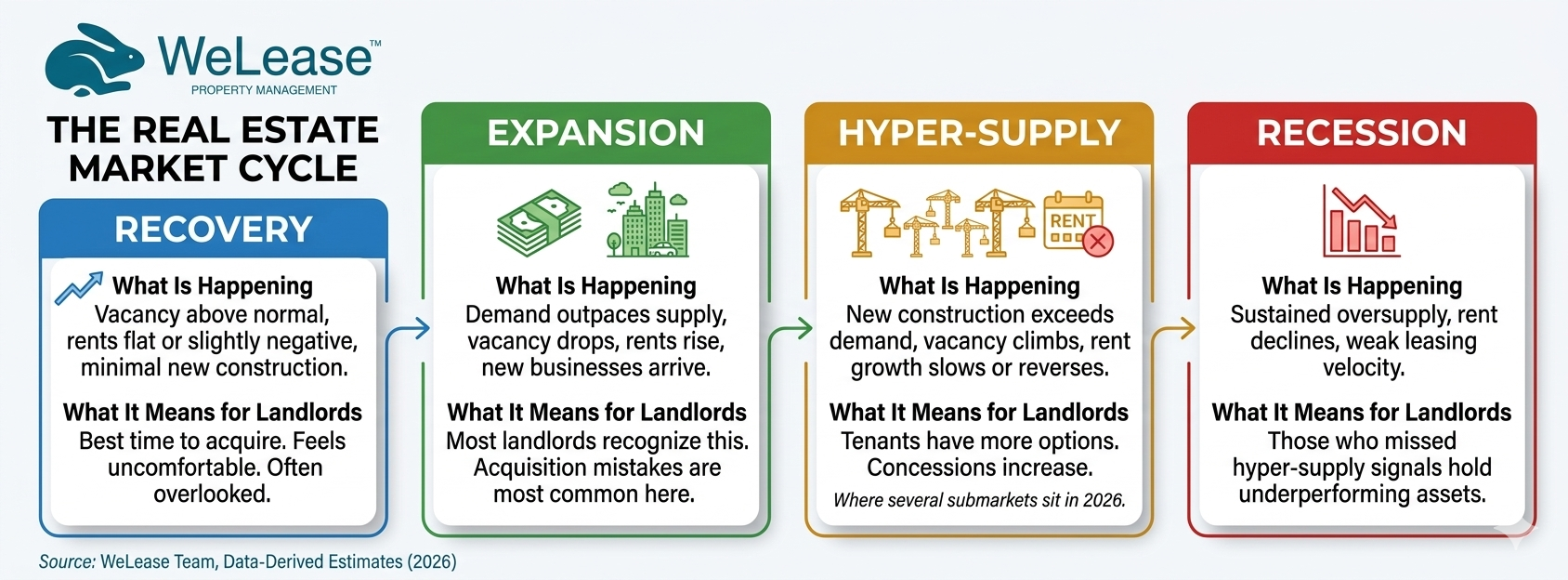
Source: WeLease Team, updated 2026
The cycle then begins again. Recovery follows recession. Neighborhoods that look broken at the bottom are often the ones that look obvious in hindsight five years later.
The skill is not timing the cycle perfectly. It is reading which phase a specific neighborhood is in accurately enough to make the right decision at the right time.
How to Read Where a Neighborhood Actually Is Right Now
Many landlords rely on old data instead of looking at what is happening in the market right now.
Published rent reports reflect what happened over the past quarter. By the time a softening trend shows up in a market report, that market has often been declining for six months. By the time a recovery shows up in the data, prices have already moved.
The signals that tell you where things are heading are more useful than the ones that tell you where things were.
What to watch -and why:
| Signal | What It Tells You |
|---|---|
| Vacancy direction (rising or falling) | Direction matters more than the absolute number. A market at 5% vacancy that is falling is stronger than one at 3% vacancy that is rising. |
| Days on market for active rentals | Units leasing in under two weeks = tight demand. Units sitting four to six weeks = tenants are comparing and taking their time. |
| New business arrivals | Coffee shops, independent restaurants, and art spaces tend to arrive one to two years before property prices reflect the same shift. This is one of the most reliable early signals of a neighborhood moving from recovery into expansion. |
| Infrastructure investment | When cities, transit authorities, or major private developers commit capital, they are making a forward bet on the neighborhood’s trajectory. |
| Permit activity | Rising renovation permits and ADU applications signal that investors see opportunity. A slowdown in previously active markets signals that the development community sees the same softening the rent data is beginning to show. |
Source: WeLease Team, updated 2026
What this means for you: Stop looking at what rents were six months ago. Start watching vacancy direction, days on market for active listings, and what kinds of businesses are arriving. Those signals reflect where the neighborhood is going, not where it has been.
When to Hold: Stability Beats Drama
The hold decision is almost always right when two conditions are met simultaneously: the neighborhood’s fundamentals are sound, and the property is performing without requiring significant ongoing capital.
The clearest hold candidates in San Diego right now:
Stabilized Class B and C properties in affordable, transit-accessible submarkets. North Park, Normal Heights, La Mesa, and South Bay continue to hold vacancy in the 2.5 to 4% range even as the luxury segment softens. These properties are not exciting. That is the point. They are producing consistent cash flow against a cost basis that makes the math work.
Chula Vista is a strong hold market in 2026. The Chula Vista rental market offers a tenant base of families and long-term residents who prioritize stability, moderate rent growth that supports durable occupancy, and an affordability advantage versus coastal San Diego that is likely to hold for years.
El Cajon is a hold on cash flow grounds. The El Cajon cash flow case rests on yields of 4 to 5% annually on acquisition costs well below the county median, with a renter-majority population producing steady demand. The Grossmont Center redevelopment adds a genuine long-term upside story, but the immediate case for holding is simpler: the cash flow works, and the tenant base is stable.
When does the hold decision become wrong?
When the property is consuming capital faster than it is generating it. Or when the neighborhood has experienced a structural shift in demand that makes recovery unlikely within a reasonable time horizon.
What this means for you: If your property is cash-flowing positively in a neighborhood with stable demand, the default answer is almost always hold. The time to reconsider is when the property is losing money or the neighborhood’s underlying drivers have fundamentally changed.
When to Improve: Targeting the Right Phase for Capital Investment
Improvement decisions produce the best returns when the neighborhood is in recovery or early expansion.
In recovery, improvements position a property to capture the first wave of rising rents as demand returns. The cost of the improvement is made in a soft market. The return is collected as the market tightens.
In early expansion, improvements allow a landlord to move from the mid-market into a slightly higher demand segment, supporting rent growth that exceeds the neighborhood average.
The worst time to make major improvements is in hyper-supply.
Investing $40,000 in a kitchen renovation when comparable units are offering free rent as a concession produces a nicer property that is still competing in a soft market. The improvement cost is real. The rent premium may not materialize for one to two years.
Where the improvement case is strongest in San Diego right now:
| Opportunity | Why It Makes Sense |
|---|---|
| Early-transition neighborhoods (Barrio Logan, Golden Hill) | Multiple market observers compare these areas to what East Village looked like before its transformation. Capital invested now can capture the next phase of rent growth as the transition accelerates. |
| Functional upgrades in stable Class B/C stock | In-unit laundry, updated appliances, efficient HVAC. These change whether a qualified tenant accepts or declines the unit. Cosmetic upgrades do not. |
| ADU development | San Diego ADUs are generating $1,500 to $3,500+ per month depending on location. Regulatory changes have continued to reduce barriers, including no owner-occupancy requirement, impact fee waivers for units under 750 sq ft, and streamlined permitting. |
Source: WeLease Team, updated 2026
What this means for you: Before approving any capital improvement, ask one question: will the cost of this improvement be recovered through higher rents, lower vacancy, or a higher sale price within a timeframe that makes financial sense? If the answer requires the neighborhood to be two or three phases ahead of where it currently sits, the improvement can wait.
When to Exit: Reading the Signals Before the Market Does
Exiting at the right moment is the hardest decision in rental property ownership.
The best time to sell is usually when the property is performing well, the neighborhood looks stable, and the instinct is to stay. By the time the neighborhood clearly signals that exit is the right move, the window for a strong sale has often already narrowed.
The situations that make exit the clearer choice:
The property is consuming capital faster than it is generating returns. A property that needs $80,000 in deferred maintenance, located in a submarket where rents are softening, and attracting tenants who are increasingly price-sensitive is not a hold. Exiting while the property is still presentable creates more value than waiting until the deferred maintenance becomes a habitability problem that complicates both the tenant relationship and the eventual sale.
The neighborhood’s trajectory has genuinely reversed. Not every soft market will recover on a useful timeline. Some neighborhoods lose a structural demand driver. An employer exits. A transit line is eliminated. When the demand shift is structural rather than cyclical, the recovery timeline can extend well beyond what most landlords can sustain. The honest read requires distinguishing between the two.
The capital could be doing something better. A property that has appreciated significantly and is producing yields that a 1031 exchange could redeploy into a higher-performing asset may be a hold for emotional reasons and an exit for financial ones.
New luxury oversupply is directly affecting the property. Class A properties in oversupplied submarkets, competing against buildings offering free rent concessions, face pressure that is not just about the individual property. It is about the entire competitive set. Mission Valley is the clearest local example of this dynamic in 2026.
What this means for you: Exit does not mean panic. San Diego’s fundamental demand drivers, including population growth, constrained land, employment diversity, and lifestyle appeal, remain intact. The question is whether a specific property in a specific submarket is the right vehicle for your capital through the recovery period.
A Three-Question Test Before Any Hold, Improve, or Exit Decision
Before making any major property decision, run through these three questions. They cut through the noise and focus on what actually matters.
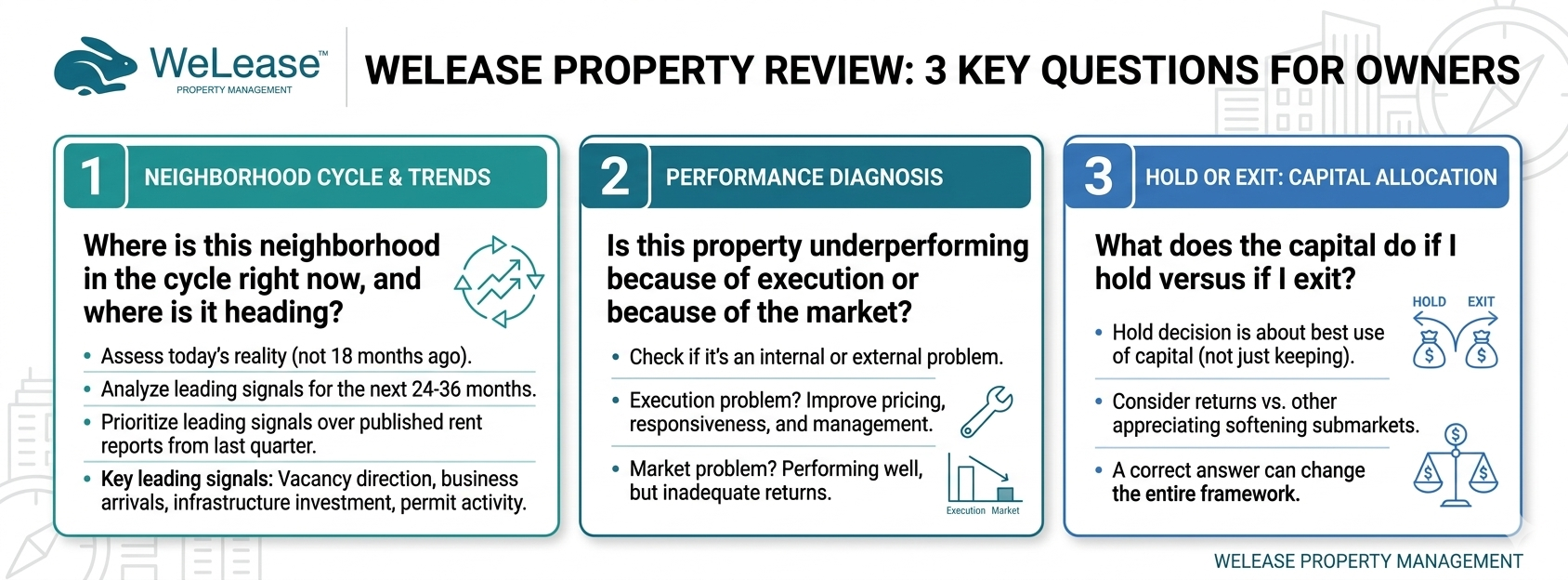
Question 1: Where is this neighborhood in the cycle right now, and where is it heading?
Not where it was 18 months ago. Where it is today, and what the leading signals suggest about the next 24 to 36 months. Vacancy direction, new business arrivals, infrastructure investment, and permit activity are more useful than published rent reports from last quarter.
Question 2: Is this property underperforming because of execution or because of the market?
A property that is underperforming in a strong neighborhood is usually an execution problem, not a market problem. Better pricing, improved maintenance responsiveness, and stronger management can recover that underperformance without an exit or major capital investment. A property that is performing as well as the market allows and still producing inadequate returns is a different problem entirely.
Question 3: What does the capital do if I hold versus if I exit?
The hold decision is not just about whether this property is worth keeping. It is about whether this is the best use of the capital it represents. In a market where some submarkets are softening and others are quietly appreciating, the answer to that question can change the entire framework.
How San Diego Submarkets Stack Up Right Now
| Submarket | Current Phase | Hold / Improve / Exit |
|---|---|---|
| Chula Vista | Stable expansion | Hold -strong tenant base, durable demand |
| El Cajon | Stable expansion | Hold -cash flow works, Grossmont upside |
| Barrio Logan / Golden Hill | Early transition | Improve -capital invested now captures next phase |
| Mission Valley (Class A) | Hyper-supply | Caution -vacancy pressure, active concessions |
| Mission Valley (Class B/C) | Stable | Hold -less new supply exposure |
| North Park / Normal Heights | Stable | Hold -consistent demand, limited new supply |
| Coastal / La Jolla / Del Mar | Stable to early correction | Hold or review -depends on specific property |
| Downtown / East Village | Hyper-supply | Caution -luxury oversupply, review returns |
Source: WeLease Team, updated 2026. Market positions are general assessments -individual properties may vary significantly.
Talk to Yesenia and Billy

The hold, improve, or exit decision is rarely as obvious as it looks from the outside. Every property has a specific set of conditions – tenant profile, cost basis, neighborhood trajectory, capital position – that changes what the right answer looks like.
At WeLease, we work with San Diego property owners across every submarket in the county. We know which neighborhoods are in which part of the cycle, what the leading indicators are suggesting about the next 24 to 36 months, and what the execution gaps look like for properties that are underperforming in strong markets. If you are evaluating a decision for a specific property and want a clear, grounded read on where it stands, we would be glad to have that conversation.
www.WeLeaseUSA.com | (619) 876-0753
Disclaimer: This article is intended for general informational purposes only and draws on publicly available market data and research as of early 2026. It does not constitute legal, financial, investment, or tax advice. Real estate market conditions change frequently and vary significantly by submarket. For guidance specific to your property and situation, please consult a qualified California real estate professional or licensed advisor, or contact us at www.weleaseusa.com.
Key Takeaways
- Every neighborhood moves through four phases: recovery, expansion, hyper-supply, and recession. The right strategy – hold, improve, or exit – depends on which phase a specific neighborhood is in, not on general market sentiment.
- Leading indicators are more useful than lagging data. Vacancy direction, days on market, new business arrivals, infrastructure investment, and permit activity signal where a neighborhood is heading before rent data reflects it.
- The hold decision is strongest when neighborhood fundamentals are sound and the property is generating returns without requiring significant ongoing capital. Chula Vista, South Bay, and stable East County Class B and C properties are the clearest hold candidates in 2026.
- Improvement decisions produce the best returns in recovery or early expansion. In hyper-supply, capital invested in upgrades may not generate the expected rent premium for one to two years.
- Exit signals include a property that is consuming capital faster than it is generating returns, a neighborhood whose structural demand drivers have reversed, and situations where the capital could be redeployed into a significantly better-performing asset.
- San Diego’s overall fundamentals remain intact. The decision is not whether San Diego real estate recovers. It is whether a specific property in a specific submarket is the right vehicle for your capital through the recovery period.
- San Diego’s compound appreciation over the last 25 years has run roughly 4 to 6% annually. The long-term case for well-positioned San Diego rental ownership remains sound for landlords with the right asset in the right submarket.
Frequently Asked Questions
How do I know if my San Diego rental is in a hold, improve, or exit market right now?
Start with vacancy direction and days on market for comparable rentals in your specific submarket, not county-wide averages. Then look at the leading indicators: new business arrivals, infrastructure investment, and permit activity. If those signals point to early expansion or stable demand, hold is usually right. If they point to sustained supply pressure without clear absorption in sight, the calculus shifts.
What are the best San Diego neighborhoods for a long-term hold in 2026?
Stable, affordable submarkets with limited new supply exposure tend to be the strongest hold candidates. Chula Vista, La Mesa, Normal Heights, and parts of East County fit this profile in 2026. These areas have durable tenant demand, limited luxury supply competition, and a cost basis that makes the cash flow math work without requiring appreciation to justify the investment.
When is the right time to make capital improvements to a rental property?
Recovery and early expansion are the optimal phases. In these phases, the improvement cost is incurred in a soft market and the return is captured as demand tightens. Making major improvements in hyper-supply, when comparable units are offering concessions to attract tenants, often produces a better property without a corresponding rent premium in the near term.
How do I know when it is time to sell a rental property in San Diego?
When the property is consuming capital faster than it is generating returns, when the neighborhood has experienced a structural shift in demand that makes recovery unlikely within a reasonable time horizon, or when the capital could be redeployed into a significantly better-performing asset. The best exit timing is usually before the neighborhood’s trajectory reversal is obvious to everyone – which requires leading indicators, not lagging ones.
Is 2026 a good time to sell San Diego rental property?
It depends entirely on the specific property and submarket. For Class A luxury properties in oversupplied submarkets competing against buildings offering concessions, the near-term performance outlook is challenging and exit may make sense. For well-positioned Class B and C properties in stable affordable submarkets, the hold case is often stronger than exit, particularly for landlords with a long-term orientation.
Reviewed by Yesenia Nogales Co-Founder & Commanding Officer, WeLease REALTOR® | DRE# 01487100: Yesenia Nogales is a licensed REALTOR® and Co-Founder of WeLease Property Management. She specializes in residential sales, investment properties, and property management. Yesenia served on the board of the NAHREP San Diego Chapter for four years and was President in 2017. She is an active member of both NAHREP and NARPM. She also leads the San Diego Women Real Estate Investors group and is a member of the Southern California Developers Creative Investors Association. In addition, she volunteers with Friends of Del Cerros; WeLease Credentials: NARPM® Member, BBB Accredited, MLS Participant, Equal Housing Opportunity. Recognized as San Diego’s Best Property Management Company – Union-Tribune Winner (2022, 2024); Finalist (2023, 2025). DRE: 02047533

Ivana M. Janakieva is a Property Management Marketer and SEO Content Manager who turns confusing real estate jargon into practical, actionable advice. She’s the type who reads maintenance reports like morning news and can make lease agreement clauses sound (almost) fun. With years of experience writing about everything from tenant turnover and landlord-tenant laws to climate risks and curb appeal ROI, Ivana creates content for people who want straight answers about protecting and profiting from their most valuable asset, their property.