The Hidden Costs That Quietly Kill Rental Returns
Home / The Hidden Costs That Quietly Kill Rental Returns

The Hidden Costs That Quietly Kill Rental Returns
Most landlords know their mortgage payment, their property taxes, and roughly what they spend on maintenance each year.
What they do not know, and what costs them the most, is everything in between.
The most damaging costs in rental ownership almost never show up in a spreadsheet. They accumulate in the background. Between lease cycles. Inside delayed decisions. Through compliance gaps that nobody flagged until they became expensive.
And by the time most landlords notice them, they have been paying them for years.
Here is where the money actually goes.
How Much Could Hidden Costs Actually Be Costing You?
Before diving in, here is a quick snapshot of the six hidden cost categories and their typical impact on a San Diego rental.
| Hidden Cost | Typical Impact |
|---|---|
| Extended vacancy | $1,700–$4,600+ per extra month |
| Tenant turnover | $2,300–$6,900 per cycle |
| Deferred maintenance | 2–10x more expensive when ignored |
| Legal and compliance errors | Triple damages + attorney’s fees |
| Self-management time | 5–15+ hours/month (untracked) |
| Slow follow-up on inquiries | Best applicant goes elsewhere |
Source: WeLease Team, updated 2026
None of these feel dramatic in the moment. That is exactly what makes them so expensive over time.
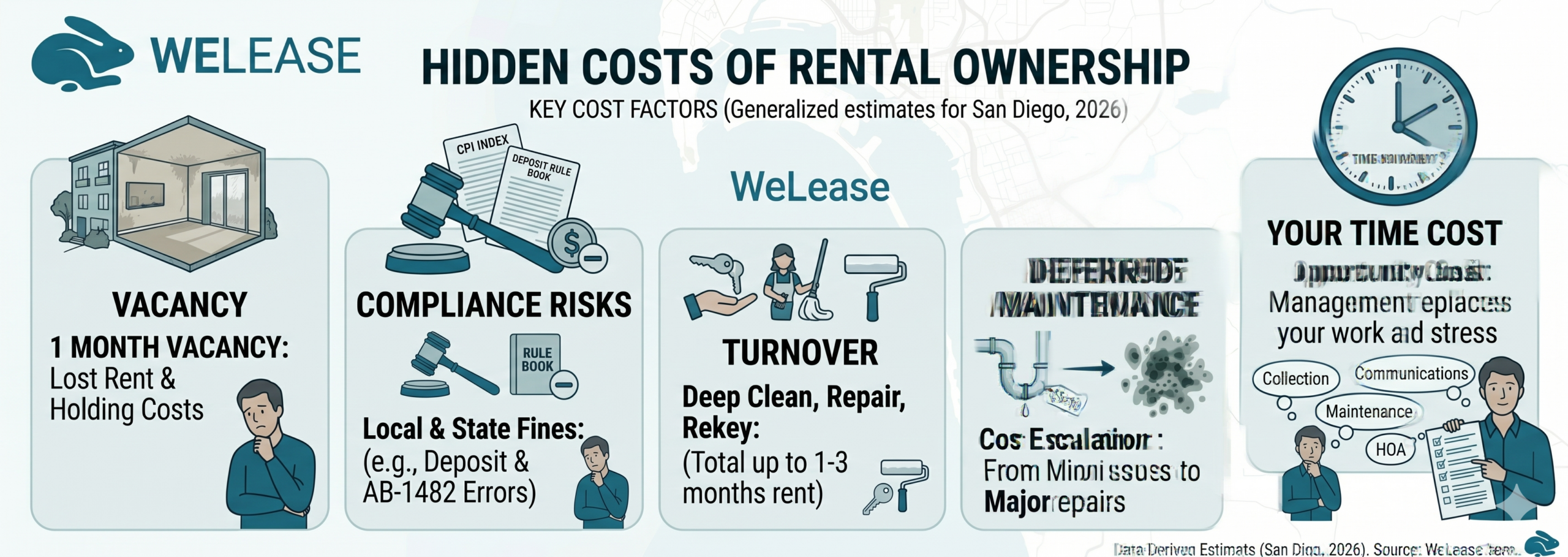
Hidden Cost #1: Vacancy, You Know It Exists. You’re Still Underestimating It.
Every landlord knows an empty unit costs money. Fewer landlords actually do the math on what it costs relative to annual returns.
Here is a simple breakdown for a San Diego unit renting at $2,300 per month:
The Vacancy Math Most Landlords Skip
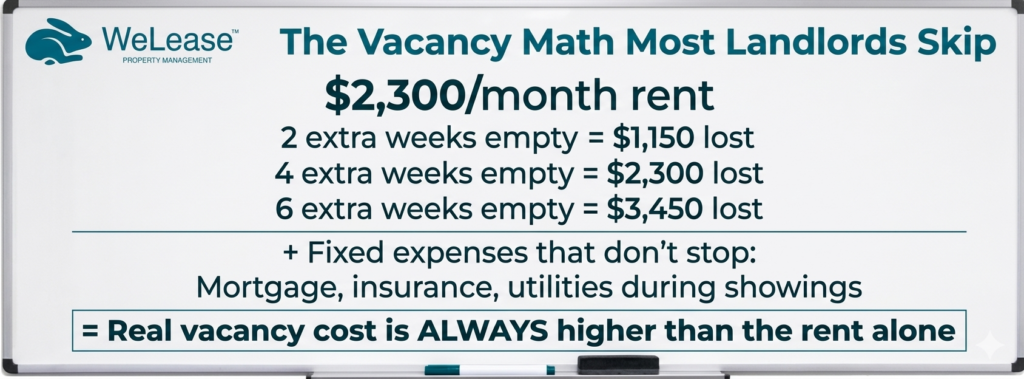
One month of vacancy = 8–10% of your annual gross income. Gone.
Now factor in the fixed expenses that do not pause because the unit is empty, mortgage, insurance, utilities left on for showings, and the real number is consistently higher than landlords expect.
Why does vacancy run long in the first place?
Two reasons, almost every time.
The first is overpricing. In a market where tenants are comparing four or five options before applying, a unit priced $100 to $150 above market does not attract negotiation. It attracts silence. Tenants move on to the next listing.
The second is slow follow-up. Qualified renters in San Diego are reaching out to multiple properties simultaneously. The window between an inquiry and a decision to apply elsewhere can be 24 to 48 hours. Self-managing landlords juggling jobs and family often miss that window, and the best applicant in the pool disappears quietly.
What this means for you: Vacancy is almost always a pricing or responsiveness problem, not a market problem. Both are fixable. But they require current data and systems that respond faster than the average landlord can manage alone.
Hidden Cost #2: Tenant Turnover, The Full Cost Is Longer Than You Think
Vacancy is only the visible part of tenant turnover. The rest of the chain is what makes turnover one of the most destructive patterns in rental ownership.
When a tenant leaves, here is what typically follows:
- Deep cleaning of the unit
- Paint touch-ups or full repaint
- Carpet cleaning or replacement
- Appliance inspection and servicing
- Rekeying the locks
- Small repairs that accumulated during the tenancy
- New listing photos if needed
- Leasing time: showings, screening, applications
The numbers:
Over 80% of landlords spend at least $1,000 per unit on turnover costs, and that does not include the lost rent during vacancy. Add it all together and a full turnover cycle typically runs one to three months of rent.
On a $2,300 per month San Diego property, that is $2,300 to $6,900 per turnover event.
A tenant who stays for three years instead of one avoids two of those cycles entirely. Run that math and the case for investing in tenant retention becomes very clear, very fast.
What actually keeps good tenants?
Three things that cost very little:
- Responsive maintenance (see Hidden Cost #3 below)
- Gradual, predictable rent increases rather than sudden jumps
- A proactive renewal conversation that starts 60 to 90 days before the lease ends
What this means for you: Retention is one of the highest-value investments a landlord can make. The cost of keeping a good tenant is almost always lower than the cost of replacing them, often by a significant margin.
Hidden Cost #3: Deferred Maintenance, Where Small Problems Become Big Bills
This is the category where the gap between what landlords think they are saving and what they are actually paying is widest.
A minor plumbing issue that costs $150 to fix today can become a $900 repair in six months. A small roof penetration left unattended through one wet season becomes water intrusion. Water intrusion becomes mold. Mold becomes a habitability issue with legal implications.
The planning benchmark the industry uses:
| Property Value | Annual Maintenance Budget |
|---|---|
| $500,000 | $5,000 – $15,000/year |
| $650,000 | $6,500 – $19,500/year |
| $800,000 | $8,000 – $24,000/year |
Source: WeLease Team, updated 2026
Most self-managing landlords spend well below this in years when nothing major happens, and then get hit with a large, unexpected bill when deferred issues catch up with them.
The relationship cost matters too.
Slow maintenance response is consistently cited as one of the primary reasons tenants do not renew. A tenant who feels like requests disappear into a void will start quietly looking elsewhere, often months before they give notice.
By the time the landlord realizes what is happening, the vacancy is already coming.
What about 2026 compliance?
California landlords now have clearer statutory obligations around significant mold problems and disaster damage. Structural inspection requirements for balconies, decks, stairways, and walkways carry daily penalties for non-compliance that can accumulate rapidly.
These are not theoretical risks. They require proactive scheduling, not waiting for a problem to appear.
What this means for you: Deferred maintenance is not just a relationship risk. It is a compliance risk and a financial one. A $300 fix ignored for a season can easily become a $3,000 problem, plus a tenant who has already started their search.
Hidden Cost #4: Legal and Compliance Mistakes, The Bills That Arrive Without Warning
This is the category that surprises landlords most. Not because the mistakes are dramatic, but because they are invisible until they are not.
Most compliance failures result from landlords operating on information that was accurate two or three years ago, and has not been updated since.
The areas where errors are most expensive in 2026:
Security deposit miscalculations. As of July 2024, California capped security deposits at one month’s rent for most residential rentals. Landlords still collecting two months are overcollecting and creating immediate legal exposure. Add the new AB 2801 photography requirements, move-in, pre-cleaning, and post-cleaning, and there are three new checkpoints where a missed step creates liability.
AB-1482 rent increase errors. The San Diego County cap is 8.8% through July 2026. Landlords who calculate using the wrong CPI index, or who assume their property is exempt without the required written documentation, are carrying risk they cannot quantify. Violations can result in repayment of excess rent and, in some circumstances, triple damages.
Defective termination notices. In the City of San Diego, a termination notice missing required language is defective at the moment it is served. The eviction process does not pause for the error, it restarts entirely. And under AB 2347, tenants now have 10 court days (not the previous 5) to respond to unlawful detainer lawsuits. Every procedural mistake is more expensive than it used to be.
New 2026 appliance requirements. As of January 1, 2026, California landlords must provide a working stove and refrigerator for most residential rentals. Non-compliance carries fines up to $2,500. This is the kind of requirement that landlords not actively tracking regulatory updates simply may not know about yet.
What this means for you: California law does not adjust penalties for good intentions. The cost of a single compliance error, triple damages, restarter eviction costs, fines, can easily exceed years of management fees. Staying current is not optional. It is the job.
Hidden Cost #5: Your Time, The One That Never Gets Counted
This one is harder to quantify. Which is exactly why it never makes it into the spreadsheet.
Self-managing a San Diego rental is a part-time job that does not announce itself as one.
In a normal month, a self-managing landlord typically handles:
- Responding to tenant inquiries and maintenance requests
- Coordinating vendors and following up on repairs
- Tracking California regulatory updates
- Managing lease renewals and rent increase calculations
- Processing rent payments and late notices
- Staying on top of HOA compliance (where applicable)
In quiet months, this might be five to ten hours. In months when a maintenance issue escalates, a tenant gives notice, or a compliance question comes up, it can be considerably more.
The honest math:
When the hourly value of that time is measured against what a professional management fee would cost, the numbers often surprise landlords who thought self-management was saving them money.
The management fee that looks like an expense is frequently replacing a cost that was already being paid in time and stress, without ever being tracked as either.
So What Actually Changes With Professional Property Management?
When demand is overwhelming and every unit leases immediately regardless of how it is managed, the value of professional property management is harder to see.
When execution actually matters, and in 2026, it does, that value becomes a lot more visible.
Here is what changes:
Vacancy shrinks. Accurate market pricing, same-day inquiry response, and syndication across 100+ platforms means units lease faster. The best applicants stay in the process long enough to apply.
Turnover drops. Proactive renewal conversations, responsive maintenance, and relationship-driven management keep good tenants in place longer.
Repair costs fall. Established vendor relationships and preventive maintenance scheduling mean fewer emergencies and lower per-incident costs than a landlord sourcing independently.
Compliance is built in. Lease templates reflect current law. Notice formats include required language. Rent calculations are verified against current CPI data. The compliance piece takes care of itself as part of the management process.
The financial difference between a well-managed property and a self-managed one is usually larger than the management fee, often by a meaningful margin.
In a market where the hidden costs are adding up quietly in the background, that margin matters a lot.
Want to Know What Your Rental Is Actually Costing You?
Talk to Yesenia and Billy

Billy and Yesenia work with San Diego landlords across the county every day.
If you are not completely certain what your rental is producing after vacancy, turnover, maintenance, and compliance are fully accounted for, that conversation is worth having.
There is no obligation, just a clear, honest look at your property and what it could be doing.
www.WeLeaseUSA.com | (619) 876-0753
Disclaimer: This article is intended for general informational purposes only and draws on industry research and publicly available regulatory information as of early 2026. It does not constitute legal, financial, or tax advice. Market conditions and regulations change frequently. For property-specific guidance, please consult a qualified California real estate professional or licensed legal advisor, or contact us at www.weleaseusa.com.
Key Takeaways
- A single month of vacancy reduces annual gross rental income by 8 to 10 percent, and that figure does not include the fixed expenses that continue running while the unit sits empty.
- Over 80 percent of landlords spend $1,000 or more per turnover event, not counting the lost rent during vacancy. Total turnover costs often run one to three months of rent.
- Deferred maintenance compounds faster than most landlords expect. The industry planning benchmark is 1 to 3 percent of property value annually for repairs and maintenance.
- California compliance errors carry serious financial penalties. AB-1482 violations can result in triple damages. New 2026 requirements include stove and refrigerator obligations with fines up to $2,500 for non-compliance.
- Self-managing landlords rarely count the time cost of management accurately, which makes professional management appear more expensive on paper than it typically is in practice.
- Professional property management tends to produce shorter vacancy periods, lower turnover frequency, lower repair costs, and meaningfully reduced legal exposure, often exceeding the management fee in total financial impact.
Frequently Asked Questions
What is the most expensive hidden cost for San Diego landlords?
Vacancy and turnover together tend to represent the largest single gap between what a landlord thinks their property is earning and what it is actually producing. A poorly timed vacancy or a high-turnover property can easily cost more in a single year than a full professional management arrangement, without the landlord ever connecting those costs to a fixable cause.
How much should I budget for maintenance on a San Diego rental?
The standard planning benchmark is 1 to 3 percent of the property’s value annually. On a $650,000 property, that is $6,500 to $19,500 per year. Properties with older systems, deferred maintenance history, or exposure to coastal conditions may sit toward the higher end of that range.
Can compliance mistakes really result in major penalties in San Diego?
Yes, and in 2026 the exposure is higher than many landlords realize. AB-1482 violations can trigger triple damage penalties. Structural inspection non-compliance carries daily fines. New appliance requirements carry fines up to $2,500. Most of these consequences result not from deliberate violation but from landlords operating on outdated information.
Does professional property management actually pay for itself?
In most cases, yes, and in ways that do not show up immediately on a spreadsheet. The combination of shorter vacancy, lower turnover frequency, faster and cheaper maintenance, and reduced legal exposure typically produces a net financial outcome that exceeds the management fee. The fee is visible. The costs it prevents are largely invisible until they are not.
What is the biggest mistake self-managing landlords make?
The most common and costly is overpricing combined with slow follow-up. These two factors together produce extended vacancy, which is the most immediate and unrecoverable drain on rental returns. Both are correctable with the right market data and the right systems, which is exactly what a professional property management relationship provides.
Reviewed by Yesenia Nogales Co-Founder & Commanding Officer, WeLease REALTOR® | DRE# 01487100: Yesenia Nogales is a licensed REALTOR® and Co-Founder of WeLease Property Management. She specializes in residential sales, investment properties, and property management. Yesenia served on the board of the NAHREP San Diego Chapter for four years and was President in 2017. She is an active member of both NAHREP and NARPM. She also leads the San Diego Women Real Estate Investors group and is a member of the Southern California Developers Creative Investors Association. In addition, she volunteers with Friends of Del Cerros; WeLease Credentials: NARPM® Member, BBB Accredited, MLS Participant, Equal Housing Opportunity. Recognized as San Diego’s Best Property Management Company – Union-Tribune Winner (2022, 2024); Finalist (2023, 2025). DRE: 02047533

Ivana M. Janakieva is a Property Management Marketer and SEO Content Manager who turns confusing real estate jargon into practical, actionable advice. She’s the type who reads maintenance reports like morning news and can make lease agreement clauses sound (almost) fun. With years of experience writing about everything from tenant turnover and landlord-tenant laws to climate risks and curb appeal ROI, Ivana creates content for people who want straight answers about protecting and profiting from their most valuable asset, their property.