El Cajon Rentals: Cash Flow vs. Appreciation Tradeoffs | WeLease
Home / El Cajon Rentals: Cash Flow vs. Appreciation Tradeoffs | WeLease
El Cajon Rentals: Cash Flow vs. Appreciation Tradeoffs | WeLease
Most conversations about San Diego real estate start near the coast and stay there. La Jolla, Del Mar, Pacific Beach. The numbers are big, the headlines are frequent, and the status appeal is obvious.
El Cajon does not get that kind of attention. It never really has.
But if you are a landlord trying to build something that actually works over time, that gap in attention is worth paying attention to. Because El Cajon is doing something that a lot of flashier markets are not doing right now: it is producing consistent, predictable returns for owners who understand what they are buying.
This is not a market for everyone. It rewards a specific kind of strategy, and it punishes a different kind.
Understanding which is which before you price your rental, before you decide whether to hold or sell, before you think about who your ideal tenant is – is what separates owners who perform from those who are perpetually surprised.
El Cajon at a Glance: The Numbers That Matter
Before going deeper, here is a quick snapshot of where El Cajon sits as a rental market in 2026.
| Factor | El Cajon 2026 |
|---|---|
| Average rent (all types) | ~$2,295/month |
| 1-bedroom average | ~$1,912/month |
| 2-bedroom average | ~$2,321/month |
| Renter-occupied households | ~59% |
| Year-over-year rent change | ~-2% |
| Typical rental yield | 4–5% annually |
| Entry price vs. county median | 30–50% lower |
| Vacancy rate | 2.5–5% |
| Best fit | Cash flow, long-term hold |
That 59% renter-occupancy figure is significant. More than half of El Cajon households rent. That is not a temporary trend. It is a structural characteristic of this market that holds steady regardless of what the broader San Diego County numbers are doing.
What El Cajon Actually Looks Like as a Rental Market
El Cajon sits in San Diego’s East County, roughly 15 miles inland from downtown. It is sometimes called “The Big Box,” a nod to its valley geography, surrounded on most sides by hills. It is denser than a lot of East County communities, more suburban than urban, and home to a genuinely diverse population that spans income levels, backgrounds, and life situations.
For landlords, the numbers that matter most right now look like this:
Is El Cajon a Cash Flow Market or an Appreciation Market?
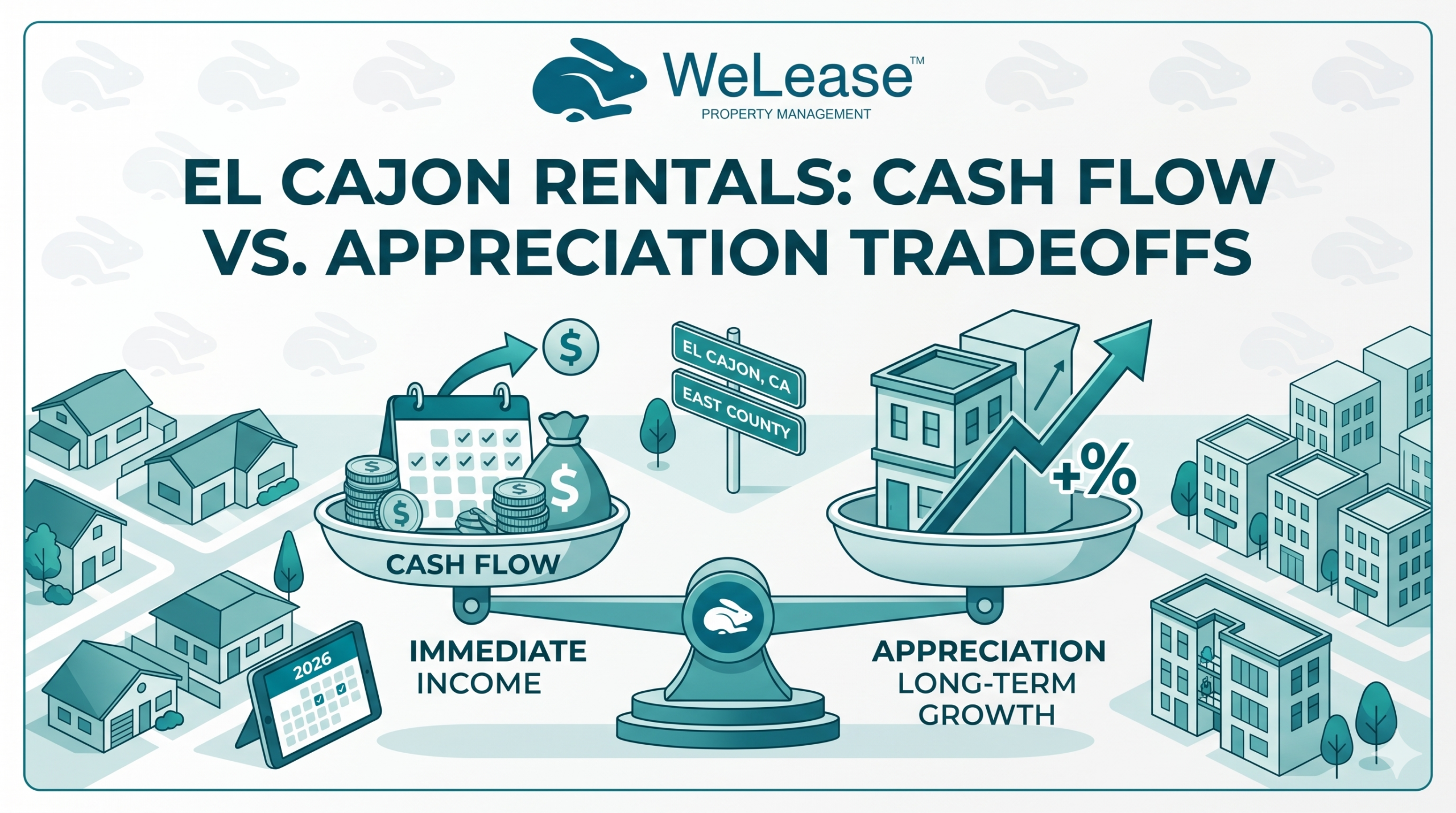
The short answer: cash flow first, appreciation second.
That is not a criticism. For the right landlord with the right time horizon, it is exactly the profile that produces stable, compounding returns. But it is important to be honest about what El Cajon offers and what it does not, before making any investment or pricing decision.
Here is the case for each side.
Median home values sit around $590,000 to $650,000 depending on the sub-area. That is well below the county-wide median, which has pushed past $900,000 in many neighborhoods. When you pair those acquisition costs with rents in the $2,200 to $2,900 range, the yield math looks genuinely different.
What does that look like in practice?
- El Cajon typical yields: 4 to 5% annually
- Coastal San Diego cap rates: 2 to 3%
- The gap: roughly 2 percentage points, every year, compounding
A property generating 4.5% on a $620,000 acquisition is producing meaningful monthly income. The equivalent coastal property at 2.5% on a $1.4 million acquisition is often cash-flow negative or barely breaking even.
For landlords who measure success by monthly income, not balance-sheet appreciation, El Cajon presents a straightforwardly more attractive picture than most of what San Diego County offers right now.
What this means for you: If your goal is consistent monthly income and you are not depending on a quick appreciation spike, El Cajon’s math is worth running seriously. The entry cost advantage is real, and the yield difference compounds significantly over a 10 to 15 year hold.
The Appreciation Picture: Honest and Nuanced
al and central San Diego neighborhoods tend to spike faster when the market heats up. That is simply a function of desirability, supply constraints, and the premium buyers pay to be close to the water or to urban amenities. That is not El Cajon’s identity, and trying to force that expectation onto this market leads to disappointment.
What El Cajon does deliver is steadier, longer-term appreciation that tracks more closely with county-wide fundamentals. Broader San Diego County appreciation rates are expected to run around 4 to 6% annually over the coming decade. El Cajon’s trajectory is likely to stay within that band.
Is there an upside story here?
Possibly. The Grossmont Center mixed-use redevelopment, expected to complete in 2026 and 2027, is drawing comparisons to what happened in North Park a decade ago – sudden cultural momentum and meaningful price appreciation in a neighborhood that was previously overlooked.
The sub-areas getting the most attention for long-term positioning are Fletcher Hills and Rancho San Diego, where school quality and proximity to newer retail corridors add durable demand factors.
This is speculative, not guaranteed. But the structural argument is not unreasonable for investors who can wait.
What this means for you: Do not buy El Cajon expecting a 15% appreciation pop in two years. Buy it because the cash flow is real, the renter demand is steady, and the appreciation over a 10 to 15 year hold is likely to be meaningful – even if it is not exciting.
Who Actually Rents in El Cajon and Why It Matters
Understanding the tenant base matters as much as understanding the numbers. In El Cajon, the two are connected.
The renter population here is primarily:
- Working families who need space and reasonable access to employment corridors along the I-8 and SR-94
- Long-term residents who have built community connections and are not looking to move
- Professionals who need East County access and value square footage over zip code prestige
This is not a demographic that chases the newest building or the trendiest neighborhood. They make deliberate decisions about where to live. And when they find a property that fits, they stay.
What does that mean financially?
Lower turnover means fewer vacancy gaps. Fewer gaps mean more predictable cash flow. And when a good tenant eventually does leave, they usually signal it early rather than disappearing mid-lease.
El Cajon continues to hold vacancy in the 2.5 to 5% range, competitive against other San Diego County submarkets. That occupancy consistency reflects the nature of the tenant base, not luck.
The Tradeoff Most Landlords Miss
Here is the tension that actually defines El Cajon as an investment, and it is subtler than the simple cash flow vs. appreciation frame suggests.
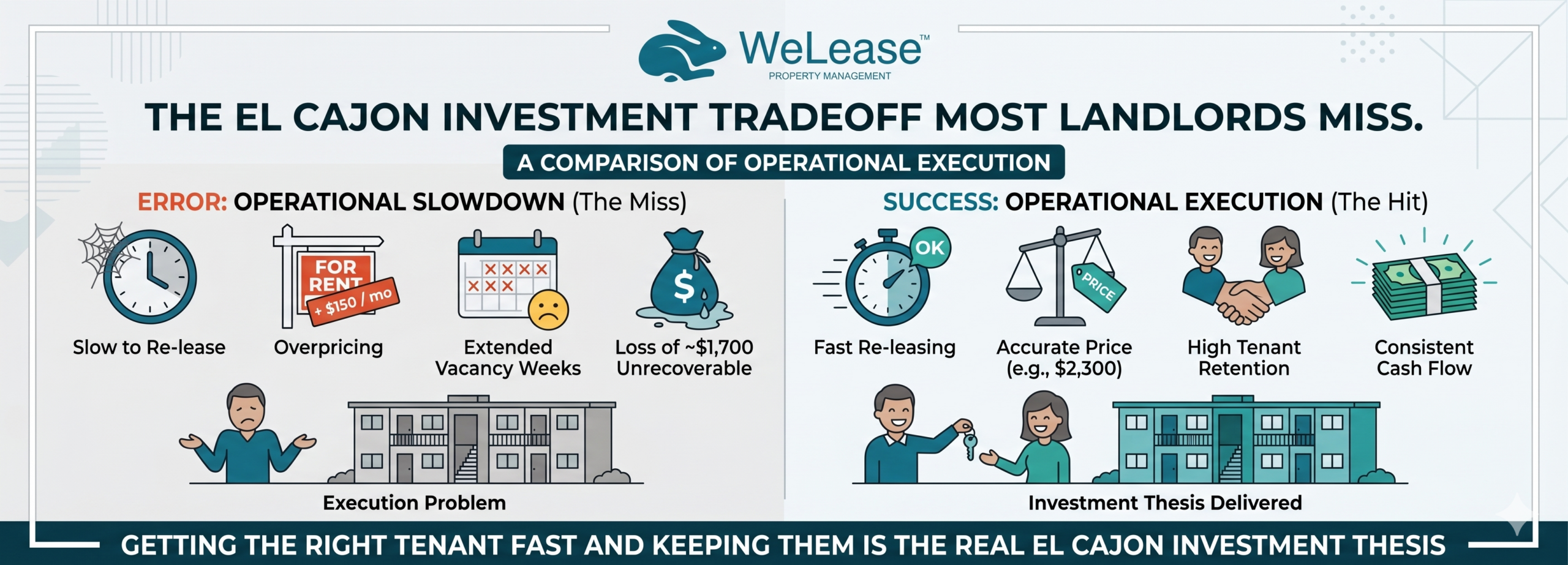
El Cajon’s cash flow advantage depends entirely on occupancy.
A vacant property here is not expensive to carry the way a coastal San Diego property is. But it is also not generating the appreciation buffer that gives coastal landlords room to breathe through a vacancy cycle. The return profile is different. That means the operational stakes are different too.
In a high-appreciation market, a landlord who is slow to re-lease gives away a few weeks of income but still benefits from the long-term appreciation trajectory.
In El Cajon, the cash flow is the investment thesis. Which means vacancy is a bigger relative threat. And the margin for operational error is smaller.
In practical terms:
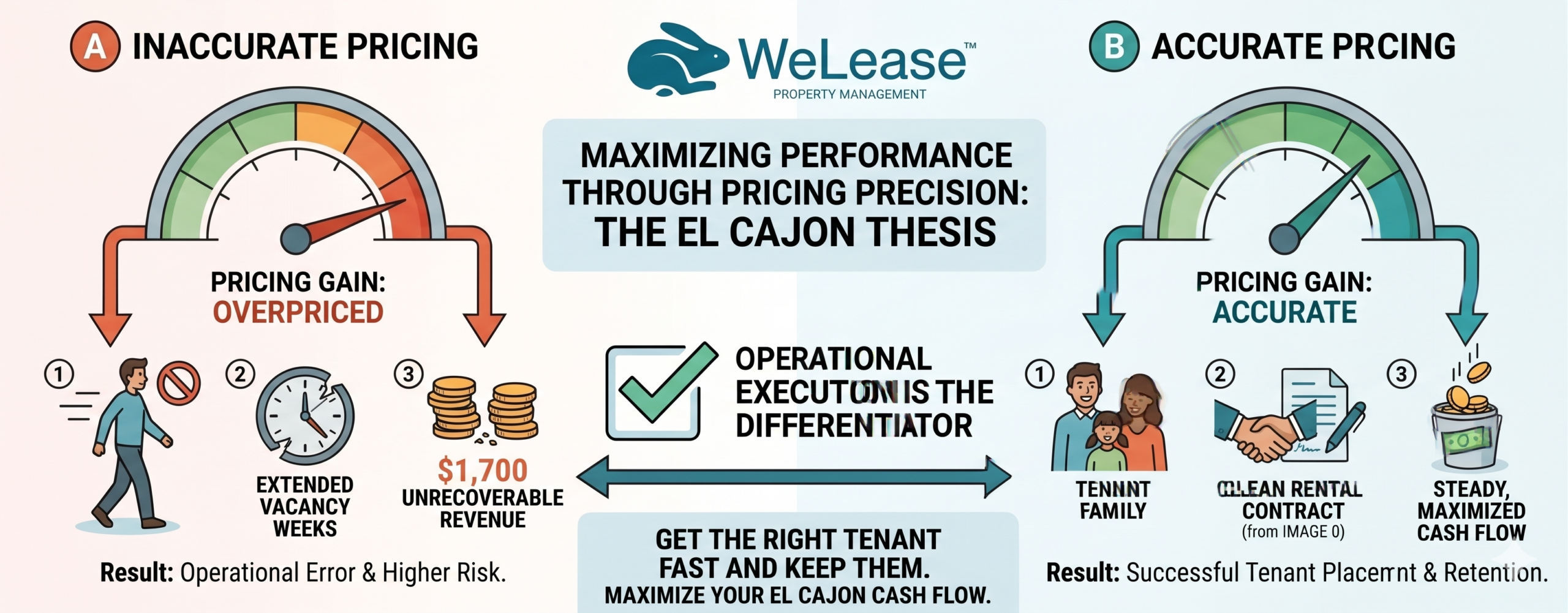
- Overpricing by even $100 to $150 per month can extend vacancy by weeks
- On a $2,300 per month unit, three extra weeks is roughly $1,700 in unrecoverable revenue
- That is not a market-condition problem. It is an execution problem.
The landlords who see the best long-term performance here screen carefully, price accurately, and invest in the tenant relationship through responsive maintenance and clear renewal communication. Getting the right tenant in fast and keeping them is what actually delivers on the El Cajon investment thesis.
Here is the tension that actually defines El Cajon as an investment, and it is subtler than the simple cash flow vs. appreciation frame suggests.
El Cajon’s cash flow advantage depends entirely on occupancy.
A vacant property here is not expensive to carry the way a coastal San Diego property is. But it is also not generating the appreciation buffer that gives coastal landlords room to breathe through a vacancy cycle. The return profile is different. That means the operational stakes are different too.
In a high-appreciation market, a landlord who is slow to re-lease gives away a few weeks of income but still benefits from the long-term appreciation trajectory.
In El Cajon, the cash flow is the investment thesis. Which means vacancy is a bigger relative threat. And the margin for operational error is smaller.
In practical terms:
- Overpricing by even $100 to $150 per month can extend vacancy by weeks
- On a $2,300 per month unit, three extra weeks is roughly $1,700 in unrecoverable revenue
- That is not a market-condition problem. It is an execution problem.
The landlords who see the best long-term performance here screen carefully, price accurately, and invest in the tenant relationship through responsive maintenance and clear renewal communication. Getting the right tenant in fast and keeping them is what actually delivers on the El Cajon investment thesis.
What Do El Cajon Landlords Need to Know About AB-1482?
El Cajon does not have a municipal rent control ordinance. California state law is the controlling framework for most landlords here.
The key rules to know:
AB-1482 applies to most residential rental properties built before January 1, 2005, and caps annual rent increases at 5% plus local CPI – currently 8.8% through July 2026 for San Diego County.
Just-cause eviction protections under the same law govern how and when tenants can be asked to leave after 12 months of tenancy.
If your property qualifies for an AB-1482 exemption – such as a single-family home where the tenant was properly notified of the exemption in writing – different rules apply. But that exemption requires correct documentation delivered at the time the tenancy began.
Landlords who assumed they were exempt but did not follow the documentation requirements can find themselves in a legally exposed position that is both expensive and time-consuming to resolve.
For a full breakdown of how state and local laws interact across San Diego County, see our article on how local ordinances override state law in San Diego rentals.
WeLease in El Cajon: Recognized, Local, and Working Here Every Day
In 2026, Expertise.com – which scores companies across more than 25 variables – named WeLease one of the Top 10 Property Management Companies in El Cajon. That recognition reflects what our clients in the area already know: we understand this market specifically, not just San Diego County in general.
The El Cajon properties we manage consistently share a few things.
Accurate pricing based on current market data – not what the owner charged last year or what a neighbor claimed to be getting. In a market where cash flow is the point, pricing that minimizes vacancy is not a secondary concern. It is the primary lever.
Responsive maintenance – El Cajon tenants have reasonable expectations and track whether those expectations are being met. A maintenance request that goes unacknowledged for a week erodes the tenant relationship in ways that compound toward non-renewal.
Proactive lease renewals – the single most expensive event in a long-term rental relationship is tenant turnover. Owners who start the renewal conversation early, communicate clearly, and adjust rent thoughtfully hold tenants longer. And in El Cajon, longer tenancies are where the investment thesis actually pays out.
The Bigger Picture for El Cajon Landlords in 2026
El Cajon is a cash flow market. It rewards patience, operational consistency, and an investment horizon measured in years rather than months.
Here is how it stacks up against the broader San Diego landscape:
| El Cajon | Coastal San Diego | |
|---|---|---|
| Median acquisition cost | $590K–$650K | $1.2M–$1.8M+ |
| Typical rental yield | 4–5% annually | 2–3% annually |
| Vacancy rate | 2.5–5% | Varies; Class A up to 6.6% |
| Appreciation style | Steady, long-term | Higher spikes, more volatile |
| Tenant turnover | Lower | Higher in some segments |
| Best fit | Cash flow, long-term hold | Appreciation, value-add |
Those numbers do not produce dramatic stories. They produce compounding returns, lower stress, and the kind of long-term performance that tends to look very good in hindsight.
The landlords who will get the most out of El Cajon are the ones who commit to the strategy it actually rewards: accurate pricing, tenant quality, operational responsiveness, and a patient orientation toward appreciation that does not try to force this market to behave like a different one.
El Cajon is not trying to be La Jolla. It does not need to be.
Talk to Yesenia and Billy

Not sure if your El Cajon property is set up for cash flow or long-term appreciation?
Billy and Yesenia work with El Cajon landlords every day. They can help you run a free cash flow analysis for your specific property – looking at current rents, vacancy exposure, tenant quality, and long-term positioning – so you know exactly where you stand and what, if anything, needs to change.
No obligation. Just a practical conversation about your property and your goals.
www.WeLeaseUSA.com | (619) 876-0753
Disclaimer: This article is intended for general informational purposes only and draws on publicly available market data from RentCafe, Zillow, and other sources as of early 2026. It does not constitute legal, financial, or tax advice. Market conditions change frequently. For property-specific guidance, please consult a qualified California real estate professional or licensed legal advisor, or contact us at www.weleaseusa.com.
Key Takeaways
- El Cajon’s average rents sit around $2,295 per month, with 59% of households renter-occupied, creating a large and stable tenant pool.
- Cash flow is the primary investment thesis here: entry prices 30 to 50% below coastal San Diego produce meaningfully higher yields, often 4 to 5% annually.
- Appreciation is steady rather than spectacular, tracking county-wide trends with upside potential tied to ongoing revitalization in the area.
- The cash flow advantage only holds with strong occupancy. Vacancy is a bigger relative threat in El Cajon than in high-appreciation coastal markets.
- The tenant base is predominantly families, long-term residents, and commuter-oriented professionals who prioritize stability and tend to stay when managed well.
- AB-1482 applies to most El Cajon properties built before 2005. There is no local rent control ordinance, but state law carries full exposure.
- Operational execution, accurate pricing, responsive maintenance, and proactive lease renewal communication, is what determines whether this market delivers on its potential.
Frequently Asked Questions
Is El Cajon a good rental market in 2026?
Yes, for the right investor and the right strategy. El Cajon offers stronger cash flow yields than most coastal or central San Diego markets, stable renter demand, and a tenant base that tends toward longer tenancies. If your goal is predictable monthly income and steady long-term appreciation, it checks important boxes.
How do El Cajon rents compare to the rest of San Diego County?
El Cajon rents are meaningfully below coastal and central San Diego, which is exactly what drives the cash flow advantage. A median rent around $2,295 per month on a property acquired at a fraction of what coastal equivalents cost produces a yield profile that simply is not available closer to the water.
Does El Cajon have rent control?
El Cajon does not have a local rent control ordinance. However, AB-1482, California’s statewide rent stabilization law, applies to most properties built before 2005 and caps annual increases at 5% plus CPI (maximum 10%). Understanding whether your specific property is covered, or exempt, requires attention to the details of the exemption criteria and documentation requirements.
What is the biggest risk for El Cajon landlords right now?
Vacancy is the primary risk, and it is almost entirely avoidable. In a market where cash flow is the investment thesis, extended vacancy is disproportionately costly. The most common causes are overpricing relative to current market conditions and slow follow-up on tenant inquiries. Both are fixable with the right information and systems.
Is it worth hiring a property manager for an El Cajon rental?
In a cash flow market, the operational details compound more significantly than in markets where appreciation carries the return. Accurate pricing, fast leasing, responsive maintenance, and proactive renewal communication all have a direct and measurable impact on annual returns. Many landlords find that professional management pays for itself through reduced vacancy alone, not counting the time and compliance exposure it removes.
Reviewed by Billy Colestock Co-Founder & Executive Officer, WeLease REALTOR® | DRE# 01771188: Billy Colestock brings over 20 years of experience in real estate to his leadership role at WeLease Property Management. As a licensed REALTOR® and Co-Founder of WeLease, he is a trusted voice in the San Diego real estate community and frequently leads educational sessions at the San Diego Association of REALTORS® (SDAR), covering key topics such as evictions, tenant screening, maintenance, and housing regulations. Billy is also a member of the National Association of REALTORS®, California Association of REALTORS®, and serves as President of his HOA. His depth of expertise ensures WeLease remains proactive, compliant, and highly effective in serving homeowners and investors throughout Southern California | WeLease Credentials: NARPM® Member, BBB Accredited, MLS Participant, Equal Housing Opportunity. Recognized as San Diego’s Best Property Management Company – Union-Tribune Winner (2022, 2024); Finalist (2023, 2025). DRE: 02047533

Ivana M. Janakieva is a Property Management Marketer and SEO Content Manager who turns confusing real estate jargon into practical, actionable advice. She’s the type who reads maintenance reports like morning news and can make lease agreement clauses sound (almost) fun. With years of experience writing about everything from tenant turnover and landlord-tenant laws to climate risks and curb appeal ROI, Ivana creates content for people who want straight answers about protecting and profiting from their most valuable asset, their property.