San Diego Rents Are Down. Here Is What That Means for Property Owners
Home / San Diego Rents Are Down. Here Is What That Means for Property Owners
San Diego Rents Are Down. Here Is What That Means for Property Owners
If you own a rental property in San Diego, you may have already noticed that something has shifted. Units are sitting a little longer. Prospective tenants seem less rushed. The sense of urgency that defined the rental market a year or two ago has quietly cooled.
This is not your imagination, and it is not cause for alarm. But it is a real change, and understanding what is driving it will help you make smarter decisions about your property going forward.
According to a recent report from Zumper, a national rental data platform, median rents in San Diego have declined meaningfully over the past year. The drop is more pronounced here than in almost any other major rental market in the country. And the reason behind it matters as much as the numbers themselves.
What the Numbers Actually Say
The Zumper National Rent Report, published in late March 2026, shows that San Diego has seen a 5.6% decline in median 1-bedroom rents year-over-year, and a 7.5% decline in median 2-bedroom rents. To put that in context:
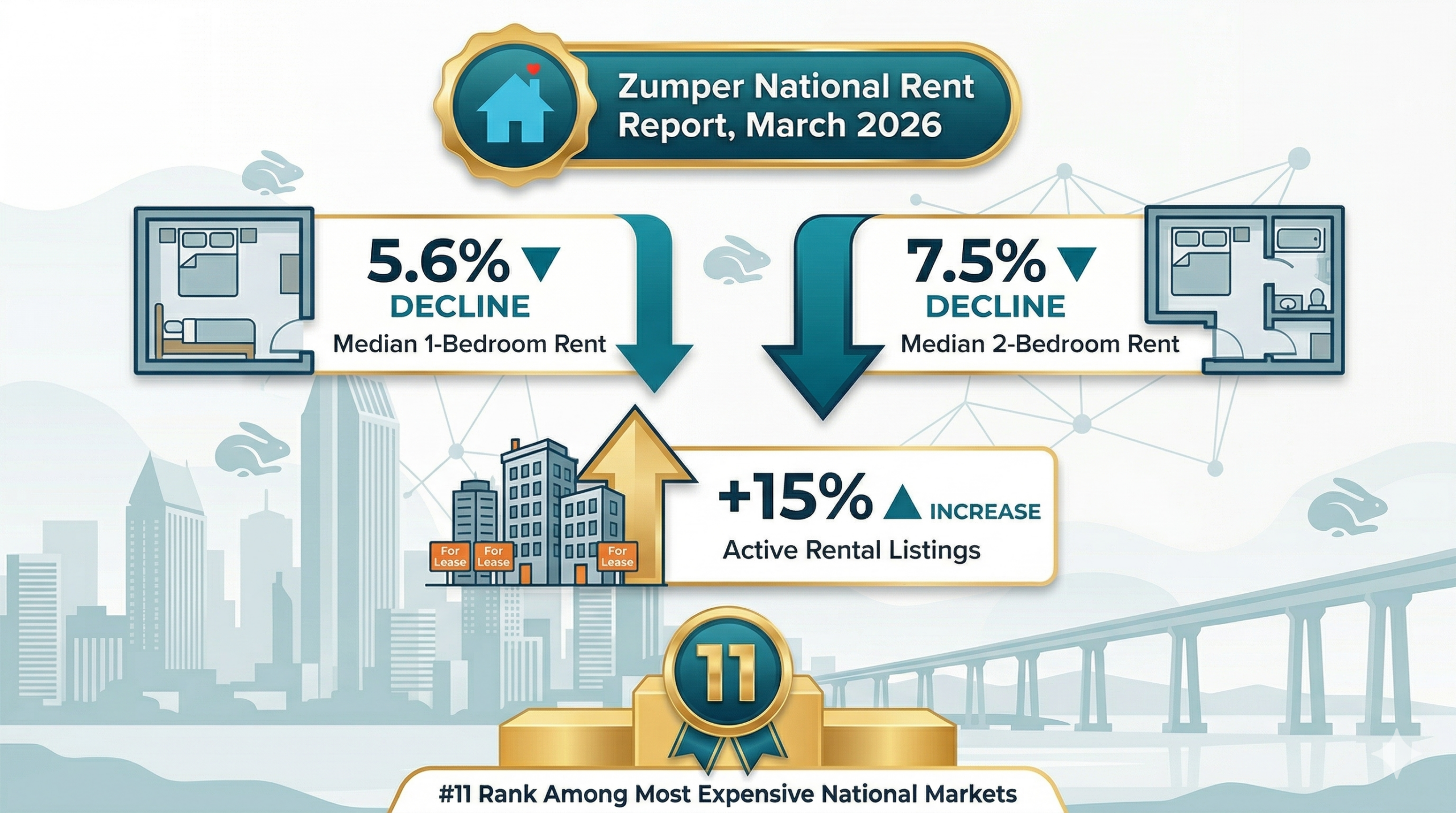
- 5.6% year-over-year decline in median 1-bedroom rent
- 7.5% year-over-year decline in median 2-bedroom rent
- 15% increase in active rental listings over the same period
- #11 San Diego’s rank among the most expensive rental markets nationally
Of the top 20 most expensive rental markets in the country, only one city saw a steeper drop in 1-bedroom rents. San Diego is near the top of that list, and the primary driver is simple: more supply.
As reported by KPBS, the city of San Diego has been issuing housing permits at a pace approaching 10,000 per year for the past two years. That new housing is now hitting the market, and renters are noticing. They have more options. And when renters have more options, competition among property owners goes up.
Peak deliveries are now arriving after peak demand, pushing inventory higher and intensifying competition among property owners. As a result, many markets are seeing downward pressure on rents, increased concessions, and more choice for renters.
Zumper National Rent Report, March 2026
This Is a Market Shift, Not a Crisis
Before going further, it is worth saying clearly: this is not a collapse. San Diego remains one of the most expensive rental markets in the country. The median 1-bedroom still sits at $2,200 per month. Demand has not disappeared. People still need to live somewhere, and San Diego is still one of the most desirable places in the country to do that.
What has changed is the dynamic. A year ago, a well-priced unit in San Diego would attract multiple qualified applicants within a few days. Today, tenants are taking more time. They are comparing options. They have some negotiating leverage that they did not have before.
For landlords who are set up well, this is simply a new normal to adapt to. For landlords who have been relying on a hot market to carry them through, it is a wake-up call.
The owners who will perform well through this period are the ones who price accurately, market effectively, and move quickly when good applicants show up. That sounds straightforward. In practice, it is harder than it looks, especially for landlords managing their own properties without professional support.
Where Self-Managing Landlords Are Getting Hurt Right Now
In a competitive market, the margin for error on the operational side gets smaller. Small mistakes that barely mattered when demand was sky-high can now cost real money. These are the patterns we are seeing most often among self-managing owners right now.
Overpricing and Extended Vacancy
It is natural to anchor on what you charged last year, or what a neighbor claimed they were getting. But pricing decisions made without current, real-world market data are often off by more than owners realize. In a market where tenants are comparing five or six options before applying, a unit priced even $100-$150 above market can sit for weeks longer than necessary.
Every extra week of vacancy is revenue that cannot be recovered. At $2,200 per month, two extra weeks of vacancy costs roughly $1,100. Over a few cycles, that adds up to much more than the cost of professional management.
Slow Follow-Up on Inquiries
Tenant behavior has changed alongside market conditions. Renters today are reaching out to multiple properties at the same time. The window between an initial inquiry and a decision to apply elsewhere can be very short, sometimes just 24 to 48 hours. Self-managing landlords who are juggling jobs, families, and other responsibilities often cannot respond that quickly, consistently.
Missing a qualified applicant because of a delayed response is not dramatic. It just quietly costs you the best candidate in the pool, and you end up settling for someone less qualified or waiting longer.
Poor Marketing Reach
A single listing on one platform used to be enough. Today, tenants are searching across multiple sites simultaneously. If a property is not showing up everywhere qualified renters are looking, with good photos, a well-written description, and accurate pricing, it is effectively invisible to a meaningful portion of the market.
Missing the Right Tenant Entirely
In a slower market, the first qualified applicant matters more than ever. Weak screening that lets in a problem tenant, or an overly cautious process that scares off a good one, both have consequences. Getting this right consistently requires systems, experience, and attention that many landlords simply do not have the time to bring to the process.
How a Property Manager Changes the Equation
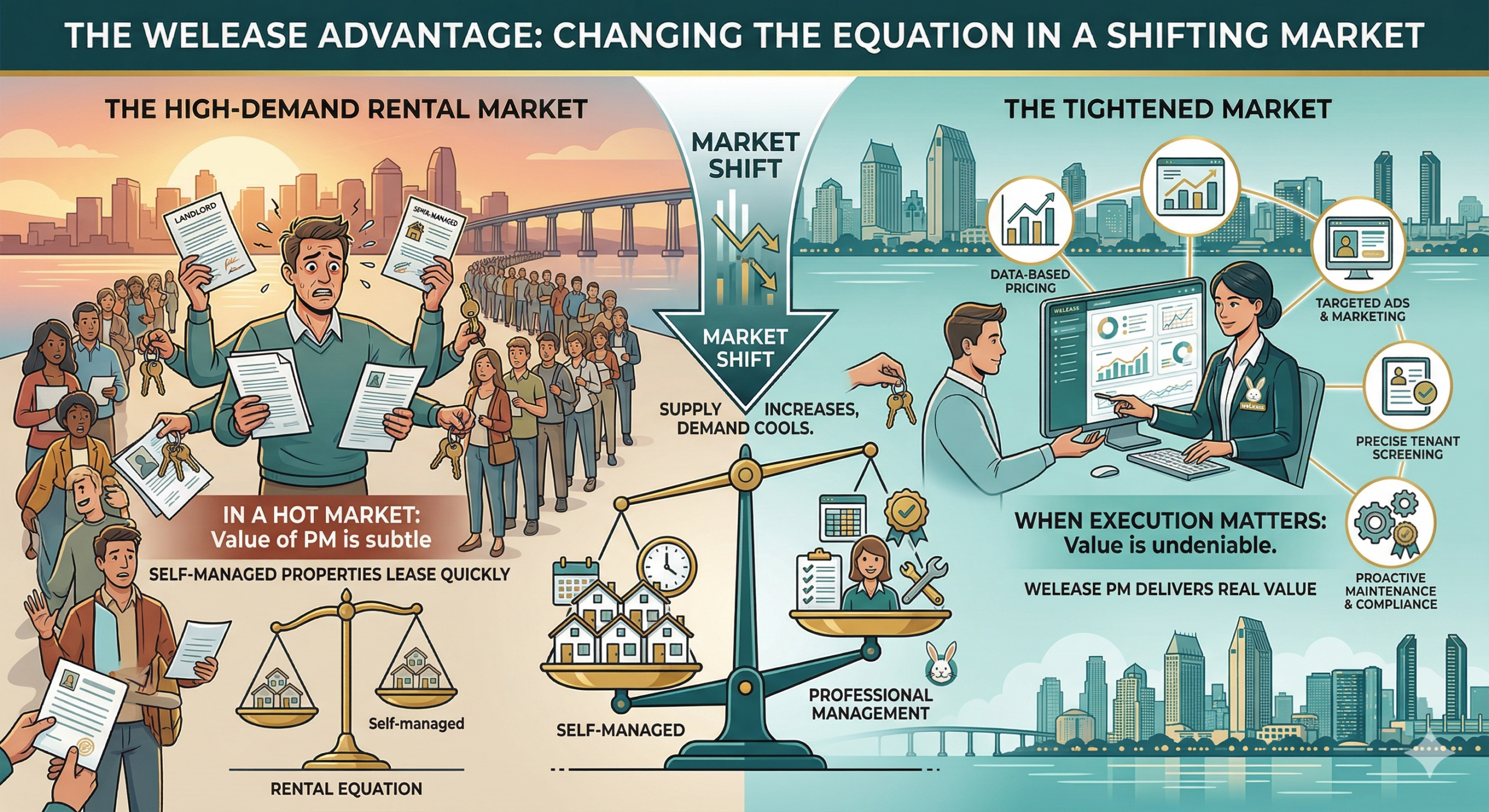
This is the part of the market shift that represents a genuine opportunity for landlords who are willing to think about it clearly.
When demand is overwhelming and every unit leases immediately regardless of how it is managed, the value of professional property management is harder to see. When the market tightens and execution actually matters, that value becomes a lot more obvious.
Accurate Pricing Based on Real Data
A professional property manager is pricing units constantly. They know what similar properties in the neighborhood are actually renting for this week, not six months ago. That real-time data leads to pricing decisions that minimize vacancy without leaving money on the table, which is a genuinely difficult balance to strike without current information.
Wider Marketing Across Multiple Platforms
Professional management teams have established listings, professional photography workflows, and syndication across every major rental platform. A new listing goes up fast, looks good, and reaches the full pool of active renters in the market. That coverage matters when renters have more choices and are less likely to dig through incomplete listings.
Fast, Consistent Tenant Follow-Up
The response time advantage is not small. A property management team with systems in place responds to inquiries the same day, schedules showings quickly, and keeps the pipeline moving. That speed means more qualified applicants stay in the process long enough to apply, and the best ones get placed.
Access to a Larger, Qualified Tenant Pool
Established property managers bring a network of active applicants, referrals from past tenants, and relationships with relocation services and employers. That means the search for a qualified tenant starts from a stronger position than a single listing on a single platform.
Better Tenant Screening
In a market where owners need to be more selective to protect long-term performance, consistent, thorough screening matters. Income verification, rental history, credit review, and reference checks done systematically and in compliance with California law produce better outcomes than ad hoc screening done under time pressure.
Federal Housing Policy Is Moving in the Same Direction
The supply increase driving rent adjustments in San Diego is not happening in a vacuum. At the federal level, there is now significant legislative momentum behind expanding housing supply and reducing barriers to new construction. The 21st Century ROAD to Housing Act, a bipartisan bill co-sponsored by Senator Tim Scott (R-SC) and Senator Elizabeth Warren (D-MA), passed the Senate in March 2026 by a vote of 89 to 10. The House had already passed its own version of the legislation in February with a 390 to 9 vote. The bill is designed to streamline environmental reviews, modernize financing programs, cut regulatory red tape, and unlock private capital for housing development across the country.
For property owners, the direction of this legislation reinforces what is already playing out locally: more housing supply is coming, and the policy environment is actively encouraging it. That does not make ownership less worthwhile. It makes the quality of how a property is managed more consequential. In a market with more inventory and more tenant choice, the properties that stand out on pricing, presentation, and responsiveness are the ones that continue to perform. The gap between a well-managed property and a poorly managed one tends to widen in exactly this kind of environment.
The Bigger Picture for San Diego Landlords in 2026
It is worth stepping back and recognizing what this market moment actually represents. A 5.6% drop in rents after years of significant increases is not catastrophic. It is a correction. And in a market that had run as hot as San Diego had, some degree of normalization was inevitable.
The fundamentals underlying San Diego’s rental market have not changed. Population growth continues. The region remains one of the most desirable places in the country to live. Demand is still there. What has shifted is the balance of power between owners and tenants, and that shift demands a more professional, attentive approach to property management.
Landlords who respond to this environment with better systems, better pricing, and better service will hold their performance. Landlords who wait for the market to bail them out the way it did in 2022 and 2023 may be waiting a long time.
Disclaimer: This article is intended for general informational purposes only and draws on publicly available market data from Zumper and KPBS reporting as of March 2026. It does not constitute legal, financial, or tax advice. Market conditions change frequently. For property-specific guidance, please consult a qualified California real estate professional or licensed legal advisor.
Talk to Yesenia and Billy
If you are a property owner in San Diego County and you are feeling the effects of this market shift, or if you are simply wondering whether your current approach is positioned well for what is ahead, we would be glad to have a conversation.
At WeLease, we work with landlords across San Diego County every day. We track the market closely, we know what qualified tenants are seeing when they search right now, and we know what separates properties that lease quickly from ones that sit. If your rental is underperforming, there is usually a fixable reason. And if it is performing well, we can help you protect that.
Reach out to us at the contact information below. There is no obligation, just a practical conversation about your property and your goals.
www.WeLeaseUSA.com | (619) 876-0753
Key Takeaways
- San Diego 1-bedroom median rents fell 5.6% year-over-year; 2-bedroom rents fell 7.5%.
- Active rental listings in San Diego increased approximately 15%, giving tenants more options.
- The cause is new housing supply, not a collapse in demand. San Diego remains the 11th most expensive rental market in the country.
- Tenants now have more leverage and are comparing options more carefully before applying.
- Self-managing landlords face real risks from overpricing, slow follow-up, and limited marketing reach.
- Professional property management provides pricing data, platform reach, and response speed that are harder to replicate on your own.
- Landlords who adapt their operations to this environment will hold performance. Those who wait for conditions to return to 2022 may see extended vacancies.
- The 21st Century ROAD to Housing Act, passed by the Senate 89-10 in March 2026, signals a national policy direction toward more housing supply and less regulatory friction, reinforcing that this competitive environment is likely to continue.
Frequently Asked Questions
Are San Diego rents actually going down?
Yes, according to Zumper’s March 2026 National Rent Report. Median rents for 1-bedroom apartments fell 5.6% year-over-year, and 2-bedroom rents fell 7.5%. The primary driver is a significant increase in available rental inventory, with active listings up roughly 15%.
Should San Diego landlords be worried?
Concerned and prepared is a reasonable stance. The market has shifted from one where demand outpaced supply to one where tenants have more choices. San Diego is still one of the most expensive rental markets in the country, and demand has not evaporated. But the operational approach that worked in 2021 or 2022 needs to be sharper right now.
What is the biggest risk for a self-managing landlord in this market?
Overpricing is probably the most common and costly mistake right now. Without access to current, real-time market data, many landlords are pricing based on outdated benchmarks. In a more competitive market, that leads to extended vacancy, which is typically more expensive than the rent premium being chased.
Does professional property management actually reduce vacancy?
In most cases, yes. The combination of accurate market pricing, faster response to inquiries, broader platform marketing, and a larger pool of active applicants generally produces shorter vacancy periods than self-management. In a market where vacancy costs are rising, that difference becomes more meaningful.
Will San Diego rents recover?
Most indicators suggest this is a period of stabilization following a supply increase, not a sustained long-term decline. San Diego’s underlying demand drivers, population growth, lifestyle appeal, employment diversity, remain solid. Rents are likely to stabilize and resume gradual growth as the new supply is absorbed, though the speed of that recovery is difficult to predict.

Ivana M. Janakieva is a Property Management Marketer and SEO Content Manager who turns confusing real estate jargon into practical, actionable advice. She’s the type who reads maintenance reports like morning news and can make lease agreement clauses sound (almost) fun. With years of experience writing about everything from tenant turnover and landlord-tenant laws to climate risks and curb appeal ROI, Ivana creates content for people who want straight answers about protecting and profiting from their most valuable asset, their property.