How Maintenance Response Times Impact Tenant Retention in San Diego
Home / How Maintenance Response Times Impact Tenant Retention in San Diego
How Maintenance Response Times Impact Tenant Retention in San Diego
A tenant who submits a maintenance request and hears nothing for four days has already started thinking about their next apartment.
They have not opened a listing site yet. They may not even realize the relationship has shifted. But something has. And by the time the lease renewal conversation arrives three months later, that silence is part of how they decide whether staying makes sense.
This is the dynamic most landlords underestimate. Not the cost of repairs. Not even the cost of vacancy. The cost of the gap between when a tenant signals that something is wrong and when a landlord responds.
That gap, measured in hours and days, is one of the strongest predictors of whether a tenant renews or moves on.
The Numbers Every San Diego Landlord Should Know
Before going deeper, here is the quick snapshot.
| Metric | Without Systems | With Professional Management |
|---|---|---|
| Average maintenance response time | ~4.6 days | Under 18 hours |
| Tenant satisfaction improvement (1 pt) | , | 8.36% higher renewal rate |
| Satisfied tenants vs. unsatisfied | , | 16% less likely to move out |
| Typical turnover cost per vacancy | $2,300–$6,900 | Reduced through retention |
| Active San Diego listings (YOY change) | , | Up ~15%, tenants have more options |
Source: WeLease Team, Kingsley Associates KingsleyIndex, updated 2026
The gap between 4.6 days and under 18 hours is not just an operational detail. It is where tenant trust is built or lost, and where the renewal decision quietly gets made.
Why Maintenance Is the Most Important Interaction You Have With Your Tenant
Most landlords interact with tenants in a handful of ways over the course of a lease: move-in, rent payment, lease renewal, and maintenance requests.
Most of those interactions are transactional. Maintenance is different.
When a tenant submits a request, they are not just reporting a problem. They are watching to see what happens next.
A prompt acknowledgment, even before the repair is scheduled, communicates that the request was received and taken seriously. Silence communicates the opposite.
And here is the part that surprises most landlords:
It does not matter how quickly the repair eventually gets done if the first 48 hours produced no response. The relationship damage happens in that window. The speed of the repair rarely fully recovers it.
Research from Kingsley Associates, whose KingsleyIndex draws on over 35 years of tenant survey data, is specific: a one-point improvement in overall satisfaction on a five-point scale is associated with an 8.36% higher willingness to renew. Satisfied tenants are nearly 16% less likely to move out.
Maintenance response is consistently the single strongest driver of that satisfaction score.
What this means for you: Maintenance response time is not a service quality metric. It is a retention metric. And in a market where each turnover cyclecosts between one and three months of rent, the math on fast, consistent maintenance response is not subtle.
What Tenants Actually Notice and How They Respond
Tenants do not leave because of a single maintenance failure.
The pattern that research identifies consistently is accumulated frustration. A request that takes a week to acknowledge. A follow-up that gets no response. A repair that gets scheduled and then postponed.
Each of those is a small signal that the landlord is not paying attention. Small signals compound.
Here is the detail that changes how to think about this:
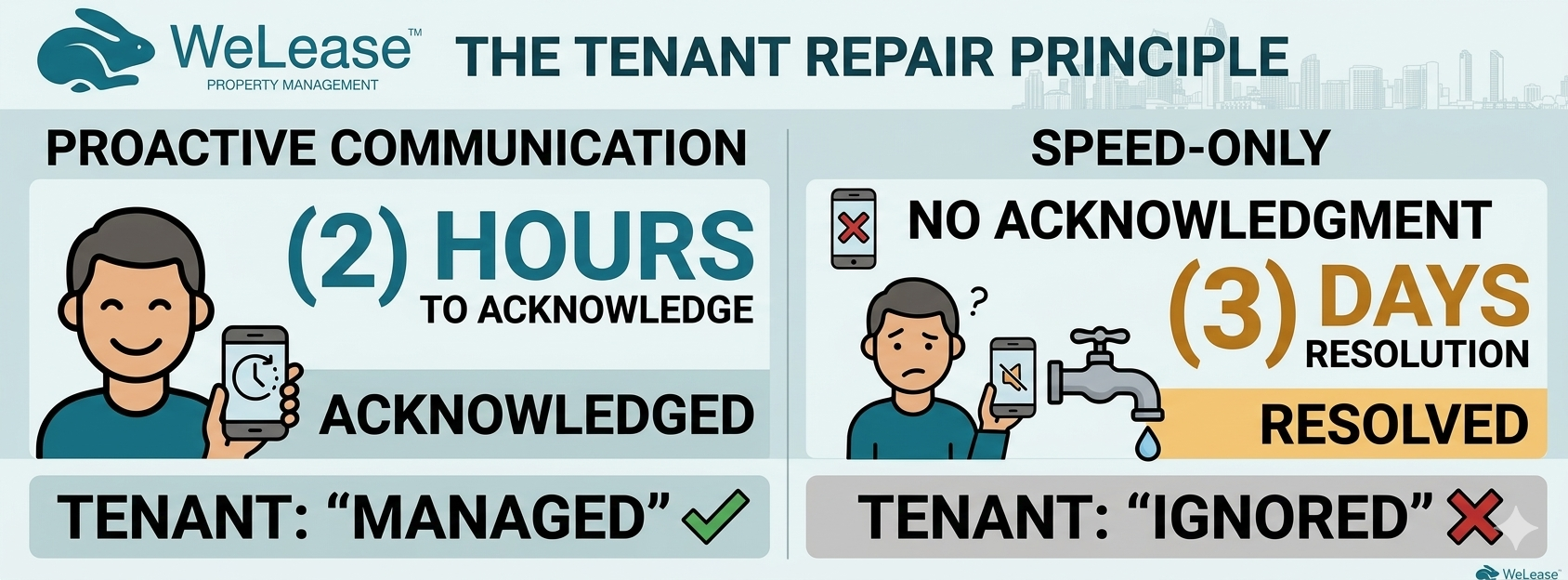
Tenants track acknowledgment time more than resolution time.
A tenant whose leaking faucet takes ten days to fix, but who receives acknowledgment within two hours and regular updates throughout, will almost always rate the experience more positively than a tenant whose faucet gets fixed in three days with no communication in between.
What tenants want to feel is that someone is managing the situation. Not necessarily that it is resolved instantly.
This matters operationally because communicating well is far cheaper than repairing quickly. Sending a brief message within a few hours confirming the request and providing a timeline costs almost nothing, and does most of the relationship work that a same-day resolution would do.
Emergency, Urgent, or Routine? Why Triage Changes Everything
Not every maintenance request carries the same urgency. And treating them all the same creates problems in both directions.
A leaking water heater routed through the same pipeline as a sticking door does not just waste time. It signals to the tenant that the management system is not actually functioning.
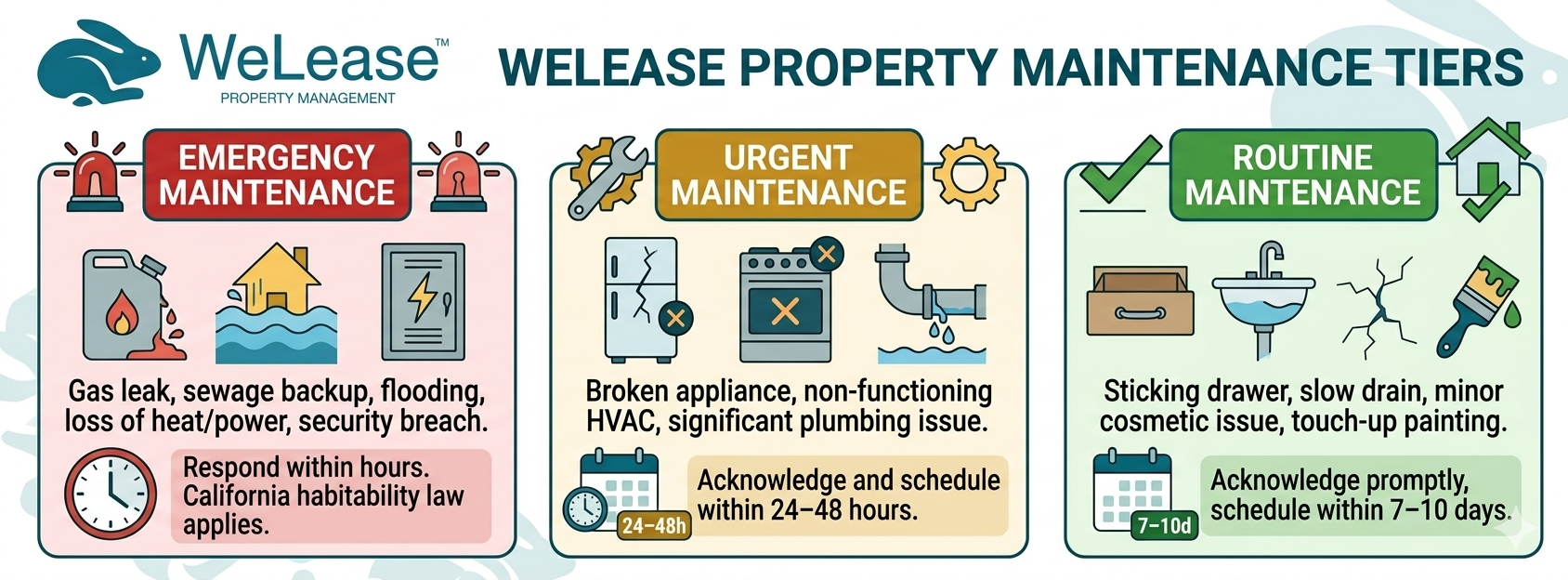
A basic triage framework divides requests into three categories, and sets clear response expectations for each.
Source: WeLease Team, updated 2026
The rule that applies to all three categories:
Acknowledge every request promptly, regardless of urgency tier.
A tenant whose emergency is acknowledged within hours and resolved in two days feels managed.
A tenant whose routine request is acknowledged within hours and scheduled for next week also feels managed.
A tenant whose emergency disappears into silence for 36 hours does not, and that feeling does not reset easily.
What this means for you: The triage system is not just about prioritizing repairs. It is about setting clear expectations for every category so tenants always know where they stand. That clarity is what prevents the silence from feeling like neglect.
See How WeLease Handles Maintenance in Practice
Before getting into the preventive maintenance strategy, here is a quick look at how a professional maintenance system actually works in practice, from intake to resolution.
The video below walks through how WeLease’s maintenance process works from the tenant’s first request to repair completion, and why the system matters for both tenant satisfaction and landlord returns.
Regolamento eIDAS e Identity Proofing: il nuovo webinar di AgID Academy
The process is not complicated. But it requires consistency that is very difficult to maintain when a landlord is also working a full-time job, managing a family, or handling their property from a distance. That is where the system makes the difference.
Preventive Maintenance: Why It Costs Less Than Waiting for an Emergency
Reactive maintenance is always more expensive than preventive maintenance.
Both in dollars and in tenant impact.
A plumbing issue caught during a routine inspection costs a fraction of what it costs after it becomes water damage. An HVAC filter changed on schedule is a small line item. An HVAC failure in July that makes the unit uncomfortable for a week is an emergency that affects the tenant relationship, the repair budget, and potentially the unit’s availability.
The planning benchmark:
Budget approximately 1% of your property’s value annually for preventive maintenance.
| Property Value | Annual Preventive Budget |
|---|---|
| $500,000 | $5,000/year ($417/month) |
| $650,000 | $6,500/year ($542/month) |
| $800,000 | $8,000/year ($667/month) |
Source: WeLease Team, updated 2026
Properties that run structured preventive maintenance programs report significantly fewer emergency work orders per unit per year. Fewer emergencies mean more capacity to respond quickly to routine requests, which closes the loop on the entire response-time problem.
A basic preventive schedule for a San Diego property:
- Monthly: HVAC filter changes, smoke and CO detector testing, visible leak checks
- Quarterly: Pest control, gutter inspection, HVAC servicing
- Annually: Roof inspection, water heater check, full appliance servicing, exterior condition review
There is also a compliance dimension to this in 2026.
California’s updated habitability standards now include working stoves and refrigerators as a baseline requirement for most residential rentals. Structural inspection requirements for balconies, decks, and stairways carry daily penalties for non-compliance.
A proactive maintenance schedule that includes these checkpoints protects both the tenant relationship and the landlord’s legal standing.
What this means for you: Preventive maintenance does two things simultaneously, it reduces the number of emergency requests you receive, and it keeps the property compliant with California’s evolving habitability standards. Both outcomes directly protect your returns.
How Maintenance History Determines the Renewal Decision
The lease renewal conversation does not happen in a vacuum.
By the time a landlord sends a renewal notice, or a tenant begins evaluating whether to stay, the preceding twelve months of maintenance interactions have already shaped their answer.
Tenant who had a good maintenance experience:
Requests acknowledged quickly, repaired without drama, communication consistent throughout. They are approaching renewal from a position of satisfaction and inertia. Staying is the easy choice.
Tenant who had a poor maintenance experience:
Requests sent into an unclear process, follow-ups ignored, repairs promised and then delayed. They are approaching renewal as an active decision. They are comparing their current situation against alternatives. The relationship has already given them reasons to leave.
Here is the difficult part: by the time a dissatisfied tenant is signaling it openly, many have already made their renewal decision.
The lag between when a problem develops and when it becomes visible to the landlord can be months. Problems that go undetected mid-lease quietly influence a decision that the landlord only discovers when the non-renewal notice arrives.
This is why tracking maintenance history as a relationship indicator, not just an operational log, is one of the most important habits a landlord can build.
What Changes With Professional Property Management
For self-managing landlords, consistent maintenance response across every request, every week, regardless of competing demands, is one of the hardest operational disciplines to maintain.
Life intervenes. Responses slip. A request submitted on a Friday evening might not get acknowledged until Monday morning. That gap is invisible to the landlord and very visible to the tenant.
Here is what a professional management structure changes:
- Same-day acknowledgment on every request, regardless of when it arrives
- Established vendor networks mean repairs get scheduled faster and at lower cost than a landlord sourcing independently
- Preventive maintenance schedules run on a calendar, not on memory
- Maintenance history tracked across every tenant, surfacing early warning signs before a dissatisfied tenant has made their renewal decision
Properties that streamline maintenance communication consistently report meaningful reductions in turnover within months of implementation.
For a San Diego landlord whose investment thesis depends on stable, long-term tenancy, the connection between maintenance systems and financial performance is direct.
This is not a service quality question. It is a returns question.
Talk to Yesenia and Billy

If you own a rental property in San Diego County and are not certain how your current maintenance response process is affecting tenant retention, that conversation is worth having before a good tenant decides not to renew.
At WeLease, we work with landlords across San Diego County every day. We know what tenant relationships look like when maintenance is handled well and when it is not, and we know what it costs to close that gap after the fact versus managing it proactively from the start.
Reach out to us at the contact information below. No obligation, just a practical conversation.
www.WeLeaseUSA.com | (619) 876-0753
Key Takeaways
- A one-point improvement in overall tenant satisfaction is associated with an 8.36% higher willingness to renew, and satisfied tenants are nearly 16% less likely to move out. Maintenance response is the strongest single driver of that satisfaction score.
- Average maintenance response times on unmanaged systems run around 4.6 days. Structured management systems bring that average under 18 hours. The gap between those two numbers is where tenant trust is built or lost.
- Tenants track acknowledgment time more than resolution time. A request acknowledged within hours and resolved in ten days is rated more positively than one resolved in three days with no communication in between.
- A triage system that distinguishes emergency, urgent, and routine requests allows faster response to high-priority issues and manages tenant expectations on lower-priority ones, without sacrificing the relationship in either direction.
- San Diego’s rental market is more competitive than it was two years ago. Active listings are up roughly 15% year-over-year. Tenants with a maintenance grievance have more alternatives to evaluate at renewal than they did in 2021 or 2022.
- Preventive maintenance, budgeted at roughly 1% of property value annually, reduces emergency volume, improves response capacity for routine requests, and keeps the property compliant with California’s evolving habitability standards.
- Lease renewal decisions are shaped by the preceding twelve months of maintenance interactions, not by the renewal conversation itself. By the time a tenant signals dissatisfaction, many have already decided to leave.
Disclaimer: This article is intended for general informational purposes only and draws on industry research and publicly available data as of early 2026. It does not constitute legal, financial, or property management advice. California habitability standards and local regulations change frequently. For guidance specific to your property, please consult a qualified California real estate professional or licensed legal advisor, or contact us at www.weleaseusa.com.
Frequently Asked Questions
How quickly should a landlord respond to a maintenance request?
For emergencies affecting health or safety, response should begin within hours. For urgent issues affecting daily living, acknowledgment and scheduling within 24 to 48 hours is the standard. For routine repairs, acknowledging the request promptly and scheduling within a week to ten days is generally sufficient to maintain the tenant relationship. The acknowledgment is what matters most, regardless of the urgency tier.
Does maintenance response time actually affect whether tenants renew?
Yes, and the data is specific. Research from Kingsley Associates across decades of tenant surveys shows that maintenance response is consistently the strongest driver of overall tenant satisfaction, and that satisfaction directly correlates with renewal rates. Tenants who feel their maintenance requests are handled promptly are nearly 16% less likely to move out.
What is the most expensive maintenance mistake a San Diego landlord can make?
Deferred maintenance and slow response together. A repair that costs $200 when caught early can cost $2,000 or more after six months of neglect. And the tenant relationship damage from a prolonged unresolved issue often triggers non-renewal, which adds one to three months of turnover costs on top of the repair bill itself.
How does preventive maintenance reduce emergency requests?
Preventive maintenance catches problems before they escalate. A roof inspection that identifies a small penetration prevents water intrusion. An annual plumbing check catches slow leaks before they become water damage. Properties running structured preventive programs report significantly fewer emergency work orders per unit per year, which frees up response capacity for the requests that do come in and reduces the overall cost of maintenance across the property.
What should a landlord do if they cannot respond to a request within 24 hours?
Send an acknowledgment anyway. A message that says the request was received and provides a realistic timeline costs nothing and does most of the relationship work that a same-day resolution would do. The failure that damages tenant relationships is not the delay itself. It is the silence that makes tenants wonder whether anyone is paying attention.
Reviewed by Billy Colestock Co-Founder & Executive Officer, WeLease REALTOR® | DRE# 01771188: Billy Colestock brings over 20 years of experience in real estate to his leadership role at WeLease Property Management. As a licensed REALTOR® and Co-Founder of WeLease, he is a trusted voice in the San Diego real estate community and frequently leads educational sessions at the San Diego Association of REALTORS® (SDAR), covering key topics such as evictions, tenant screening, maintenance, and housing regulations. Billy is also a member of the National Association of REALTORS®, California Association of REALTORS®, and serves as President of his HOA. His depth of expertise ensures WeLease remains proactive, compliant, and highly effective in serving homeowners and investors throughout Southern California | WeLease Credentials: NARPM® Member, BBB Accredited, MLS Participant, Equal Housing Opportunity. Recognized as San Diego’s Best Property Management Company – Union-Tribune Winner (2022, 2024); Finalist (2023, 2025). DRE: 02047533

Ivana M. Janakieva is a Property Management Marketer and SEO Content Manager who turns confusing real estate jargon into practical, actionable advice. She’s the type who reads maintenance reports like morning news and can make lease agreement clauses sound (almost) fun. With years of experience writing about everything from tenant turnover and landlord-tenant laws to climate risks and curb appeal ROI, Ivana creates content for people who want straight answers about protecting and profiting from their most valuable asset, their property.