Compliance Mistakes That Trigger Audits, Complaints, or Lawsuits
Home / Compliance Mistakes That Trigger Audits, Complaints, or Lawsuits
Compliance Mistakes That Trigger Audits, Complaints, or Lawsuits
Did you know that most San Diego landlords who end up in legal trouble were not breaking the law intentionally?
They were using a lease template from three years ago. Or a notice format that used to be correct. Or an assumption about which properties are exempt from rent caps that turned out to need documentation they never delivered.
California landlord law is structured to make these oversights expensive. Not as a trap, but as an incentive to take compliance seriously. The penalty for withholding a security deposit incorrectly is not a warning. It is up to two times the deposit amount in punitive damages, plus the deposit itself.
Here are the six compliance mistakes hitting San Diego landlords hardest in 2026, and what actually prevents each one.
The Six Mistakes at a Glance
| Mistake | Potential Consequence |
|---|---|
| Security deposit errors | Lose right to deductions + up to 2x deposit in damages |
| AB-1482 rent cap violations | Repayment of excess rent + potential triple damages |
| Defective termination notice | Eviction process restarts entirely |
| Habitability failures | Code inspection, rent withholding, civil suit, fines up to $2,500 |
| Fair housing violations | Civil liability, investigation, enforcement action |
| Retaliation | Presumed guilty within 180-day window, burden shifts to landlord |
Source: WeLease Team, updated 2026
None of these require bad intent. They require only that the landlord was operating on information that was accurate two years ago, and has not been updated since.
Mistake 1: Getting the Security Deposit Wrong
Think the deposit is simple? In California, one missed photo or a late deadline can turn a routine move-out into a costly legal dispute.
Security deposits are one of the most complaint-generating areas in California landlord law, and they became significantly more complicated in 2024 and 2025.
What changed, and what landlords are still missing:
The cap dropped to one month’s rent. As of July 1, 2024, California limits security deposits to one month’s rent for most residential rentals. The previous two-month limit is gone. Landlords still collecting two months on new leases are overcollecting, and creating immediate exposure if a tenant challenges it.
Photography is now required. AB 2801, effective April 1, 2025, requires landlords to photograph the rental unit at three specific moments:
- At move-in
- At move-out, before any cleaning or repairs begin
- After those services are completed
These photographs must be provided to the tenant. This is not optional documentation. Landlords who send a deduction itemization without the required photos are not missing a best practice. They are violating a specific statutory requirement.
The 21-day return deadline is strict.
| Timeline | What Happens |
|---|---|
| Within 21 days | Return deposit OR provide itemized deduction statement + photos |
| After 21 days | Landlord loses the right to make any deductions |
| If court finds withholding wrongful | Full deposit + up to 2x the deposit in punitive damages |
Source: WeLease Team, updated 2026
The clock starts the day the tenant vacates the unit. Not when the repairs are finished. Not when you get around to it.
The fix: Make the move-in walkthrough with photographs non-negotiable on every new tenancy. Do the move-out inspection immediately when the tenant vacates. Put the 21-day deadline in your calendar the moment you receive the keys back.
Mistake 2: Miscalculating or Misapplying the AB-1482 Rent Cap
One wrong percentage can turn a routine rent increase into a compliance problem, and retroactive liability.
The math looks simple. Five percent plus local CPI. But this is where a surprising number of landlords go wrong in 2026.
The three most common AB-1482 errors:
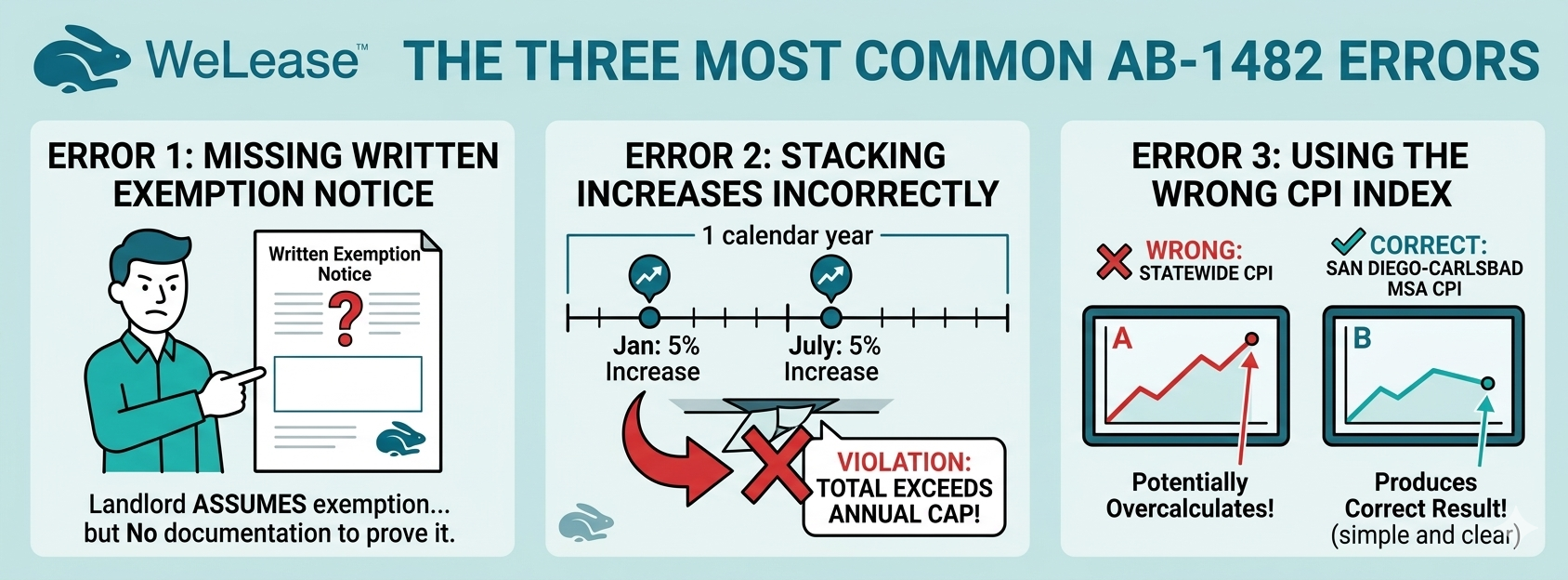
Error 1: Assuming the property is exempt without checking the documentation. Single-family homes and condos owned by individuals can be exempt from AB-1482, but only if the tenant received a specific written exemption notice at the start of the tenancy. No notice delivered correctly? No exemption. A landlord who has been raising rent on an “exempt” property without the documentation to prove it is carrying risk they cannot quantify.
Error 2: Stacking increases incorrectly. No more than two rent increases are allowed in any 12-month period. And the total of those increases cannot exceed the annual cap, regardless of how the notices were structured. Two separate 5% increases in the same calendar year on a covered property is a violation, even if each individual notice was technically correct.
Error 3: Using the wrong CPI index. The correct index for San Diego County is the San Diego-Carlsbad Metropolitan Statistical Area CPI, not a statewide or national figure. Using the wrong index produces a different result and potentially an overcalculation.
| AB-1482 Status | Current Limit | Notes |
|---|---|---|
| Covered (built before 2011) | 8.8% through July 2026 | = 5% + San Diego-Carlsbad CPI |
| Condo/SFH with exemption notice | No cap | Written notice required at lease inception |
| No exemption notice delivered | Treated as covered | Cannot claim exemption retroactively |
| Built 2011 or later | No state cap | CA notice requirements still apply |
Source: WeLease Team, updated 2026
The fix: Verify your CPI source before every increase on a covered property. Pull the original lease to confirm whether the exemption notice was delivered correctly. Do not assume.
Mistake 3: Serving a Defective Termination Notice
In California, a notice can look official and still be legally defective, and the eviction process does not pause to fix it.
Eviction proceedings in California are unforgiving of procedural errors. A termination notice that is missing required content, delivered incorrectly, or based on a misclassification of the just-cause reason does not delay the process.
It restarts it. From the beginning.
Where City of San Diego landlords get tripped up most:
Under the Residential Tenant Protections Ordinance (SDMC §§ 98.0701–98.0709), a termination notice must include:
- A description of the basis for termination
- A statement of the tenant’s right to relocation assistance
- The tenant’s right to receive an offer to renew the tenancy
A notice missing any of these elements is defective at the moment it is served.
The other errors that restart the clock:
| Error | Consequence |
|---|---|
| 30-day notice where 60 days required | Notice is void, restart required |
| Wrong relocation assistance amount | Civil liability of 3x the shortfall |
| No just-cause stated for City of San Diego tenancy | Wrongful eviction exposure from Day 1 |
| Missing Tenant Termination Notice Registry filing | Separately enforceable violation |
Source: WeLease Team, updated 2026
Also worth knowing: AB 2347, effective January 1, 2025, extended the period tenants have to respond to unlawful detainer lawsuits from 5 to 10 court days. Every procedural mistake is more expensive to recover from than it used to be.
The fix: Use City of San Diego-specific notice templates, not generic California forms. Have the notice language reviewed against current ordinance requirements before serving. File the registry notice within three business days.
Mistake 4: Habitability Failures and Code Complaints
One repair request left too long can open the door to a full property inspection, and much bigger problems.
When a tenant contacts code enforcement about a specific issue, what follows is often not just an inspection of that item. It is a full property review.
Landlords who have deferred maintenance, marginal systems, or unpermitted work can find that a single habitability complaint opens a much broader compliance review.
What California’s 2026 habitability standards require:
Proper functioning heating, plumbing, electricity, and sanitation remain the baseline. As of January 1, 2026, the warranty of habitability under AB 628 now explicitly includes:
- A working stove for most residential rentals
- A working refrigerator for most residential rentals
For leases entered into, amended, or extended on or after that date, the landlord is responsible for maintaining these appliances in safe working order. A recalled appliance must be repaired or replaced within 30 days.
Non-compliance carries fines up to $2,500.
The retaliation trap:
A tenant who reports a habitability violation and then faces adverse action from the landlord, a rent increase, reduced service, or a termination notice, within 180 days has a statutory presumption of retaliation in their favor. The landlord carries the burden of proving the action was taken for an independent, unrelated reason.
Tenants who experience habitability failures can:
- Withhold rent in serious cases
- Repair and deduct for smaller items up to one month’s rent
- File suit for damages caused by uninhabitable conditions
The fix: Treat deferred maintenance as a compliance risk, not just a relationship risk. Schedule proactive inspections. Address requests before they escalate. Document every maintenance action at the time it happens.
Mistake 5: Fair Housing and Source of Income Violations
One unfair screening step, even an unintentional one, can create a complaint, an investigation, and significant legal exposure.
In FY2025, San Diego’s fair housing program screened 2,299 inquiries for fair housing issues and opened 224 unduplicated investigations.
[Editorial note: Verify this figure against the current San Diego Fair Housing Council or City of San Diego annual report before publishing.]
Most of those cases did not involve landlords who were openly discriminatory. They involved landlords who made screening decisions in ways that produced discriminatory outcomes, often without realizing it.
What California and City of San Diego law prohibits:
Federal law and California’s Fair Employment and Housing Act prohibit discrimination based on race, religion, national origin, sex, familial status, disability, sexual orientation, and other protected characteristics.
California’s protections are broader than federal law in several respects. And the City of San Diego adds one more:
Source of income is a protected class within City of San Diego limits.
A blanket “no Section 8” policy on a property inside City of San Diego limits is not an informal preference. It is a violation of the Tenant Protection Ordinance, with its own enforcement consequences.
Where fair housing risk is highest:
| Screening Practice | Risk Level |
|---|---|
| Running credit checks on some applicants but not others | High |
| Applying income thresholds differently across applicants | High |
| Using listing language that signals preference for a tenant type | High |
| Consistent written criteria applied equally to every applicant | Low |
| Documentation of every screening decision | Low |
Source: WeLease Team, updated 2026
The fix: Write your screening criteria down. Apply them identically to every applicant. Document every decision at the time it is made. A landlord who can show consistent, written criteria applied equally is in a fundamentally different legal position than one who made judgment calls and kept no records.
Mistake 6: Retaliation, The Clock Starts the Moment a Tenant Acts
The 180-day retaliation window is automatic. It starts without warning, and shifts the burden of proof to the landlord.
California law creates a rebuttable presumption of retaliation if a landlord takes adverse action against a tenant within 180 days of the tenant exercising a protected right.
Protected rights include:
- Requesting repairs
- Contacting code enforcement
- Organizing with other tenants
- Filing a complaint about a rent increase or habitability issue
Adverse actions include:
- Raising rent
- Reducing services
- Threatening eviction
- Serving an eviction notice
The combination of a protected action followed by an adverse action within 180 days shifts the burden of proof to the landlord. They must demonstrate the action was taken for a legitimate, independent reason that had nothing to do with the tenant’s complaint.
What protects you:
Documentation that predates the tenant’s complaint. If a rent increase was already planned before the complaint was filed, that decision needs to exist in writing, with a date, before the complaint was received.
A landlord who made the decision verbally, informally, or after the fact has very little to work with in court.
| Situation | Risk Level |
|---|---|
| Rent increase planned and documented before complaint | Low |
| Termination notice prepared before complaint, with paper trail | Low |
| Adverse action taken within 30 days of complaint, no prior documentation | Very High |
| Adverse action taken 150 days after complaint, no documentation | High |
Source: WeLease Team, updated 2026
The fix: Document every management decision at the time it is made. Rent increases, non-renewal decisions, service changes, all of it in writing before the notice goes out. Paper trails do not generate themselves. Landlords who create them habitually almost never face retaliation exposure. Landlords who rely on memory and good intentions face it regularly.
What Professional Property Management Actually Prevents
California’s compliance landscape is not new. What has changed is the pace at which new requirements are being added, and the financial consequences attached to getting them wrong.
Staying current on all of it while also managing a property, responding to maintenance requests, processing applications, and handling renewals is a significant operational burden.
At WeLease, compliance is built into the management process from the start, not treated as a separate checklist.
- Lease templates that reflect current law
- Security deposit workflows that include AB 2801 photography requirements
- Rent increase calculations verified against current CPI data
- Termination processes built around both state law and the City of San Diego ordinance simultaneously
- Fair housing screening criteria applied consistently and documented for every applicant
The compliance piece alone, the legal exposure it removes, the mistakes it prevents, tends to justify the professional property management fee for most owners before any of the operational benefits are counted.
A single avoided wrongful eviction claim or deposit dispute is worth years of management fees on most San Diego properties.
Talk to Yesenia and Billy

If you are managing a San Diego rental and are not completely certain your current lease templates, security deposit processes, rent increase calculations, and notice formats reflect the law as it stands in 2026, that uncertainty is worth resolving before it becomes an issue.
At WeLease, we work with landlords across San Diego County every day. We know where the compliance gaps appear most frequently, what the consequences look like when they do, and what it takes to close them before they cost real money. A conversation costs nothing. An eviction defense or a deposit liability case costs considerably more.
www.WeLeaseUSA.com | (619) 876-0753
Disclaimer: This article is intended for general informational purposes only and draws on publicly available regulatory information as of early 2026. It does not constitute legal advice. California law and local ordinances change frequently, and the consequences of specific compliance errors vary depending on the facts of each situation. For guidance specific to your property, please consult a qualified California real estate attorney or licensed property management professional, or contact us at www.weleaseusa.com.
Key Takeaways
- Most landlord compliance errors are not intentional. They result from outdated lease templates, incorrect exemption assumptions, and procedural gaps that accumulate quietly until a complaint or dispute makes them visible.
- Security deposit rules changed in 2024 and 2025. The cap is now one month’s rent for most properties. AB 2801 requires photographs at move-in, move-out before cleaning, and after cleaning. The 21-day return deadline is strict and carries punitive consequences.
- AB-1482 rent increase errors are common and expensive. The current San Diego cap is 8.8% through July 2026. Exemptions require specific written documentation at lease inception. Using the wrong CPI index produces incorrect calculations.
- Termination notices in the City of San Diego must include specific content required by the local ordinance. A notice missing that language is defective at service and restarts the process entirely.
- Habitability failures can trigger code inspections that go well beyond the original complaint. The new 2026 appliance requirement under AB 628 makes working stoves and refrigerators a habitability standard in most new or renewed leases.
- Adverse action taken within 180 days of a tenant exercising a protected right creates a presumption of retaliation. Documentation that predates the tenant’s complaint is the primary defense.
- Fair housing and source-of-income violations are often unintentional but carry serious consequences. Consistent, documented screening criteria applied equally to every applicant is the best protection.
Frequently Asked Questions
What are the most common landlord compliance mistakes in San Diego?
Security deposit miscalculations and late returns, AB-1482 rent increase errors on covered properties, defective termination notices missing required City of San Diego ordinance language, and habitability failures that trigger code complaints. Most of these result from outdated documentation or processes rather than intentional violations.
What happens if a San Diego landlord returns a security deposit late?
If the deposit is returned after the 21-day statutory deadline, the landlord loses the right to make deductions. If a court finds the withholding was wrongful, the landlord faces liability for the full deposit plus up to two times the deposit amount in punitive damages. The clock starts the day the tenant vacates the unit.
Can a San Diego tenant sue their landlord for a code violation?
Yes. Tenants who experience habitability failures can contact code enforcement, which triggers an inspection, and can also sue in civil court for damages caused by uninhabitable conditions. For serious habitability failures, tenants may also have the right to withhold rent until repairs are made. Retaliation following a habitability complaint is separately actionable under California law.
What is the penalty for an illegal rent increase in San Diego?
Tenants can challenge the increase, seek repayment of the excess rent collected, and in some circumstances pursue additional damages. Under the City of San Diego ordinance, wrongful eviction linked to an improper rent dispute can trigger liability of at least three times the tenant’s actual economic damages. Getting the AB-1482 calculation right before every increase is significantly cheaper than resolving a challenge after the fact.
How do I know if my property is exempt from AB-1482?
Exemptions include single-family homes and condos owned by individuals (not corporations), properties built after 2010, and owner-occupied duplexes. But exemptions require written notice to the tenant at the start of the tenancy using language that meets the statutory requirement. Without that documentation delivered at the right time, the exemption is not enforceable. If you are uncertain whether the exemption notice was properly delivered, review your original lease paperwork or consult a California real estate attorney.
What is the retaliation window in California landlord law?
180 days. If a landlord takes any adverse action,rent increase, service reduction, termination notice,within 180 days of a tenant exercising a protected right (filing a complaint, requesting repairs, contacting code enforcement), California law presumes the action was retaliatory. The landlord must prove the decision was made for an independent, unrelated reason. Documentation that predates the tenant’s action is the primary defense.
Reviewed by Billy Colestock Co-Founder & Executive Officer, WeLease REALTOR® | DRE# 01771188: Billy Colestock brings over 20 years of experience in real estate to his leadership role at WeLease Property Management. As a licensed REALTOR® and Co-Founder of WeLease, he is a trusted voice in the San Diego real estate community and frequently leads educational sessions at the San Diego Association of REALTORS® (SDAR), covering key topics such as evictions, tenant screening, maintenance, and housing regulations. Billy is also a member of the National Association of REALTORS®, California Association of REALTORS®, and serves as President of his HOA. His depth of expertise ensures WeLease remains proactive, compliant, and highly effective in serving homeowners and investors throughout Southern California | WeLease Credentials: NARPM® Member, BBB Accredited, MLS Participant, Equal Housing Opportunity. Recognized as San Diego’s Best Property Management Company – Union-Tribune Winner (2022, 2024); Finalist (2023, 2025). DRE: 02047533

Ivana M. Janakieva is a Property Management Marketer and SEO Content Manager who turns confusing real estate jargon into practical, actionable advice. She’s the type who reads maintenance reports like morning news and can make lease agreement clauses sound (almost) fun. With years of experience writing about everything from tenant turnover and landlord-tenant laws to climate risks and curb appeal ROI, Ivana creates content for people who want straight answers about protecting and profiting from their most valuable asset, their property.