How Professional Property Management Reduces Legal Exposure in 2026
Home / How Professional Property Management Reduces Legal Exposure in 2026
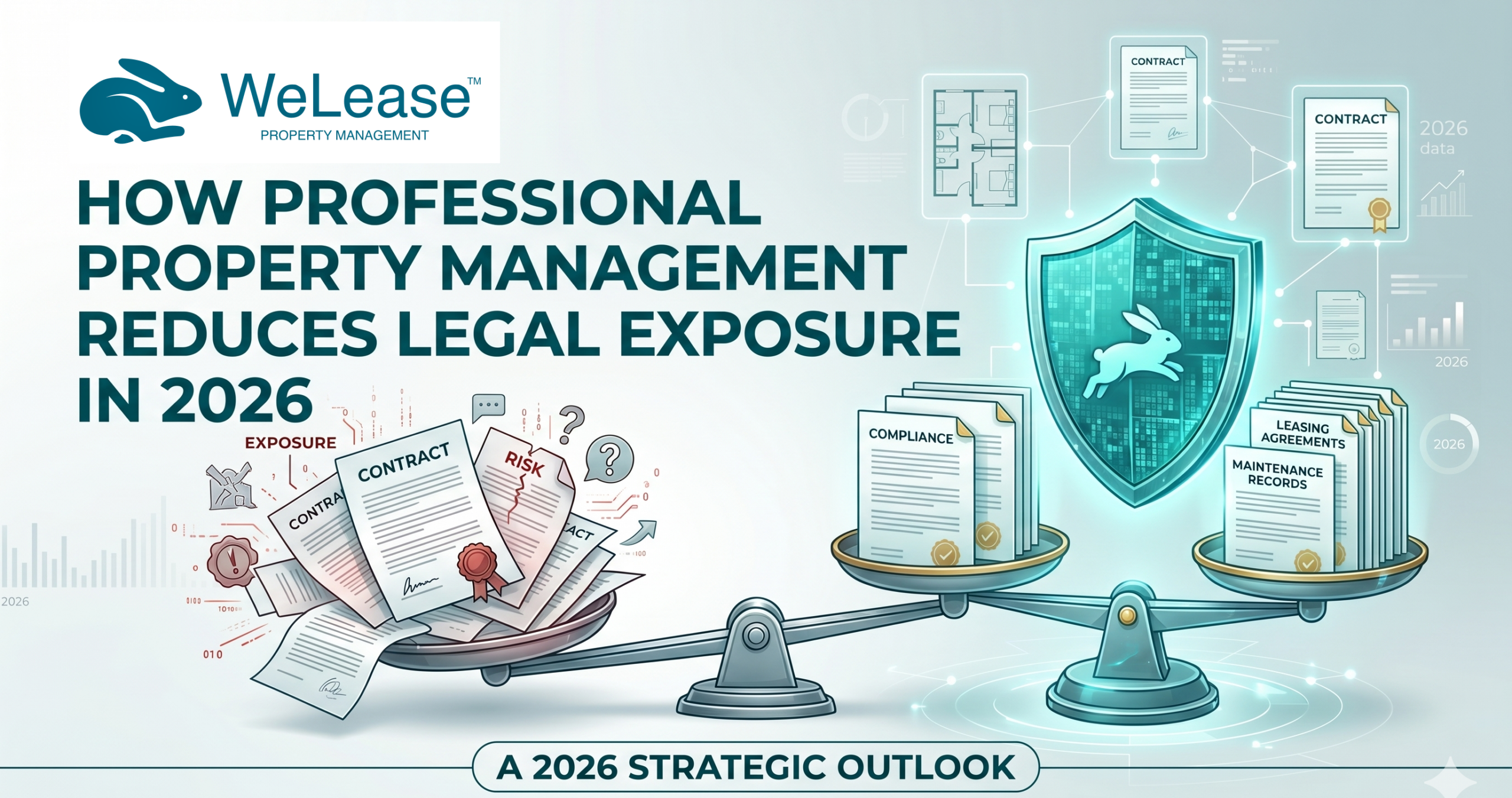
How Professional Property Management Reduces Legal Exposure in 2026
The biggest legal risk facing San Diego landlords in 2026 is not a dramatic lawsuit. It is a missed photo, a late deadline, or a lease template that fell out of date without anyone noticing.
That is the through-line in how California landlord law has evolved. The greatest risk is no longer just major violations. It is overlooking smaller statutory changes that can quickly escalate into disputes or litigation. Most penalties do not come from misunderstanding the law. They come from missing documentation deadlines.
In other words: compliance in 2026 hinges on proof, not intent. A landlord can be acting entirely in good faith, with a legitimate reason for every decision, and still face fines, statutory damages, and attorney’s fees because the paperwork was not done correctly or on time.
This is exactly where professional property management earns its keep. Not by doing anything heroic, but by building the systems, documentation, and current legal awareness that turn compliance from a constant risk into a managed process. Here is how that works in practice.
Watch: The Costly Mistakes San Diego Landlords Make
Before we get into the details, it is worth hearing this directly from Yuliana, who sees these situations play out every day.
In the video below, Yuliana walks through the specific mistakes that most often turn into legal and financial problems for DIY landlords in San Diego, from fake paystubs and missing photo documentation to notice mistakes and pricing errors.
A few points Yuliana makes in the video are worth highlighting, because they set up everything that follows:
On fake paystubs: “With prices what they are, fake paystubs and photoshopped statements are at an all-time high. A basic online credit check won’t catch that, but a professional screening database will.”
On the AB 2801 photo rule: “You cannot legally withhold a single dollar for cleaning or repairs unless you have precise timestamped photos for move-in, move-out, and post-repair items. Miss one photo and you could owe them double.”
On notice mistakes: “In California, one wrong date, one missing line, or one notice served the wrong way can delay an entire legal process. And in the City of San Diego, tenant protection rules can be even stricter.”
As Yuliana puts it, being a landlord in San Diego is “not just collecting rent anymore. It’s screening, pricing, maintenance issues, legal compliance, notices, documentation, tenant communication, and more documentation.”
These themes, screening risk, documentation as legal protection, and small procedural mistakes with outsized consequences, run through every category of legal exposure below.
Why Is Legal Exposure Rising for San Diego Landlords?
The short answer: more rules, faster changes, and stricter enforcement, all at the same time.
California regulates rental property more aggressively than any other state. Each year brings a new wave of statutes, and 2026 added a significant batch. At the same time, enforcement has shifted toward documentation standards, meaning landlords are increasingly judged on whether they can prove compliance, not just whether they acted reasonably.
Layer on top of that the local picture in San Diego: the City of San Diego’s Tenant Protection Ordinance, the Coastal Zone rules in beach communities, and the STRO ordinance for short-term rentals. State law sets the floor. Local ordinances often create the true compliance burden.
The result is a widening gap between what landlords are required to do and what most self-managing owners actually have systems for.
What this means for you: The risk is no longer just “did I follow the law.” It is “can I prove I followed the law, on time, with the right documentation.” That shift favors landlords with systems and disadvantages those relying on memory, informal communication, and outdated templates.
The 2026 Laws That Created New Exposure
Several new California laws took effect on January 1, 2026, each adding a specific compliance obligation and a corresponding way to get it wrong. Here are the ones with the most direct impact on San Diego landlords.
| Law | What It Requires | The Exposure It Creates |
|---|---|---|
| AB 628 | Working stove and refrigerator in most rentals as a habitability standard | Habitability claims, deposit disputes, fines |
| AB 414 | Updated security deposit return procedures, including electronic return when rent was paid electronically | Statutory penalties for incorrect return process |
| SB 610 | Expanded landlord responsibilities after disasters, including rent liability during evacuations | New financial and operational liability |
| AB 1529 | Tenant protection disclosures can now be included in the lease itself | Outdated lease templates may fall out of compliance |
| AB 1414 | Tenants can opt out of bundled third-party services (internet, etc.) | Tenant can deduct charges from rent if not allowed to opt out |
| AB 747 / AB 1248 | All mandatory fees must be disclosed upfront in ads, listings, and leases | Unfair business practice exposure for hidden fees |
Source: WeLease Team, updated 2026
Notice the pattern. None of these are dramatic. Each is a specific, technical requirement. And each one creates exposure not through bad intent, but through a process that was not updated to match the new rule.
A landlord using a 2023 lease template in 2026 may now be out of compliance on disclosures (AB 1529), fee transparency (AB 747/1248), and bundled services (AB 1414), all without having changed anything. The law changed underneath them.
What this means for you: If your lease, your deposit process, and your fee disclosures have not been reviewed and updated for 2026, you may already be carrying exposure you are not aware of. The laws changed. The question is whether your systems changed with them.
How Professional Management Reduces Each Type of Exposure
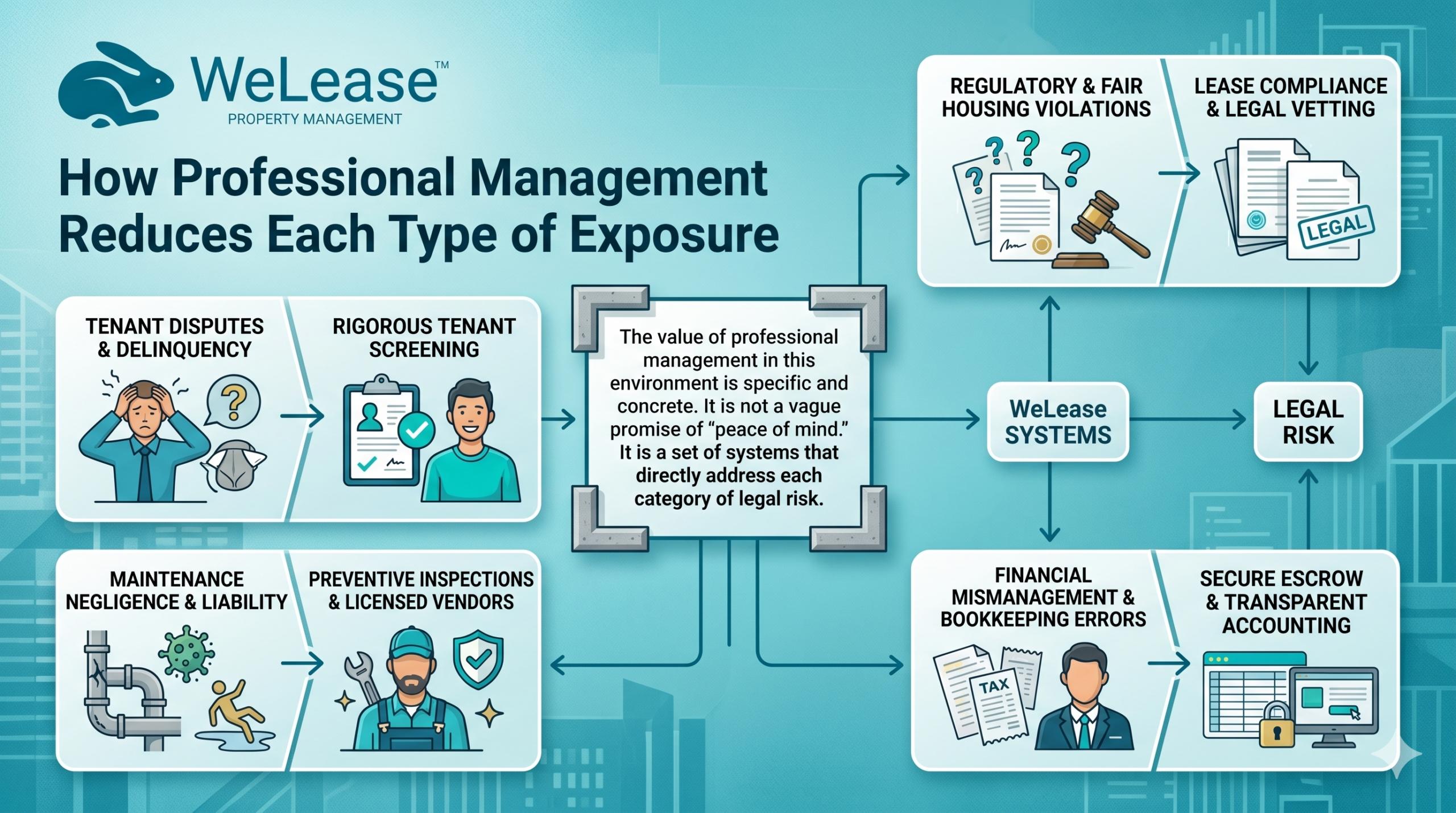
The value of professional management in this environment is specific and concrete. It is not a vague promise of “peace of mind.” It is a set of systems that directly address each category of legal risk.
Lease and Disclosure Compliance
Outdated lease templates are one of the most common sources of exposure in 2026. Professional management maintains lease templates that reflect current law, updated as new statutes take effect, with required disclosures built in.
This matters because the City of San Diego’s local ordinance layers additional disclosure and documentation requirements on top of state law. A lease that is compliant with state law but missing the City’s Tenant Protection Guide addendum is still exposed. Professional management tracks both layers.
Security Deposit Handling
Security deposit disputes are one of the most common sources of landlord-tenant litigation, and 2026 made the rules stricter. Between the one-month cap, the AB 2801 photography requirements, the AB 414 electronic return rules, and the strict 21-day deadline, there are now multiple points where a single misstep creates liability.
Professional management builds the deposit workflow around these requirements: move-in photos, move-out photos before and after work, itemized statements, electronic return where required, and the 21-day clock tracked automatically. The consequences of getting this wrong, up to twice the deposit amount plus attorney’s fees, make this one of the highest-value areas of compliance.
Eviction and Termination Procedure
Eviction timelines in California have been extended, and the procedural requirements have tightened. A termination notice filed with flawed documentation, or without satisfying relocation requirements, can result in the tenancy being reinstated, back rent owed, statutory damages, and tenant attorney’s fees.
In the City of San Diego, the exposure is higher still, with just-cause protections from day one and relocation assistance of two to three months. Professional management handles termination procedures around both state law and the City ordinance, with the documentation built to survive a challenge.
Fair Housing and Screening
Fair housing violations are among the most serious exposures a landlord faces, and they are often unintentional, the product of inconsistent screening rather than deliberate discrimination. California’s source-of-income protections, plus the City of San Diego’s voucher protections, add further requirements.
Professional management applies written screening criteria consistently to every applicant and documents every decision. That consistency and documentation is the single best protection against a fair housing claim.
Habitability and Maintenance
The new AB 628 appliance requirements make working stoves and refrigerators a habitability standard. Combined with the existing implied warranty of habitability and the retaliation protections that follow a habitability complaint, maintenance has become a compliance function as much as an operational one.
Professional management runs preventive maintenance on a schedule, documents every maintenance action with timestamps, and addresses habitability issues before they become claims. This connects directly to how maintenance response times protect both tenant retention and legal standing.
Documentation Is the Real Protection
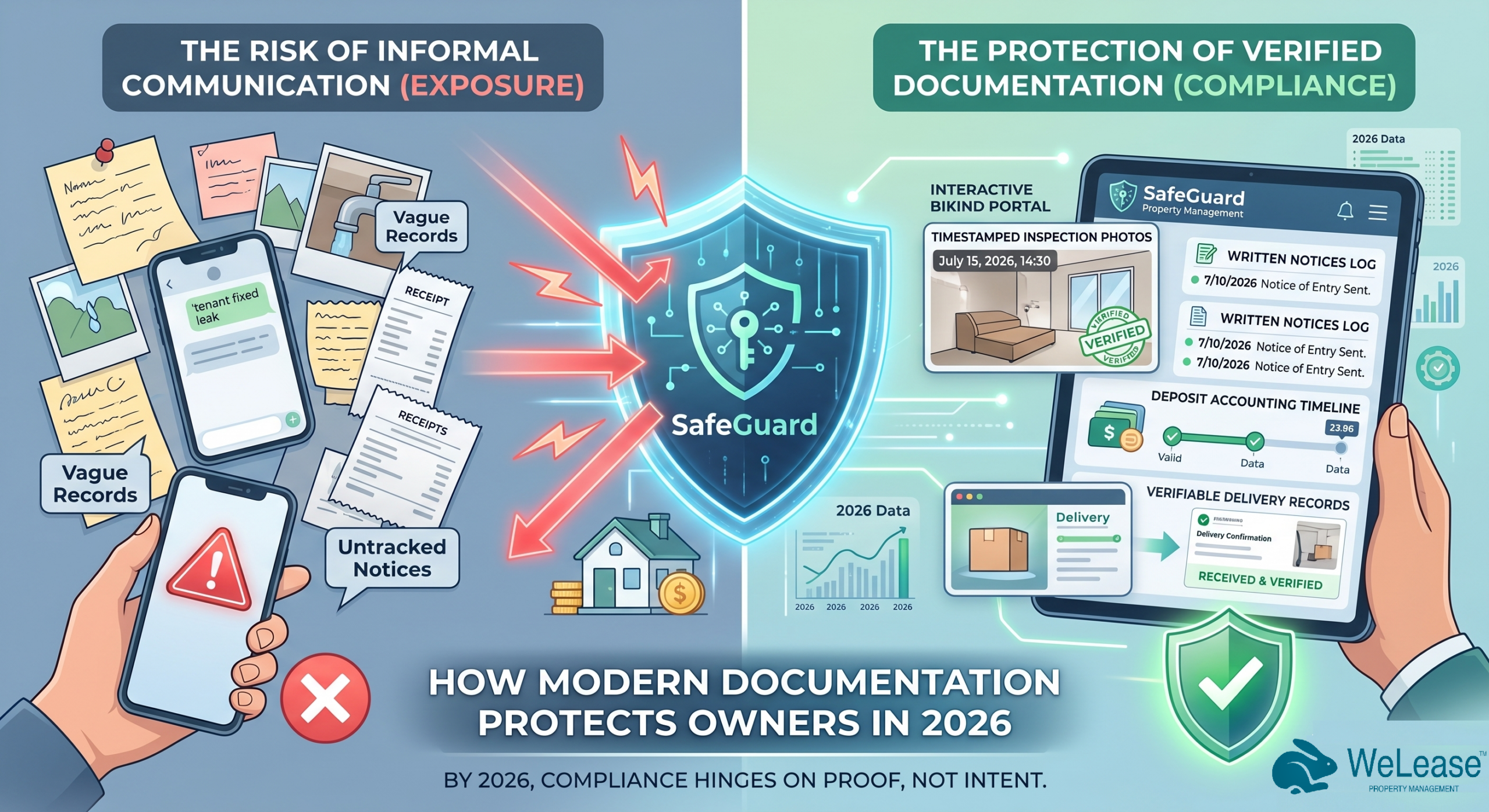
If there is one theme that runs through all of this, it is documentation.
By 2026, compliance risk increasingly hinges on proof, not intent: timestamped inspection photos, written notices, deposit accounting timelines, and verifiable delivery records. Owners relying on informal communication or delayed recordkeeping face greater exposure, even when the underlying action is lawful.
This is the part that catches good landlords off guard. They did the right thing. They had a legitimate reason. But when a dispute arises, “I did the right thing” is not enough. The question becomes “can you prove it, with dated documentation, in the format the law requires.”
Professional management systems function as legal documentation platforms, not just operational tools. Every inspection, every notice, every maintenance request, every deposit transaction is recorded, timestamped, and retrievable. That documentation is what turns a potential dispute into a non-event.
| Without Documentation Systems | With Professional Management |
|---|---|
| “I’m sure I sent that notice” | Timestamped, verifiable delivery record |
| Move-out condition disputed | Move-in and move-out photos on file |
| Deposit deadline missed | 21-day clock tracked automatically |
| Inconsistent screening defended verbally | Written criteria applied and documented for every applicant |
| Lease template years out of date | Templates updated as laws change |
Source: WeLease Team, updated 2026
What this means for you: In 2026, the landlord who can produce the right documentation wins disputes that the equally honest landlord without documentation loses. The systems that produce that documentation are the core of what professional management provides.
The Licensing Point Most Landlords Do Not Know
Here is a detail that surprises many property owners: in California, anyone who manages property on behalf of another owner for compensation must hold a valid California real estate license.
Under Business and Professions Code Section 10131(b), activities like collecting rent, leasing units, and negotiating rental agreements on behalf of an owner require a license. Operating without one when it is required is unlawful.
For a landlord, this means that a professional property manager is not just a service provider. They are a licensed professional operating under a regulatory framework, with the training, continuing education, and accountability that comes with a state license. That is a meaningfully different level of protection than an unlicensed individual handling these functions informally.
WeLease operates as a licensed brokerage (DRE# 02047533), led by a licensed REALTOR® with over 20 years of San Diego real estate experience. Compliance is not a side function. It is the foundation of how the business operates.
Keep Learning: Free WeLease Educational Events
Staying ahead of legal exposure is not a one-time task. It is an ongoing effort, and it is exactly why WeLease is committed to educating San Diego landlords, homeowners, real estate professionals, and investors in a market that keeps changing.
We regularly present educational sessions at the San Diego Association of REALTORS® (SDAR) and host local educational events throughout the year, covering the regulations, market shifts, and practical strategies that affect how you protect and profit from your property.
Follow WeLease on Eventbrite to see upcoming events and reserve your spot
Whether you own one property or a full portfolio, these sessions are a straightforward way to stay current with the laws and best practices that keep you compliant and protected.
What This Adds Up To
Legal exposure in 2026 is real, rising, and increasingly tied to documentation and current legal awareness rather than good intentions.
For a self-managing landlord, keeping pace with every new statute, updating lease templates and disclosures, maintaining airtight documentation, applying screening consistently, and tracking compliance deadlines across multiple overlapping frameworks is a substantial and ongoing burden. The cost of a single significant misstep, a wrongful eviction claim, a deposit dispute, a fair housing complaint, can easily exceed years of management fees.
Professional management does not eliminate legal risk entirely. Nothing does. But it systematically reduces exposure across every major category, replaces good intentions with documented proof, and keeps the landlord’s operation aligned with a legal landscape that changes faster than most owners can track on their own.
In a year defined by tighter rules and stricter enforcement, that protection is not a luxury. It is risk management.
Talk to Yesenia and Billy

If you are not certain whether your lease templates, deposit processes, disclosures, and documentation reflect the 2026 legal landscape, that uncertainty is itself a form of exposure, and it is worth resolving before a dispute makes it urgent.
At WeLease, we work with San Diego landlords across the county to build compliance into every part of the management process. We track the laws as they change, maintain the documentation that protects owners, and handle the procedural details that create exposure when they go wrong.
If you want a clear read on where your current setup might be leaving you exposed, reach out.
www.WeLeaseUSA.com | (619) 876-0753
Key Takeaways
- The biggest legal risk for San Diego landlords in 2026 is not major violations. It is missing documentation deadlines and overlooking smaller statutory changes that escalate into disputes.
- Compliance now hinges on proof, not intent. A landlord acting in good faith can still face penalties if the documentation is incomplete or late.
- New 2026 laws (AB 628, AB 414, SB 610, AB 1529, AB 1414, AB 747/1248) each created specific compliance obligations. Outdated lease templates may now be non-compliant on disclosures, fees, and bundled services.
- Professional management reduces exposure across every category: lease and disclosure compliance, security deposit handling, eviction procedure, fair housing, and habitability.
- Documentation is the real protection. Timestamped photos, verifiable delivery records, and tracked deadlines are what win disputes in 2026.
- In California, anyone managing property for compensation on behalf of an owner must hold a real estate license. Professional managers operate under that regulated, accountable framework.
- The cost of a single significant compliance misstep can exceed years of management fees, making professional management a form of risk management rather than just a service.
Frequently Asked Questions
How does a property manager reduce a landlord’s legal risk?
A property manager reduces legal risk by maintaining current lease templates and disclosures, building documented workflows for security deposits and notices, applying screening criteria consistently, running scheduled preventive maintenance, and tracking compliance deadlines. Because 2026 enforcement hinges on documentation rather than intent, these systems directly address the most common sources of landlord liability.
What are the biggest 2026 legal risks for California landlords?
The biggest risks come from new technical requirements: the AB 628 appliance habitability standard, AB 414 security deposit return procedures, AB 747/1248 fee disclosure rules, and updated lease disclosure requirements under AB 1529. Most exposure comes not from misunderstanding these laws but from failing to update systems and documentation to match them.
Do I need a license to manage rental property in California?
If you manage your own property, no. But anyone who manages property on behalf of another owner for compensation must hold a valid California real estate license under Business and Professions Code Section 10131(b). This is one reason professional property managers operate under a level of regulatory accountability that informal arrangements do not.
Can a property manager protect me from a tenant lawsuit?
No one can guarantee protection from all litigation. But professional management substantially reduces the likelihood of disputes and improves your position if one arises, primarily through documentation. Timestamped records, verifiable notices, consistent screening, and current-law lease templates are what determine outcomes when a dispute reaches a hearing.
Is professional property management worth it just for compliance?
For many San Diego landlords, yes. The cost of a single significant compliance failure, a wrongful eviction claim, a deposit dispute with statutory damages and attorney’s fees, or a fair housing complaint, can exceed years of management fees. In a legal environment defined by rising complexity and stricter enforcement, the compliance protection alone often justifies the cost.
Disclaimer: This article is intended for general informational purposes only and reflects California and San Diego rental law as of early 2026. It does not constitute legal advice. Laws and local ordinances change frequently. For guidance specific to your property and situation, consult a qualified California real estate attorney or licensed property management professional, or contact us at www.weleaseusa.com.
Reviewed by Billy Colestock, Co-Founder & Executive Officer, WeLease | REALTOR® DRE# 01771188
Billy Colestock brings over 20 years of real estate experience to his leadership role at WeLease Property Management. As a licensed REALTOR® and Co-Founder of WeLease, he is a trusted voice in the San Diego real estate community and regularly leads educational sessions at the San Diego Association of REALTORS® (SDAR) on topics including evictions, tenant screening, maintenance, and housing regulations. He is a member of the National Association of REALTORS® and the California Association of REALTORS®, and serves as President of his HOA. WeLease has been recognized as San Diego’s Best Property Management Company by the San Diego Union-Tribune (Winner 2022, 2024; Finalist 2023, 2025) and named a Top 10 Property Management Company in El Cajon and Chula Vista by Expertise.com in 2026. WeLease Credentials: NARPM® Member, BBB Accredited, MLS Participant, Equal Housing Opportunity. DRE: 02047533.

Ivana M. Janakieva is a Property Management Marketer and SEO Content Manager who turns confusing real estate jargon into practical, actionable advice. She’s the type who reads maintenance reports like morning news and can make lease agreement clauses sound (almost) fun. With years of experience writing about everything from tenant turnover and landlord-tenant laws to climate risks and curb appeal ROI, Ivana creates content for people who want straight answers about protecting and profiting from their most valuable asset, their property.