Talmadge Rentals: Quiet Demand in a Competitive Market | WeLease
Home / Talmadge Rentals: Quiet Demand in a Competitive Market | WeLease
Talmadge Rentals: Quiet Demand in a Competitive Market | WeLease
Some neighborhoods compete for attention. Talmadge just quietly fills up.
Tucked into San Diego’s Mid-City area, about seven miles from downtown and two miles from San Diego State University, Talmadge is one of those neighborhoods that rarely makes headlines but almost never struggles to find tenants. Historic homes, tree-lined streets named after silent-film stars, a genuine sense of community, and a location that puts renters minutes from SDSU, three major freeways, and Mission Valley.
For landlords, that combination produces something valuable and often underappreciated: steady, reliable demand that does not depend on the market being hot.
While flashier submarkets swing between overheated and oversupplied, Talmadge tends to hold a quieter, more consistent line. That consistency is the whole story here, and understanding it is the key to owning well in this neighborhood.
Talmadge at a Glance
| Factor | Talmadge 2026 |
|---|---|
| Median home sale price | ~$965,000 (down ~12% year over year) |
| 1-bedroom average rent | ~$1,900/month |
| 2-bedroom average rent | ~$2,100 to $2,500/month |
| Location | Mid-City, ~2 miles from SDSU, ~7 miles from downtown |
| Freeway access | I-8, I-15, I-805 |
| Typical tenant profile | SDSU-adjacent renters, young professionals, families, long-term residents |
| Neighborhood character | Historic district, Spanish Revival and bungalow architecture |
| Best fit | Steady demand, long-term hold, mixed tenant base |
Source: WeLease Team, updated 2026
The median home price softening, down around 12% year over year, mirrors the broader cooling across San Diego. But the rental demand fundamentals in Talmadge have held steadier than the sale-price numbers suggest, and that gap is where the opportunity lives.
What Makes Talmadge Such a Reliable Rental Market?
The short answer: location, character, and a tenant base that is naturally diverse.
Talmadge sits at an intersection of demand drivers that few San Diego neighborhoods can match at this price point. It is close enough to SDSU to draw steady student and faculty demand, residential and historic enough to attract families and long-term renters who want stability, and freeway-connected enough to appeal to professionals commuting across the county.
That diversity of demand is a genuine advantage. A neighborhood that depends entirely on one tenant type is exposed if that group’s circumstances change. Talmadge draws from several at once.
The tenant base breaks down roughly like this:
- SDSU-adjacent renters: Students, graduate students, and university staff who value proximity to campus
- Young professionals: Drawn by the character, the dining on El Cajon Boulevard, and the freeway access
- Families and long-term residents: Attracted to the historic homes, the canyons, and the strong community feel
- Commuters: Who need central county access without paying coastal or downtown prices
“When I look at Talmadge as an investor, I’m not looking for the neighborhood that spikes. I’m looking for the one that holds. You’ve got SDSU on one side, families who put down roots, and almost no room for new construction to flood the market. That combination is what keeps demand steady through cycles, and steady demand is what actually builds equity over a ten-year hold.”
Billy Colestock
What this means for you: Talmadge’s diverse demand base is a form of built-in stability. When one tenant segment softens, another tends to fill the gap. That is a meaningful advantage in a year when many single-demographic submarkets are feeling the effects of the broader cooling.
The SDSU Factor: Blessing and Consideration
Proximity to San Diego State University is one of Talmadge’s defining features, and for landlords it cuts in a few directions worth understanding.
On the positive side, SDSU generates consistent, renewable rental demand. Every year brings a new wave of students, graduate students, and university employees looking for housing near campus. That demand does not disappear in a soft market. Education is relatively recession-resistant, and the university is a permanent fixture.
On the consideration side, student-adjacent renting comes with its own dynamics. Turnover can be higher if a property is rented primarily to students on academic-year cycles. Screening matters, since student applicants may have limited credit or rental history and often rely on co-signers. And the wear-and-tear profile of a student rental can differ from a long-term family tenancy.
The neighborhoods around Talmadge have long been popular for renting to students, with easy access to campus being a primary draw. Landlords who understand how to position and manage for this demand do well. Those who treat a student-adjacent rental like any other property sometimes get surprised.
“With student-adjacent rentals, the mistake I see most is landlords getting casual with the paperwork because the applicant seems nice or a parent is co-signing. Document everything anyway. Get the co-signer agreement in writing, verify income the same way you would for anyone else, and time your lease to the academic calendar so you’re not trying to fill a unit in December. The organized landlords keep these properties full. The casual ones chase vacancies.”
Yuliana Nogales
What this means for you: The SDSU connection is a durable demand engine, but it rewards landlords who screen carefully and manage with the academic cycle in mind. Handled well, it is one of the most reliable sources of tenant demand in the county.
Why “Quiet Demand” Is Actually a Competitive Advantage
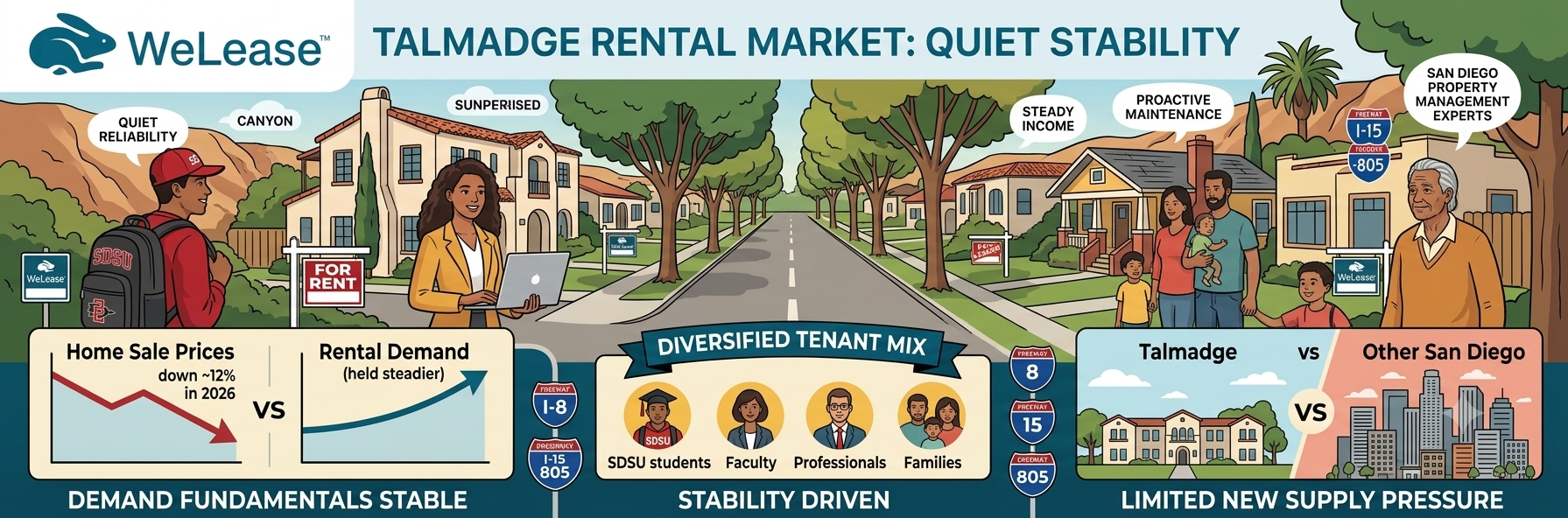
In a market where much of San Diego is dealing with rising vacancy and new-supply pressure, Talmadge’s understated steadiness looks better than it might in a hotter year.
Talmadge is largely built out and residential. There is limited room for the kind of large-scale new apartment construction that has pushed vacancy up in places like Mission Valley and Downtown. That means Talmadge landlords are not competing against a wave of brand-new luxury units offering weeks of free rent.
Instead, the competition here is more about positioning within the existing stock. A well-maintained, well-priced Talmadge rental with character and a good location tends to lease steadily, because the pool of comparable alternatives is relatively stable rather than constantly expanding.
This is a similar dynamic to what we see in other stability-driven San Diego submarkets. In Chula Vista, tenant stability rather than rapid rent growth is the primary performance driver. Talmadge shares some of that DNA, with the added layer of historic character and university-driven demand.
What this means for you: The absence of large-scale new construction means Talmadge landlords are insulated from the new-supply pressure softening other parts of the county. Quiet demand is not weak demand. It is stable demand, and in 2026 that stability is worth a great deal.
Pricing a Talmadge Rental in 2026
Getting the price right in Talmadge means understanding that this is not a top-of-market neighborhood and that trying to force it to be one usually backfires.
Talmadge rents are moderate by San Diego standards. That is part of its appeal to tenants and part of what drives the steady demand. A landlord who prices at the top of the range, hoping the historic character will command a premium the market does not support, risks the same extended-vacancy problem that hurts landlords everywhere in a cooling market.
The stronger approach is to price accurately against genuinely comparable properties, similar size, similar condition, similar proximity to campus and freeways, and to let the neighborhood’s steady demand do the work. A well-priced Talmadge rental does not usually sit for long.
This connects directly to the lesson that raising rent can hurt more than it helps. In a moderate, stability-driven market like Talmadge, an aggressive rent increase that pushes out a good long-term tenant can easily cost more than it earns.
“The most common pricing mistake in a neighborhood like Talmadge is treating the historic charm as a premium the market will automatically pay. Tenants love the character, but they’re still comparing your unit against everything else in their budget. I price against what’s actually renting right now, not what the house ‘feels’ like it’s worth. In a moderate market, an accurate price that leases in two weeks beats an ambitious one that sits for six.”
Billy Colestock
Managing for the Long Term in Talmadge
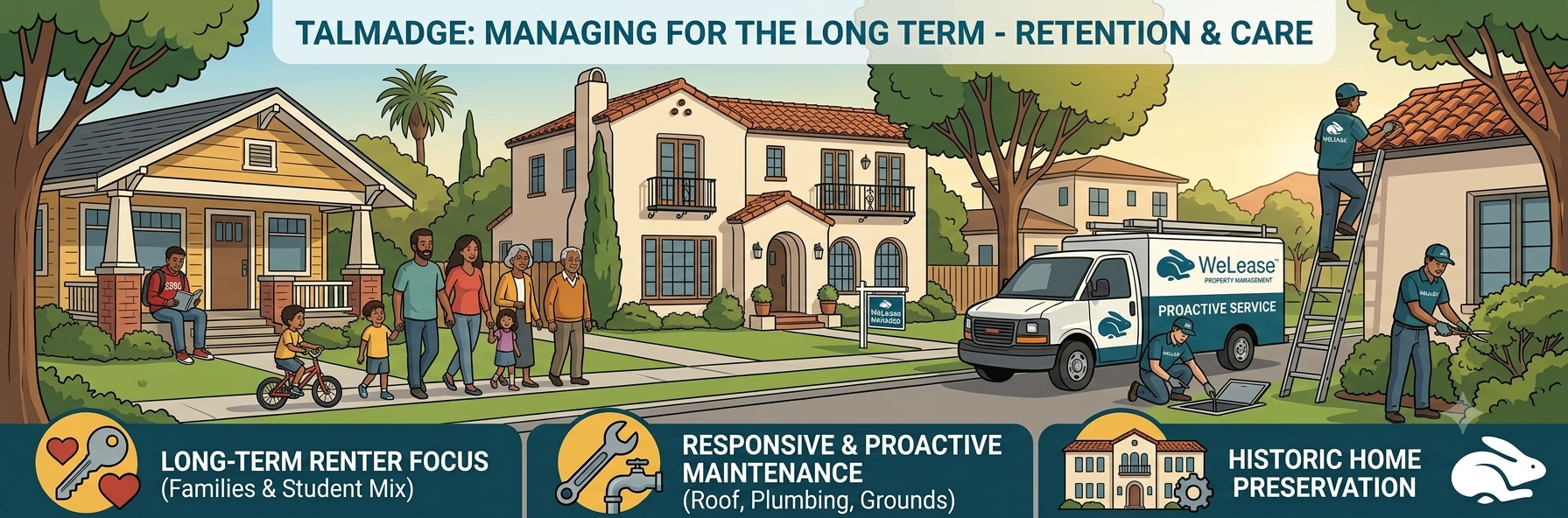
Because Talmadge attracts a meaningful share of long-term renters and families alongside its student demand, the properties that perform best here are the ones managed for retention.
The historic character that makes Talmadge appealing also means many properties are older. That puts a premium on responsive, proactive maintenance. Older homes need attention, and tenants who love the character of a 1920s Spanish Revival still expect the plumbing to work and repairs to happen promptly.
This is where the connection between maintenance responsiveness and tenant retention matters most. A landlord who keeps an older Talmadge property well-maintained and responds quickly to issues holds good tenants for years. One who defers maintenance on an older property invites both vacancy and, in 2026, potential habitability compliance problems.
What this means for you: Talmadge’s older, character-rich housing stock rewards proactive maintenance and punishes neglect. For a neighborhood built on steady, long-term demand, keeping good tenants in place through responsive management is the single highest-value thing an owner can do.
Staying Compliant in Talmadge
Talmadge sits within City of San Diego limits, which means the full stack of state and local rules applies here.
The City of San Diego’s Tenant Protection Ordinance applies, with its day-one just-cause eviction protections and elevated relocation assistance requirements. AB-1482 applies to most properties built before 2011, which covers a large share of Talmadge’s historic housing stock. And the western end of the neighborhood is a designated historic district, which can carry its own considerations for property modifications.
For any landlord who owns here, understanding how state law and local San Diego ordinances stack together is essential. The historic character of Talmadge does not exempt it from any of the 2026 compliance requirements, and the older housing stock actually raises the stakes on habitability rules like the new appliance and structural standards.
What this means for you: Talmadge’s age and historic-district status add layers most newer neighborhoods do not have. Owning here means staying current on both the standard City of San Diego requirements and any historic-district considerations that apply to your specific property.
The Long-Term Outlook for Talmadge Rentals
The case for Talmadge as a long-term hold is straightforward and durable.
The location does not change. SDSU is not moving, the freeways are not going anywhere, and the historic character that draws tenants is protected by the neighborhood’s designation and community pride. Demand is diverse and renewable. And the limited room for large-scale new construction means Talmadge is unlikely to face the oversupply pressure hitting other parts of the county.
The recent softening in home prices reflects the broader San Diego cooling, not a weakness specific to Talmadge. For a landlord focused on steady rental income and long-term stability rather than dramatic appreciation, the fundamentals here are genuinely attractive.
Talmadge is not going to be the neighborhood everyone is talking about. It is going to be the neighborhood that quietly performs, year after year, for owners who understand what they have.
Talk to Yesenia and Billy

If you own a rental in Talmadge or the surrounding Mid-City area, or you are considering investing here, we would be glad to talk through the specifics.
At WeLease, we work with San Diego property owners across the county, including the Mid-City and SDSU-adjacent neighborhoods where demand is steady but managing an older property well makes all the difference. We know how to price for this market, how to screen for the mix of tenants Talmadge attracts, and how to keep good tenants in place for the long term.
If you want a clear read on how your Talmadge property is positioned, reach out.
www.WeLeaseUSA.com | (619) 876-0753
Key Takeaways
- Talmadge is a quiet, steady rental market in San Diego’s Mid-City area, roughly two miles from SDSU and seven miles from downtown, with diverse and renewable tenant demand.
- The median home price is around $965,000, down about 12% year over year in line with the broader San Diego cooling, but rental demand fundamentals have held steadier.
- The tenant base is genuinely mixed: SDSU-adjacent renters, young professionals, families, and long-term residents. That diversity is a source of built-in stability.
- Proximity to SDSU generates consistent, renewable demand but rewards careful screening and management aligned with the academic cycle.
- Limited room for large-scale new construction insulates Talmadge from the new-supply pressure softening neighborhoods like Mission Valley and Downtown.
- The historic, older housing stock rewards proactive maintenance and raises the stakes on 2026 habitability compliance.
- Talmadge sits within City of San Diego limits, so the Tenant Protection Ordinance, AB-1482, and historic-district considerations all apply.
Frequently Asked Questions
Is Talmadge a good neighborhood to own a rental property in 2026?
Yes, for a landlord focused on steady income and long-term stability. Talmadge offers diverse, renewable demand thanks to its proximity to SDSU, its historic character, and its central location. It is not a high-appreciation or top-of-market neighborhood, but its quiet, consistent demand makes it a reliable long-term hold, especially in a year when many other submarkets are facing new-supply pressure.
How much does it cost to rent in Talmadge, San Diego?
Rents in Talmadge are moderate by San Diego standards. One-bedroom units average around $1,900 per month, and two-bedroom units generally range from about $2,100 to $2,500 depending on size, condition, and proximity to SDSU and the freeways. This relative affordability is part of what drives the neighborhood’s steady demand.
Is Talmadge a good area for student rentals?
It can be. Talmadge sits about two miles from San Diego State University, and the surrounding area is popular with students, graduate students, and university staff. Student-adjacent rentals generate reliable, renewable demand but require careful screening (often involving co-signers) and management aligned with the academic-year cycle. Handled well, this is one of the more dependable demand sources in the county.
Why are Talmadge home prices down in 2026?
The roughly 12% year-over-year decline in Talmadge home prices reflects the broader cooling across the San Diego market, not a weakness specific to the neighborhood. Rental demand fundamentals in Talmadge have held steadier than the sale-price numbers, which is part of what makes it attractive to landlords focused on rental income rather than short-term appreciation.
Do City of San Diego rental rules apply in Talmadge?
Yes. Talmadge is within City of San Diego limits, so the City’s Tenant Protection Ordinance applies, including day-one just-cause eviction protections and elevated relocation assistance requirements. AB-1482 applies to most properties built before 2011, which covers much of Talmadge’s historic housing stock. The western historic district may also carry additional considerations for property modifications.
Disclaimer: This article is intended for general informational purposes only and draws on publicly available market data as of mid-2026. It does not constitute legal, financial, or tax advice. Market conditions and regulations change frequently. For property-specific guidance, please consult a qualified California real estate professional or licensed legal advisor, or contact us at www.weleaseusa.com.
Reviewed by Billy Colestock, Co-Founder & Executive Officer, WeLease | REALTOR® DRE# 01771188
Billy Colestock brings over 20 years of real estate experience to his leadership role at WeLease Property Management. As a licensed REALTOR® and Co-Founder of WeLease, he is a trusted voice in the San Diego real estate community and regularly leads educational sessions at the San Diego Association of REALTORS® (SDAR) on topics including evictions, tenant screening, maintenance, and housing regulations. He is a member of the National Association of REALTORS® and the California Association of REALTORS®, and serves as President of his HOA. WeLease has been recognized as San Diego’s Best Property Management Company by the San Diego Union-Tribune (Winner 2022, 2024; Finalist 2023, 2025) and named a Top 10 Property Management Company in El Cajon and Chula Vista by Expertise.com in 2026. WeLease Credentials: NARPM® Member, BBB Accredited, MLS Participant, Equal Housing Opportunity. DRE: 02047533.

Ivana M. Janakieva is a Property Management Marketer and SEO Content Manager who turns confusing real estate jargon into practical, actionable advice. She’s the type who reads maintenance reports like morning news and can make lease agreement clauses sound (almost) fun. With years of experience writing about everything from tenant turnover and landlord-tenant laws to climate risks and curb appeal ROI, Ivana creates content for people who want straight answers about protecting and profiting from their most valuable asset, their property.