Why Stable Tenants Are Worth More Than Top-Dollar Rent
Home / Why Stable Tenants Are Worth More Than Top-Dollar Rent
Why Stable Tenants Are Worth More Than Top-Dollar Rent
Two landlords own identical units next door to each other.
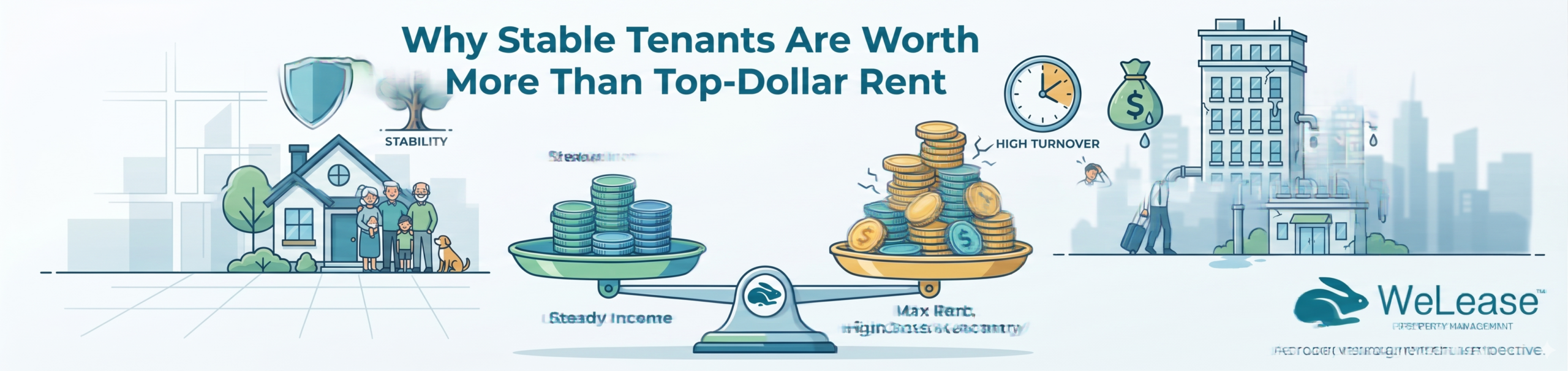
The first chases top-dollar rent. They push every increase to the maximum, accept whichever applicant will pay the highest number, and treat the property as a revenue figure to be maximized each year. Their tenants turn over every 12 to 18 months.
The second prices slightly under market, screens carefully for tenants who will stay, and invests in keeping them happy. Their tenants stay three, four, sometimes five years.
After five years, the second landlord is almost always ahead. Often by a lot.
This is one of the most counterintuitive truths in rental property ownership: the highest rent on paper rarely produces the highest return in reality.
As WeLease Operations Manager Yuliana often reminds homeowners:
“A rent increase should never be automatic. Before adjusting rent, look at how long the tenant has lived in the home, when you last raised the rent, and whether you’re looking at a tenant who’s proven they’re worth keeping.”
The number that matters is not what you charge. It is what you keep, after vacancy, turnover, and the cost of constantly replacing tenants is subtracted.
Here is why stable tenants are worth more than top-dollar rent, and how to think about the tradeoff.
The Real Cost of Chasing Top-Dollar Rent
The appeal of maximizing rent is obvious. A higher number on the lease feels like a higher return. But that number is gross, not net, and the gap between the two is where the real story lives.
Every time a tenant leaves, a predictable chain of costs follows:
| Turnover Cost | Typical Range |
|---|---|
| Lost rent during vacancy (2 to 4+ weeks) | $1,500 to $4,600 |
| Cleaning and make-ready | $500 to $2,000 |
| Repairs, paint, carpet | $1,000 to $3,500 |
| Marketing and leasing time | Varies; often a leasing fee |
| Screening and application processing | Time and cost |
Source: WeLease Team, updated 2026
Yuliana also encourages landlords to think beyond vacancy alone.
“If a tenant moves out because of a rent increase, don’t just calculate the lost rent. Think about everything needed to get the property ready again. Maybe it’s just a cleaning, or maybe you’re replacing flooring, updating bathrooms, fixing plumbing, or handling deferred maintenance. Those expenses add up very quickly.”
Research by the National Apartment Association has shown that each move-out costs over $4,000. A resident who renews their lease, even with a modest rent increase, is far more valuable than a new tenant who requires a make-ready renovation that can run $3,500 or more.
Now layer in the math. If chasing an extra $100 per month in rent causes a tenant to leave a year earlier than they otherwise would, the landlord gains $1,200 in higher rent but loses $4,000 or more in turnover costs. The “higher” rent produced a net loss.
What this means for you: Top-dollar rent only wins if the tenant stays. The moment an aggressive rent strategy triggers a turnover, the math usually flips negative. The number on the lease is not the number in your pocket.
What Is a Tenant Actually Worth Over Time?
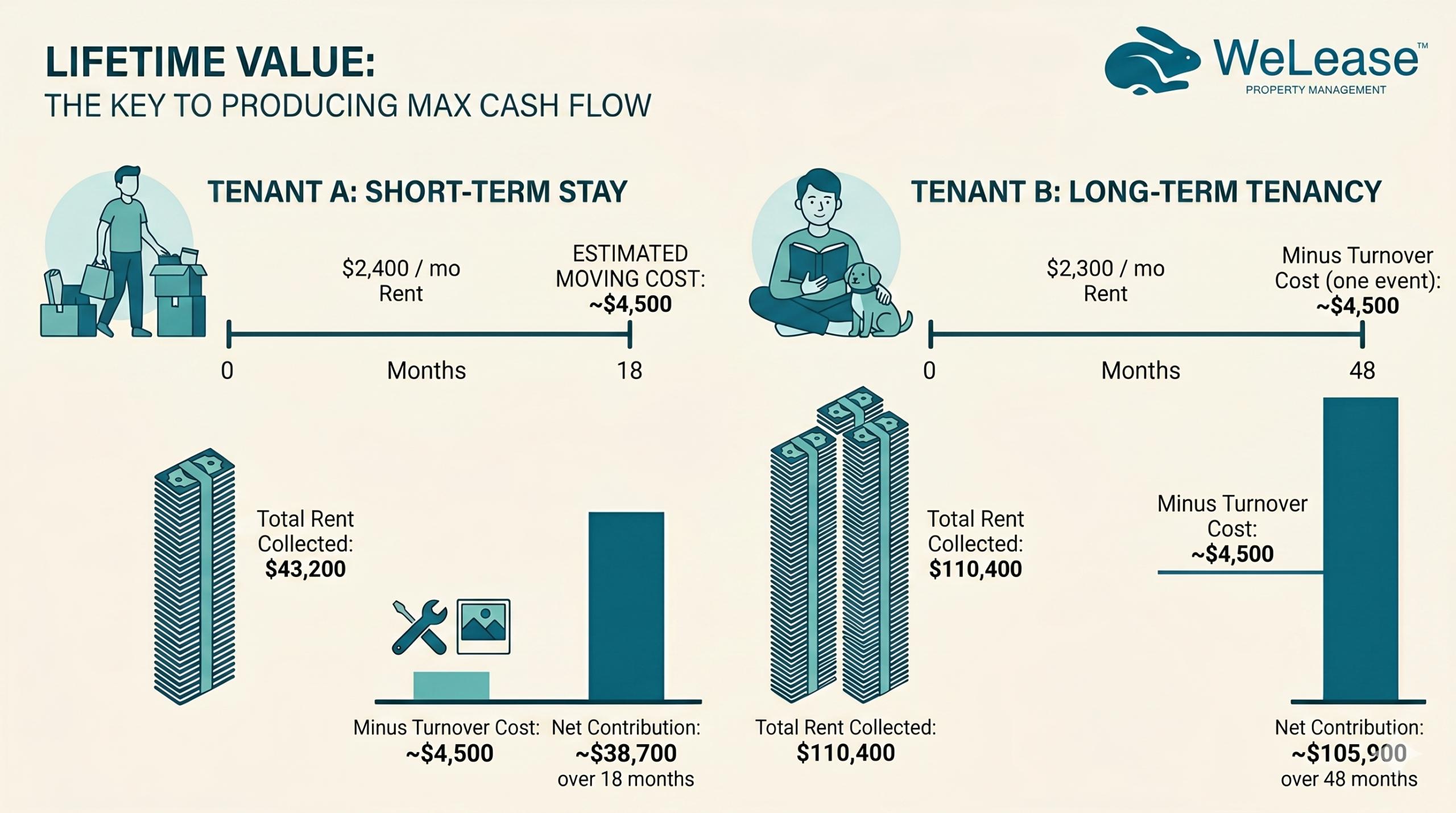
The most useful way to think about this is lifetime value: the total amount a tenant contributes to your cash flow across the entire length of their tenancy, minus what it costs to acquire and replace them.
A simple illustration:
Tenant A pays $2,400 per month and stays 18 months before leaving.
- Total rent collected: $43,200
- Minus turnover cost to replace: ~$4,500
- Net contribution: ~$38,700 over 18 months
Tenant B pays $2,300 per month (slightly under market) and stays 48 months.
- Total rent collected: $110,400
- Minus turnover cost (one event at the end): ~$4,500
- Net contribution: ~$105,900 over 48 months
On a monthly basis, Tenant B nets roughly $2,206 per month after turnover costs. Tenant A nets roughly $2,150 per month after turnover costs, despite paying $100 more in rent.
The longer-staying tenant at the lower rent produces a better monthly return, and does it with far less work, risk, and disruption.
What this means for you: A tenant is not worth what they pay per month. They are worth what they contribute across their entire tenancy after the cost of replacing them is subtracted. Measured that way, the stable tenant almost always wins.
Why Stable Tenants Reduce Risk, Not Just Cost
The financial case is only part of the story. Stable, long-term tenants also reduce risk in ways that do not always show up as a line item.
Fewer unknowns. Every new tenant is a degree of uncertainty. Will they pay on time? Will they take care of the property? Will they be a good neighbor? A long-term tenant with an established track record has already answered those questions. Each turnover reintroduces that risk.
More predictable cash flow. A property with stable tenancy produces income you can count on. A property that turns over frequently has recurring gaps, recurring make-ready costs, and recurring uncertainty about when the next qualified applicant will appear. Predictable income is worth more than volatile income, even at the same average level.
Better property condition. Tenants who plan to stay tend to treat the property as their home. They report issues before they become serious. They maintain the space. Tenants who churn frequently, by contrast, often have less invested in the property’s long-term condition.
Stronger valuations. Properties with lower turnover and stable, documented income often command higher valuations. When it comes time to sell or refinance, a track record of stable tenancy and consistent NOI is a genuine asset.
Good Tenants Protect Your Property. Stable tenants do more than provide reliable income. They also help protect your investment.
According to Yuliana, quality tenants tend to report maintenance issues as soon as they notice them instead of letting small problems become expensive repairs.
“The best tenants care about the home. They keep it clean, organized, and they let us know about legitimate maintenance issues before they become bigger problems.”
That proactive communication can prevent water damage, plumbing failures, HVAC issues, and other costly repairs that often grow when problems go unreported.
This is the same dynamic we see in stability-driven submarkets across the county. In Chula Vista’s rental market, for example, tenant stability is the primary performance driver, not aggressive rent growth. The landlords who lean into that dynamic consistently outperform.
How to Actually Keep Good Tenants
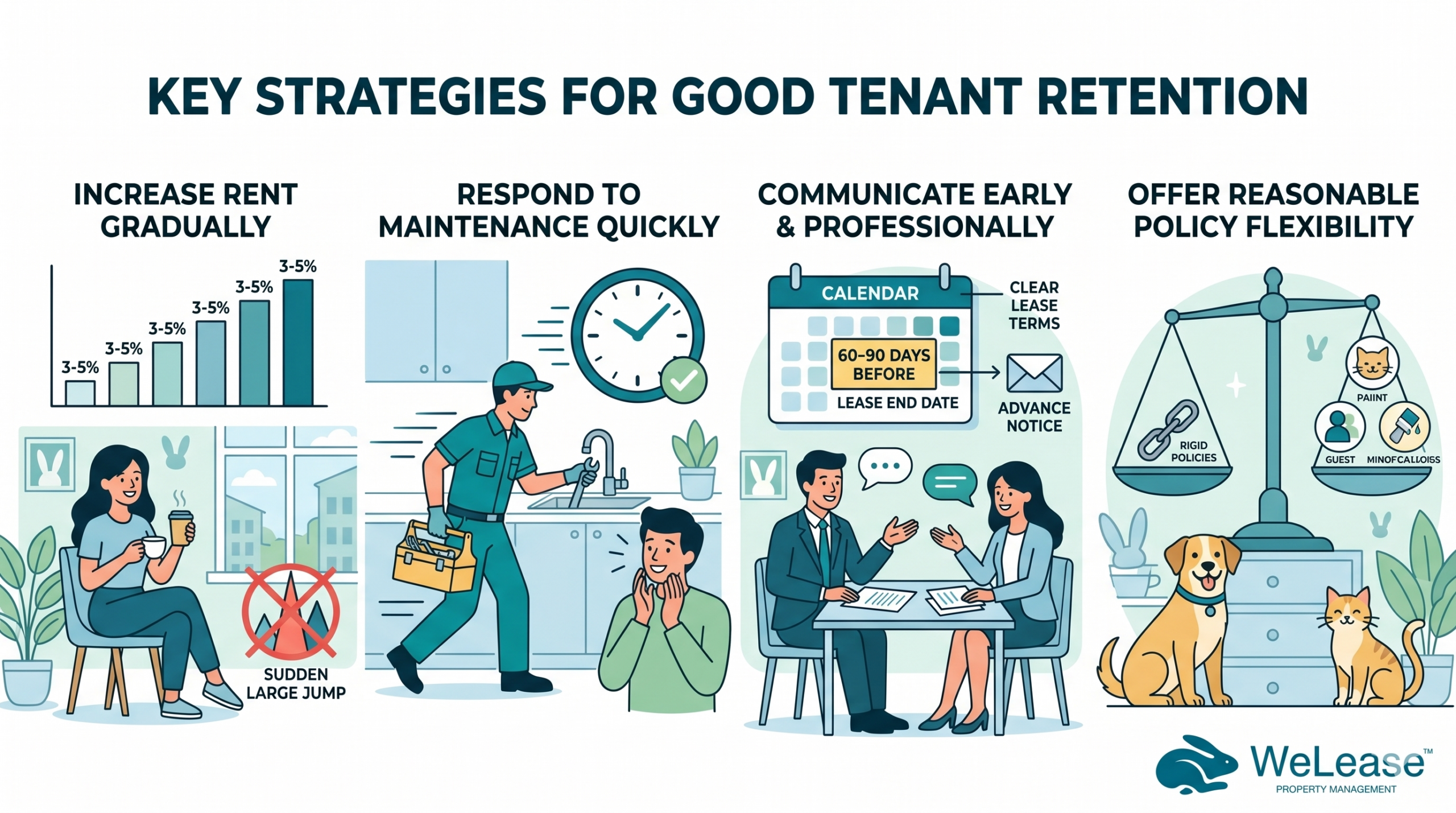
If stable tenants are worth more, the obvious question is how to keep them. The good news is that the levers are inexpensive and within every landlord’s control.
Increase rent gradually and predictably. Before deciding on any rent increase, evaluate the tenant, not just the market.
Yuliana recommends looking at four questions first:
- How long has the tenant lived in the property?
- When was the last rent increase?
- Do they consistently pay rent on time?
- Are they taking good care of the home?
“A tenant who pays on time, reports maintenance issues early, and takes pride in the property is incredibly valuable,” says Yuliana. “Sometimes a slightly smaller rent increase protects far more profit than pushing for every last dollar.”
This is the central insight of knowing when raising rent hurts more than it helps: the rent increase that maximizes this year’s revenue can easily cost more than it earns if it pushes a good tenant out the door.
Respond to maintenance quickly. Maintenance responsiveness is the single strongest predictor of renewal decisions. A tenant whose requests are acknowledged quickly and handled well is a tenant who renews. This is covered in depth in our piece on how maintenance response times impact tenant retention, and it is worth emphasizing here: nothing else moves the retention needle as reliably.
Communicate professionally and consistently. Tenants who feel respected and informed stay longer. Clear lease terms, advance notice of renewals, and responsive communication signal stability, and stability encourages renewal.
Start the renewal conversation early. A renewal discussion that begins 60 to 90 days before the lease ends gives the tenant time to feel consulted rather than presented with a take-it-or-leave-it number at the last minute.
Offer reasonable flexibility. Rigid policies around pets, guests, or minor lease modifications can force tenants to choose between compliance and their lifestyle. Reasonable flexibility, within sensible limits, measurably improves retention.
What this means for you: Keeping a good tenant rarely requires large concessions. It requires gradual rent increases, fast maintenance, professional communication, and early renewal conversations. These cost very little and produce the single highest-leverage outcome in rental ownership: a tenant who stays.
When Does Pushing for Top-Dollar Rent Make Sense?
To be fair, there are situations where raising rent toward market, even at the risk of turnover, is the right call.
| Situation | Push Rent or Prioritize Retention? |
|---|---|
| Tenant is significantly below market (15%+) | Consider a larger increase; the gap is too wide to ignore |
| Strong leasing season, easy to re-let | Pushing rent carries less risk |
| Tenant has been problematic or high-maintenance | Retention is less valuable; turnover may be acceptable |
| Tenant is reliable and near market rate | Prioritize retention almost every time |
| Slow leasing season (late fall/winter) | Prioritize retention; vacancy risk is high |
| Property in a high-turnover, high-demand area | More flexibility to push rent |
Source: WeLease Team, updated 2026
The point is not that rent should never increase. It is that the decision should be made with the full picture in view, weighing the value of the stable tenant against the incremental rent, rather than defaulting to “maximize the number” every time.
For a reliable tenant paying close to market rate, the answer is almost always to keep them.
The Bigger Picture: Stability as a Strategy
The landlords who build real long-term wealth in rental property are rarely the ones chasing the highest possible rent every year. They are the ones who understand that a rental property is a long-term asset, and that the compounding value of stability beats the short-term gain of maximization.
Stable tenants produce predictable income. Predictable income supports better financing, better planning, and stronger valuations. Lower turnover means lower costs, less risk, and less work. And a property with a track record of stable, well-managed tenancy is simply worth more than one that churns.
Top-dollar rent is a number. Stability is a strategy. Over a multi-year hold, the strategy wins.
This connects directly to how long-term tenants stabilize rental income over time, which looks at the income-smoothing and financial-planning benefits of retention in more detail.
Talk to Yesenia and Billy

If you are not sure whether your current rent strategy is actually maximizing your returns, or whether it might be quietly costing you good tenants, that is exactly the kind of question worth talking through.
At WeLease, we help San Diego landlords think about rent and retention together, not separately. We track what comparable units are actually renting for, we know what it costs to lose a good tenant in your specific market, and we build management around keeping quality tenants in place for the long term.
If you want a clear read on whether your property is positioned for stability or churning unnecessarily, reach out.
www.WeLeaseUSA.com | (619) 876-0753
Key Takeaways
- The highest rent on paper rarely produces the highest return. Net income after vacancy and turnover is what matters, not the gross number on the lease.
- Each tenant move-out costs over $4,000 on average, and a make-ready renovation can run $3,500 or more. A renewing tenant, even at a modest increase, is far more valuable than a new one.
- A tenant’s true worth is their lifetime value: total contribution across the full tenancy minus the cost to acquire and replace them. Measured this way, the stable tenant almost always wins.
- Stable tenants reduce risk as well as cost, producing more predictable cash flow, better property condition, and stronger valuations.
- Keeping good tenants is inexpensive: gradual rent increases, fast maintenance, professional communication, early renewal conversations, and reasonable flexibility.
- Pushing for top-dollar rent makes sense in specific situations (tenant far below market, strong leasing season, problematic tenant), but for a reliable tenant near market rate, retention almost always wins.
- Over a multi-year hold, stability is a stronger wealth-building strategy than rent maximization.
Frequently Asked Questions
Is it better to keep a good tenant or raise the rent to market?
For a reliable tenant who is near market rate, keeping them almost always produces a better return. The cost of turnover, often $4,000 or more, typically exceeds the gain from a modest rent increase. The main exceptions are when the tenant is significantly below market (15% or more) or when the leasing season makes re-letting easy and low-risk.
How much does it cost to replace a tenant?
Research from the National Apartment Association shows each move-out costs over $4,000 on average, factoring in lost rent during vacancy, cleaning, repairs, make-ready work, and leasing costs. A full make-ready renovation can add $3,500 or more on top of that. These costs are why retention is so financially valuable.
What is tenant lifetime value?
Tenant lifetime value is the total amount a tenant contributes to your cash flow across the entire length of their tenancy, minus the cost to acquire and replace them. A tenant paying slightly less rent but staying four years often produces a higher lifetime value than one paying more but leaving after 18 months.
How do I keep tenants from leaving?
The most effective levers are gradual and predictable rent increases, fast and reliable maintenance response, professional and consistent communication, starting renewal conversations early, and offering reasonable flexibility on lease terms. Maintenance responsiveness in particular is the single strongest predictor of whether a tenant renews.
Does lower turnover actually increase property value?
Yes. Properties with lower turnover and stable, documented income often command higher valuations. Consistent net operating income and a track record of stable tenancy are genuine assets when it comes time to sell or refinance, on top of the ongoing savings from avoided turnover costs.
Disclaimer: This article is intended for general informational purposes only and draws on industry research and publicly available data as of early 2026. It does not constitute legal, financial, or tax advice. Market conditions change frequently. For property-specific guidance, please consult a qualified California real estate professional or licensed advisor, or contact us at www.weleaseusa.com.
Reviewed by Yesenia Colestock, Co-Founder, WeLease Property Management
Yesenia Colestock is the Co-Founder of WeLease, a locally owned and operated property management company serving landlords and investors throughout San Diego County. She leads WeLease’s day-to-day operations and client relationships, with a focus on delivering responsive, practical property management that protects owners’ investments and keeps tenants satisfied for the long term. Under her leadership, WeLease has been recognized as San Diego’s Best Property Management Company by the San Diego Union-Tribune (Winner 2022, 2024; Finalist 2023, 2025) and named a Top 10 Property Management Company in El Cajon and Chula Vista by Expertise.com in 2026. WeLease Credentials: NARPM® Member, BBB Accredited, MLS Participant, Equal Housing Opportunity. DRE: 02047533.

Ivana M. Janakieva is a Property Management Marketer and SEO Content Manager who turns confusing real estate jargon into practical, actionable advice. She’s the type who reads maintenance reports like morning news and can make lease agreement clauses sound (almost) fun. With years of experience writing about everything from tenant turnover and landlord-tenant laws to climate risks and curb appeal ROI, Ivana creates content for people who want straight answers about protecting and profiting from their most valuable asset, their property.