How to Read Your Rental Property’s True ROI (Beyond Just Rent Minus Mortgage)
Home / How to Read Your Rental Property’s True ROI (Beyond Just Rent Minus Mortgage)
How to Read Your Rental Property’s True ROI (Beyond Just Rent Minus Mortgage)
Ask most landlords how their rental property is doing, and you will hear some version of the same math: “I collect $2,800 in rent, my mortgage is $2,100, so I make about $700 a month.”
That number feels right. It is also almost always wrong.
Not because the arithmetic is off, but because it leaves out most of what actually determines whether a rental property is a good investment. It ignores the expenses that do not show up on the mortgage statement. It ignores vacancy. It ignores the return streams that make real estate wealthy-building in the first place, the ones you cannot see in a monthly cash-flow figure at all.
Understanding your property’s true ROI is not an academic exercise. It is the difference between knowing whether your investment is actually performing and just hoping that it is. And in a 2026 San Diego market where margins are tighter than they were a few years ago, that difference matters more than ever.
Here is how to read what your rental is really returning.
Why “Rent Minus Mortgage” Is a Trap
The rent-minus-mortgage number is seductive because it is simple. It is also missing so much that it can make a losing property look like a winner.
Consider a property renting at $2,800 a month with a $2,100 mortgage. The “$700 a month” story ignores:
- Property taxes (often several hundred a month on a San Diego property)
- Insurance (rising fast in California)
- Maintenance and repairs (the industry benchmark is 1 to 3% of property value per year)
- Vacancy (even a few weeks a year has a real cost)
- Property management or the value of your own time
- Capital expenses (the roof, the HVAC, the water heater that will eventually need replacing)
Once those are factored in, that $700 monthly “profit” can easily shrink to a couple hundred dollars, break even, or go negative. Many San Diego deals in 2026 look exactly like this: a small positive cash flow on paper that a full accounting reveals to be much thinner.
This connects directly to what we covered in the hidden costs that quietly kill rental returns. The costs that do not appear on the mortgage statement are exactly the ones that erode returns without the landlord noticing.
What this means for you: If your entire understanding of your property’s performance is “rent minus mortgage,” you do not actually know how your investment is doing. The number that feels like profit is a gross figure with most of the real expenses still hiding inside it.
The One Number That Changes Everything: NOI
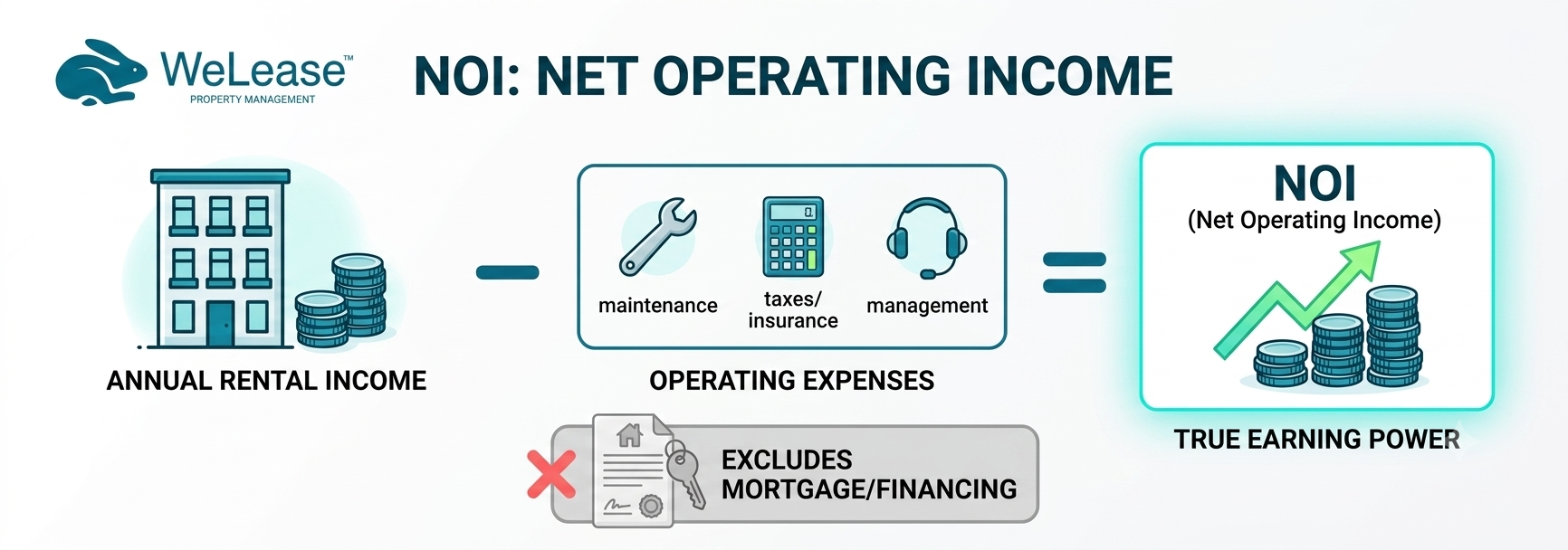
If you learn one financial concept as a landlord, make it Net Operating Income (NOI). It is the foundation of nearly every meaningful ROI calculation.
NOI is your annual rental income minus all operating expenses, but NOT including your mortgage payment.
That last part surprises people, so it is worth stressing. NOI deliberately excludes financing. It measures what the property itself earns, independent of how you paid for it. That is what makes it so useful: it shows the property’s true earning power.
A simple NOI example:
| Item | Annual Amount |
|---|---|
| Gross rental income | $33,600 |
| Minus vacancy allowance (~5%) | -$1,680 |
| Effective gross income | $31,920 |
| Minus property taxes | -$6,000 |
| Minus insurance | -$1,800 |
| Minus maintenance | -$4,000 |
| Minus management | -$2,500 |
| Net Operating Income (NOI) | $17,620 |
Source: WeLease Team, updated 2026. Illustrative example only.
Notice the mortgage is nowhere in this calculation. That is intentional. Once you have NOI, you can measure the property’s real performance and compare it to other properties on a level playing field.
What this means for you: NOI is the honest starting point. It tells you what your property earns after the real costs of operating it, before financing. Every serious ROI metric builds from this number, which is why getting it right, with realistic expense estimates, matters so much.
Cap Rate: What the Property Earns on Its Own
Once you have NOI, the cap rate tells you the property’s return as if you had bought it with all cash, no mortgage involved.
Cap Rate = NOI ÷ Property Value × 100
Using the example above, a $17,620 NOI on a $700,000 property gives a cap rate of about 2.5%. On a $400,000 property, the same NOI would be a 4.4% cap rate.
Cap rate is useful because it strips out financing entirely, letting you compare very different properties on equal footing. A property in one neighborhood with a 3% cap rate and one in another with a 5.5% cap rate can be compared directly, because the metric ignores how each was financed.
What is a good cap rate in 2026?
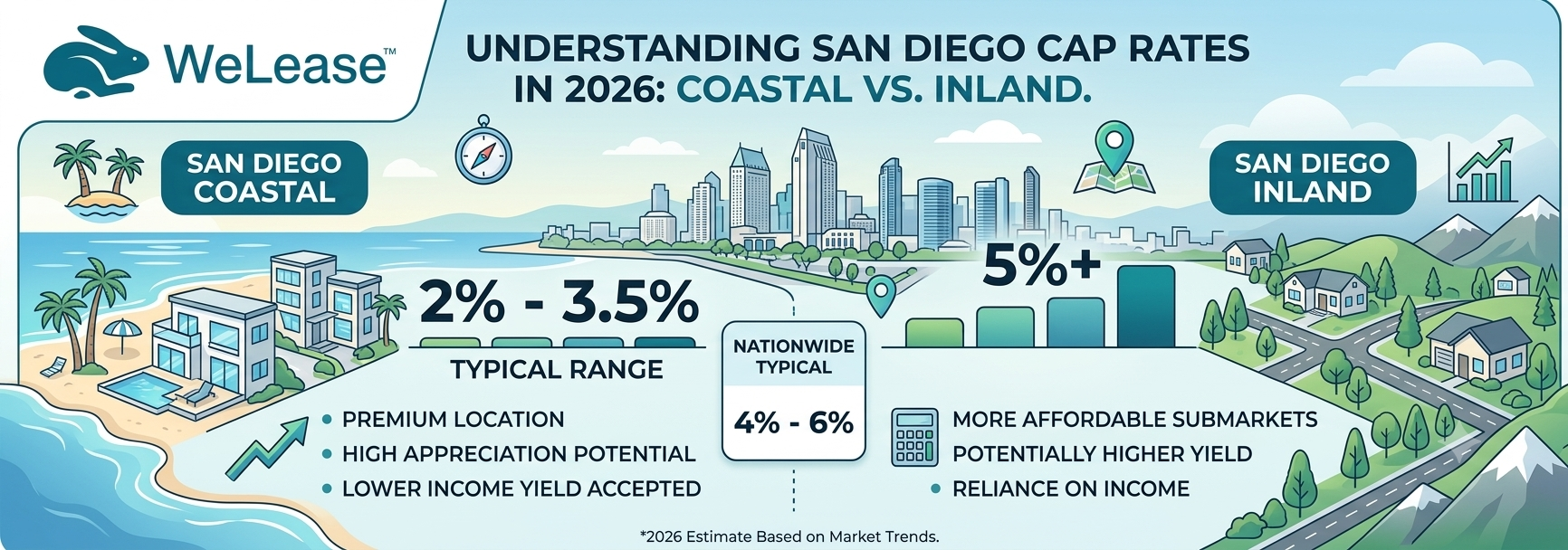
For long-term residential rentals, 4 to 6% is a typical range in most US markets. Coastal San Diego often runs lower, in the 2 to 3.5% range, because buyers pay a premium for the location and accept a lower income yield in exchange for appreciation potential. Inland and more affordable San Diego submarkets tend to run higher.
A cap rate below 4% generally means you are betting on appreciation rather than income, because the property is not producing much yield on its own. This is exactly the cash flow versus appreciation tradeoff we explored for El Cajon: a lower-cap-rate coastal property and a higher-cap-rate inland property are simply two different investment strategies.
What this means for you: Cap rate answers “how hard is this property working on its own?” A low cap rate is not automatically bad, but it does tell you that you are relying on appreciation rather than income. Knowing your cap rate tells you which kind of investment you actually own.
Cash-on-Cash Return: What You Actually Earn on Your Money
Cap rate ignores your mortgage. Cash-on-cash return does the opposite. It measures the actual cash you earn relative to the actual cash you put in.
Cash-on-Cash Return = Annual Pre-Tax Cash Flow ÷ Total Cash Invested × 100
Here, “annual cash flow” is your NOI minus your actual mortgage payments (debt service). And “total cash invested” is your down payment plus closing costs and any upfront work.
This is the number that tells you what your money is actually earning. If you put $150,000 down and the property produces $9,000 in annual cash flow after the mortgage, your cash-on-cash return is 6%.
A realistic 2026 benchmark: 6 to 10% cash-on-cash is generally considered a strong return, though in higher-cost markets like San Diego, many leveraged deals come in lower, especially at current interest rates. Some San Diego properties produce very thin cash-on-cash returns and rely on the other return streams (which we will get to) to justify the investment.
“The number that surprises people most is their real cash-on-cash return, because it’s almost always lower than the rent-minus-mortgage figure they had in their head. But I tell owners not to panic at that. A thin cash-on-cash on a well-located San Diego property isn’t a bad deal, it just means the return is coming from appreciation and loan paydown instead of monthly cash flow. As an investor, you have to know which return you’re actually buying.”
Billy Colestock
What this means for you: Cash-on-cash return is the “what is my money actually earning right now” number. It is more honest than rent-minus-mortgage because it accounts for all operating costs and your real capital invested. In San Diego, it is often lower than owners expect, which makes understanding the other return streams essential.
The Return Streams You Cannot See in Monthly Cash Flow
Here is the part that rent-minus-mortgage completely misses, and it is the reason real estate builds wealth even when monthly cash flow is thin.
A rental property produces returns through four channels, not one:
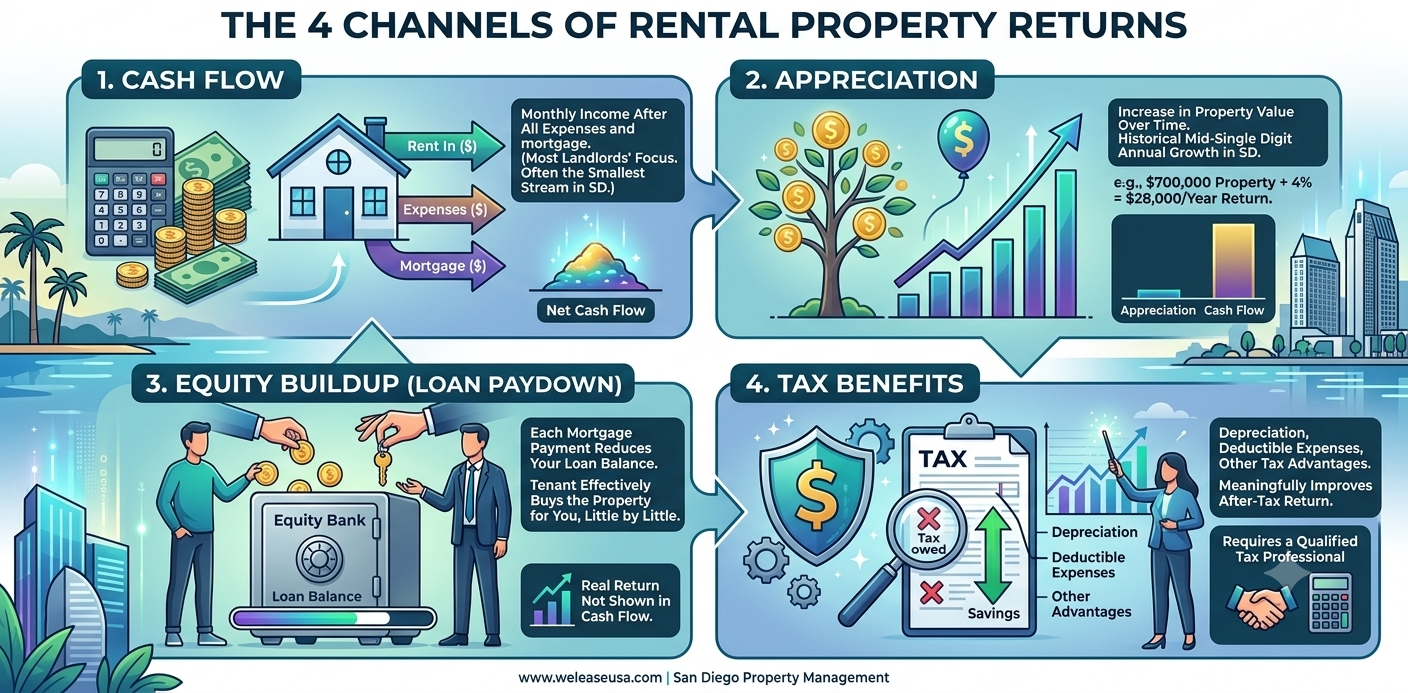
- Cash flow. The monthly income after all expenses and the mortgage. This is the only stream most landlords track, and in San Diego it is often the smallest.
- Appreciation. The increase in the property’s value over time. San Diego’s long-term appreciation has historically run in the mid-single digits annually. On a $700,000 property, even 4% appreciation is $28,000 in a year, which can dwarf the cash flow.
- Equity buildup (loan paydown). Every mortgage payment reduces your loan balance. Your tenant is effectively buying the property for you, a little each month. This is a real return that never shows up in cash flow.
- Tax benefits. Depreciation, deductible expenses, and other tax advantages can meaningfully improve your after-tax return. (This is where a qualified tax professional earns their fee.)
When you add these together, a property that looks like it barely breaks even on monthly cash flow can be producing a genuinely strong total return. This is the core insight of how long-term tenants stabilize rental income over time and why patient, long-term ownership tends to win: the streams you cannot see in a monthly figure are often the largest.
What this means for you: Judging a rental property only by monthly cash flow is like judging a business only by this month’s petty cash. Appreciation, equity buildup, and tax benefits are real returns, and over a multi-year hold they usually add up to far more than the cash flow. A complete ROI picture counts all four.
Total ROI: Putting It All Together
When you combine all four return streams, you get total ROI, the number that actually reflects how your investment is performing.
For a well-managed, leveraged rental property held over a five to ten year period, a total annualized return in the 12 to 20% range is achievable, even when year-one cash flow is modest. The reason is leverage combined with multiple return streams: you control a large asset with a relatively small amount of your own cash, and you benefit from appreciation and equity buildup on the full property value, not just your down payment.
But notice the timeframe. These returns compound over years. A deal that looks unexciting in year one often looks very different by year five, once rent has grown, the loan balance has dropped, and appreciation has accumulated. Real estate rewards patience.
“Year-one cash flow is the worst possible way to judge a San Diego rental. I’ve watched properties that barely broke even in year one turn into the best-performing assets in a portfolio by year five, once rent grew, the loan balance dropped, and appreciation compounded. When an owner asks me whether to hold or sell, I make them look at the full return over the whole hold, not one thin year. Real estate pays the patient.”
Billy Colestock
What this means for you: Total ROI, counting cash flow, appreciation, equity buildup, and tax benefits, is the only number that reflects your real return. And because most of those streams build over time, the honest way to evaluate a rental is over years, not months.
How Better Management Directly Improves Your ROI
Here is what ties this all back to the day-to-day: nearly every input in these formulas is something management directly affects.
Reduce vacancy, and your effective gross income rises, lifting NOI and every metric built on it. Control maintenance costs through preventive care and good vendor relationships, and NOI rises again. Retain good tenants, and you avoid the turnover costs that quietly erode returns. Price accurately, and you minimize the vacancy that does the most damage to cash flow.
None of these are dramatic. But together, they are the difference between a property that hits its potential ROI and one that quietly underperforms. A property with a 5% cap rate that is well-managed will outperform an identical property with the same cap rate that is poorly managed, because management determines whether the theoretical numbers become the actual numbers.
This is the practical case for professional property management in San Diego: it is not just a service, it is an input into your ROI. Lower vacancy, lower turnover, controlled costs, and accurate pricing flow directly into NOI, cash-on-cash return, and total ROI.
“Owners think of returns as something the market decides, but a lot of it is operational. Every week of vacancy we prevent, every maintenance issue we catch early, every good tenant we keep from turning over, those all show up directly in the numbers. We track vacancy days, maintenance costs, and renewal rates on every property, because you can’t improve what you don’t measure. The returns follow the discipline.”
Yuliana Nogales
What this means for you: Every ROI metric in this article has inputs that management controls: vacancy, maintenance costs, tenant retention, and pricing accuracy. Better management is not separate from your returns. It is one of the most direct levers you have to improve them.
Talk to Yesenia and Billy

If you are not certain what your rental property is truly returning, beyond the rent-minus-mortgage number, that is exactly the kind of analysis we do every day.
At WeLease, we help San Diego property owners understand their real numbers: NOI, cap rate, cash-on-cash return, and the full return picture including the streams that do not show up in monthly cash flow. And because we manage for exactly the inputs that drive those numbers, lower vacancy, controlled costs, and strong tenant retention, we can help you not just measure your ROI but improve it.
If you want a clear, honest read on how your property is actually performing, reach out.
www.WeLeaseUSA.com | (619) 876-0753
Key Takeaways
- “Rent minus mortgage” is a misleading measure of ROI. It ignores property taxes, insurance, maintenance, vacancy, management, and capital expenses, which can turn an apparent profit into break-even or a loss.
- Net Operating Income (NOI) is the foundation of real ROI analysis: annual income minus all operating expenses, but excluding the mortgage. It measures the property’s true earning power.
- Cap rate (NOI ÷ property value) shows what a property earns on its own, ignoring financing. Coastal San Diego often runs 2 to 3.5%, while inland submarkets run higher. Below 4% means you are betting on appreciation.
- Cash-on-cash return (cash flow ÷ cash invested) shows what your actual money is earning. A 6 to 10% range is strong, though many San Diego deals run lower at current rates.
- Real estate produces four return streams: cash flow, appreciation, equity buildup, and tax benefits. Most landlords track only cash flow, which in San Diego is often the smallest.
- Total ROI, counting all four streams, can reach 12 to 20% annualized over a five to ten year hold, even when year-one cash flow is modest. Real estate rewards patience.
- Management directly affects nearly every ROI input: vacancy, maintenance costs, tenant retention, and pricing. Better management is a direct lever on your returns.
Frequently Asked Questions
How do I calculate the true ROI on my rental property?
Start with Net Operating Income (NOI): your annual rental income minus all operating expenses (taxes, insurance, maintenance, vacancy, management), but not your mortgage. From NOI you can calculate cap rate (NOI ÷ property value) and, after subtracting your mortgage, cash-on-cash return (cash flow ÷ cash invested). For total ROI, also account for appreciation, loan paydown, and tax benefits. “Rent minus mortgage” alone is not a reliable measure.
What is a good cap rate for a San Diego rental property?
It depends on the submarket. Coastal San Diego often runs 2 to 3.5%, because buyers accept a lower income yield in exchange for appreciation potential. Inland and more affordable San Diego submarkets tend to run higher, in the 4 to 6% range. A cap rate below 4% generally means the investment relies on appreciation rather than income.
What is the difference between cap rate and cash-on-cash return?
Cap rate measures the property’s return independent of financing (NOI ÷ property value), which lets you compare properties on equal footing. Cash-on-cash return measures what your actual invested cash is earning after your mortgage payments (annual cash flow ÷ total cash invested). Cap rate evaluates the property; cash-on-cash evaluates your specific deal and financing.
Why does my rental have positive cash flow but still feel like it is not making money?
Often because the “cash flow” being measured is really just rent minus mortgage, which ignores taxes, insurance, maintenance, vacancy, and capital expenses. Once those are included, real cash flow is usually much thinner. The good news is that appreciation, equity buildup, and tax benefits are also part of your return, and over time they typically add up to far more than the monthly cash flow.
Does property management improve ROI or just add a cost?
Both, but the improvement often exceeds the cost. Management fees are an operating expense, but good management directly improves the inputs that drive ROI: it reduces vacancy, controls maintenance costs, retains good tenants (avoiding turnover costs), and prices accurately. Because these flow straight into NOI and cash flow, effective management frequently produces a net gain that exceeds the fee.
Disclaimer: This article is intended for general informational and educational purposes only and does not constitute financial, investment, tax, or legal advice. The examples are illustrative and do not reflect any specific property. ROI calculations depend on many property-specific factors. For guidance specific to your situation, consult a qualified financial or tax professional, or contact us at www.weleaseusa.com.
Reviewed by Yesenia Colestock, Co-Founder, WeLease Property Management
Yesenia Colestock is the Co-Founder of WeLease, a locally owned and operated property management company serving landlords and investors throughout San Diego County. She leads WeLease’s day-to-day operations and client relationships, with a focus on delivering responsive, practical property management that protects owners’ investments and keeps tenants satisfied for the long term. Under her leadership, WeLease has been recognized as San Diego’s Best Property Management Company by the San Diego Union-Tribune (Winner 2022, 2024; Finalist 2023, 2025) and named a Top 10 Property Management Company in El Cajon and Chula Vista by Expertise.com in 2026. WeLease Credentials: NARPM® Member, BBB Accredited, MLS Participant, Equal Housing Opportunity. DRE: 02047533.

Ivana M. Janakieva is a Property Management Marketer and SEO Content Manager who turns confusing real estate jargon into practical, actionable advice. She’s the type who reads maintenance reports like morning news and can make lease agreement clauses sound (almost) fun. With years of experience writing about everything from tenant turnover and landlord-tenant laws to climate risks and curb appeal ROI, Ivana creates content for people who want straight answers about protecting and profiting from their most valuable asset, their property.