How Long-Term Tenants Stabilize Rental Income Over Time
Home / How Long-Term Tenants Stabilize Rental Income Over Time
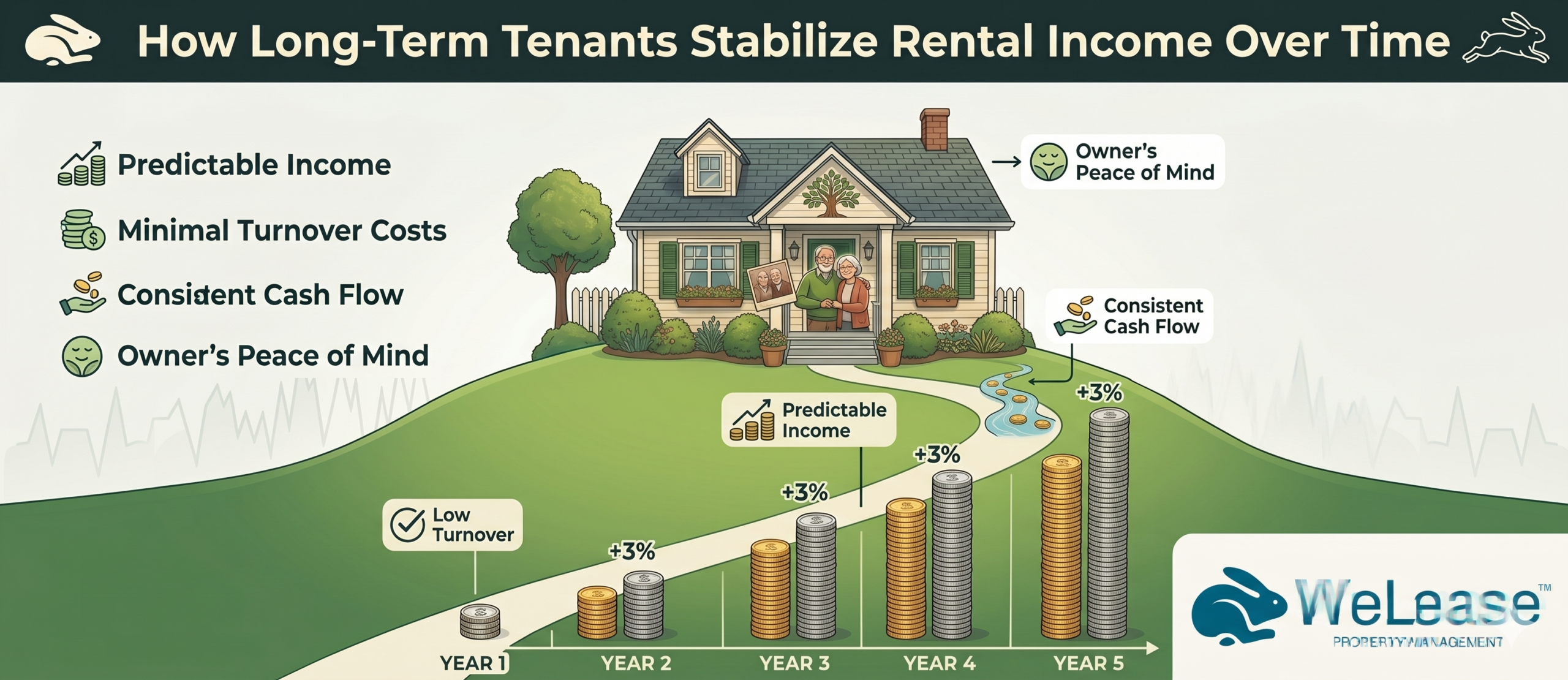
How Long-Term Tenants Stabilize Rental Income Over Time
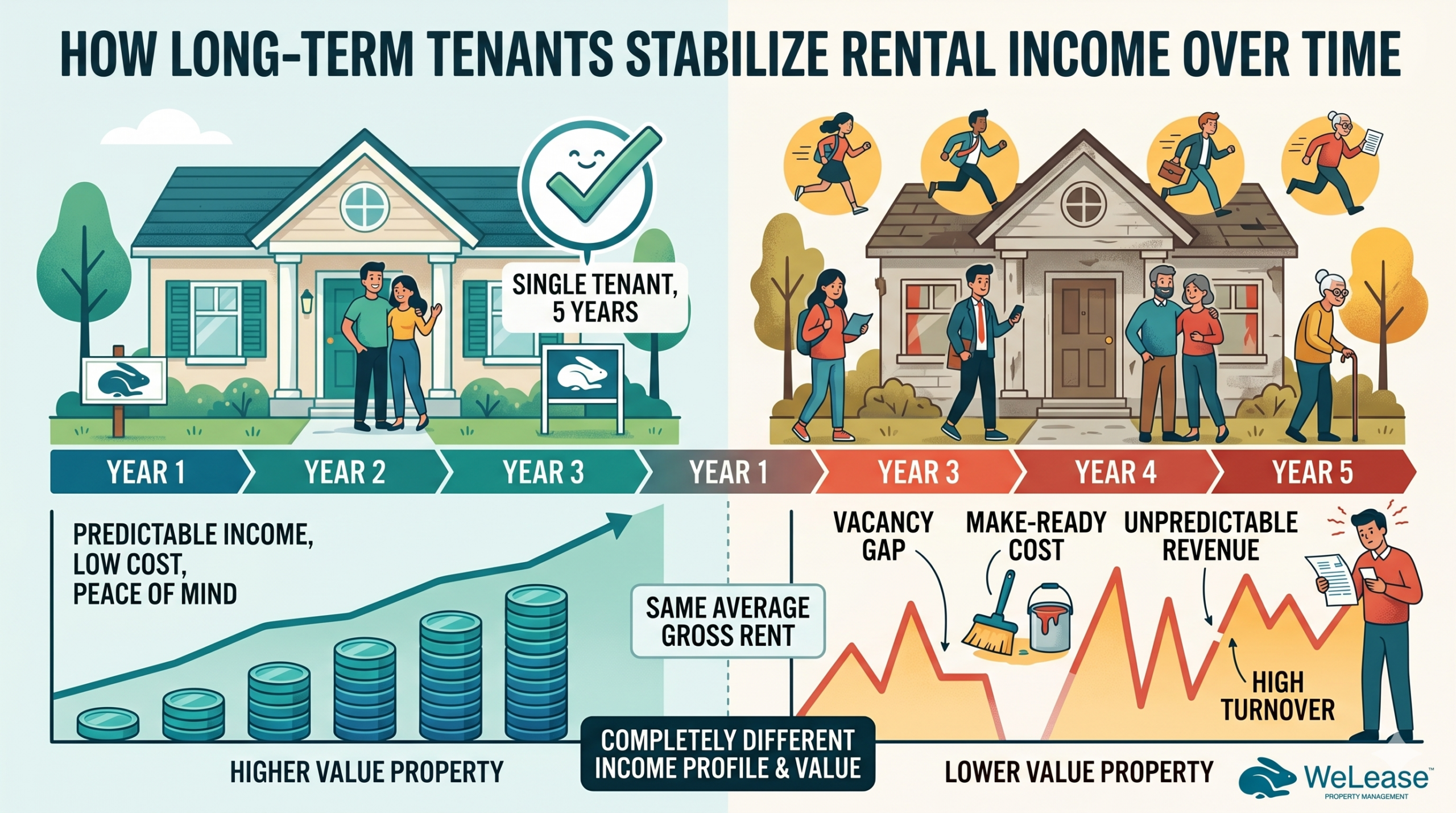
Picture two rental properties side by side, both bringing in the same average rent over five years.
The first has a tenant who stays the entire time. Rent arrives the same day every month. The owner knows almost to the dollar what the property will produce this year, next year, and the year after.
The second cycles through four different tenants over the same period. Each transition brings a vacancy gap, a make-ready cost, a stretch of uncertainty about when the next rent check will arrive, and a question mark over whether the new tenant will pay reliably.
Same average rent. Completely different income profile. And the first property is worth more, easier to finance, and far less stressful to own.
This is the quiet financial power of long-term tenants. They do not just save money on turnover. They transform rental income from something volatile and unpredictable into something steady, plannable, and bankable. Here is how that works, and why it matters more than most landlords realize.
What Does “Stable Income” Actually Mean for a Landlord?
Stable rental income is not just about the amount. It is about predictability. The difference between income you hope to receive and income you can count on.
A property with a long-term tenant produces what financial analysts would call low-variance cash flow. The same amount, on the same schedule, with minimal interruption. A property that turns over frequently produces high-variance cash flow: periods of full rent interrupted by vacancy gaps, make-ready costs, and the uncertainty of finding the next qualified tenant.
Even when the average rent is identical, the stable version is worth more. Here is why.
| Income Factor | Long-Term Tenant | Frequent Turnover |
|---|---|---|
| Monthly predictability | High | Low |
| Vacancy gaps | Rare | Recurring |
| Make-ready costs | Infrequent | Every cycle |
| Cash flow variance | Low | High |
| Planning confidence | Strong | Weak |
Source: WeLease Team, updated 2026
What this means for you: Two properties earning the same average rent are not equally valuable. The one with stable, predictable income from a long-term tenant is worth more, both in peace of mind and in measurable financial terms.
How Vacancy Gaps Quietly Erode Your Real Income
The math on this is more punishing than most landlords realize, because vacancy does not just remove income. It removes income while expenses keep running.
When a unit sits empty, the mortgage payment continues. So do property taxes, insurance, and any utilities the owner covers during showings. The income stops. The costs do not.
Standard rental analysis builds in a vacancy allowance of 5 to 10% for well-located residential properties. But that allowance is an average. A property with a long-term tenant can run far below it, while a frequently-turning property can blow well past it.
Consider a $2,500 per month unit:
- Long-term tenant, one vacancy in five years: Effective vacancy rate close to 1 to 2%
- Turns over every 18 months, 3 to 4 weeks vacant each time: Effective vacancy rate of 4 to 6% or higher
That difference, several percentage points of effective vacancy, flows directly to the bottom line. On a property generating $30,000 a year in gross rent, even three points of additional vacancy is roughly $900 a year in lost income, before counting the make-ready costs that accompany each turnover.
What this means for you: Every avoided vacancy gap is income that flows straight to your bottom line. A long-term tenant is, in effect, a vacancy-reduction strategy that also happens to reduce your costs and your risk at the same time.
Why Lenders and Buyers Pay More for Stable Income
This is the part that most landlords do not fully appreciate until they go to refinance or sell.
Rental property value is closely tied to net operating income (NOI), the income a property generates after operating expenses but before mortgage payments. NOI is what lenders evaluate, what buyers price off of, and what determines how much a property is worth.
Stable, documented income from long-term tenants produces a stronger, more reliable NOI than income interrupted by recurring vacancy and turnover costs. And that has direct financial consequences:
Financing. Lenders use the Debt-Service Coverage Ratio (DSCR), which compares a property’s income to its loan obligations. A DSCR above 1.25 signals that NOI comfortably covers the loan with a buffer. Stable income from long-term tenants supports a stronger, more consistent DSCR, which can mean better financing terms and easier qualification.
Valuation. When it comes time to sell, a property with a track record of stable tenancy and consistent NOI is more attractive to buyers than one with a history of turnover and uneven income. Buyers pay for predictability.
Refinancing. A high, stable NOI shows you have a healthy asset that can easily support a refinance or a new loan. That flexibility, the ability to pull equity or improve terms, is itself valuable.
What this means for you: Long-term tenants do not just improve your monthly cash flow. They strengthen the financial profile of the asset itself, making it easier to finance, refinance, and eventually sell at a stronger price. Stability is an asset-level advantage, not just an operational one.
The Compounding Effect of Retention Over Time
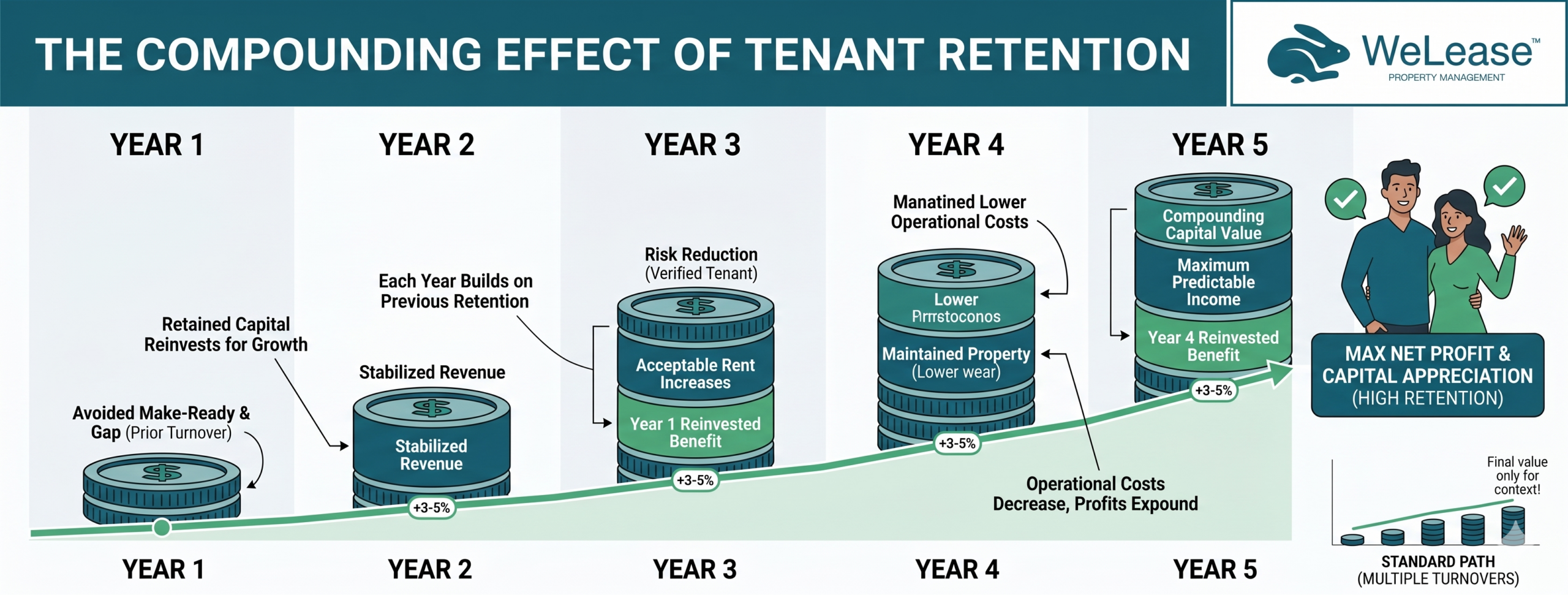
The benefits of a long-term tenant are not just additive. They compound.
Think about what happens over a five-year period with a stable tenant versus a turning one.
With a long-term tenant:
- Rent increases happen gradually and predictably, keeping pace with the market without shocks
- The relationship deepens, making renewal easier each year
- The property stays in good condition because the tenant treats it as home
- The owner’s income is predictable enough to plan around, reinvest, or leverage
With frequent turnover:
- Each cycle resets the relationship and reintroduces risk
- Make-ready costs recur every 12 to 18 months
- Income gaps interrupt cash flow planning
- The property shows more wear from repeated move-ins and move-outs
This connects directly to why stable tenants are worth more than top-dollar rent [link to be added after article no2 goes live]. The two ideas are two sides of the same coin: retention is not just cheaper than turnover, it produces a fundamentally better income stream over time.
The landlords who understand this stop thinking about each year’s rent in isolation and start thinking about the multi-year income trajectory of the asset. That shift in perspective is what separates reactive ownership from strategic ownership.
How Long-Term Tenants Reduce Hidden Costs Too
Stable income is not only about avoiding vacancy. Long-term tenants reduce a whole category of costs that quietly erode returns.
| Cost Category | Impact of Long-Term Tenant |
|---|---|
| Turnover and make-ready | Avoided for the length of the tenancy |
| Marketing and leasing | No recurring listing or leasing costs |
| Screening risk | Known, proven tenant vs. unknown applicant |
| Property wear | Less wear from fewer move-ins/move-outs |
| Management time | Far less administrative churn |
Source: WeLease Team, updated 2026
This is the same dynamic explored in the hidden costs that quietly kill rental returns: the costs that do not show up as obvious line items are often the ones that do the most damage. Long-term tenants neutralize most of them simply by staying.
For markets built specifically on tenant stability, like Chula Vista and El Cajon, this effect is the core of the investment thesis. The income is stable because the tenants stay, and the tenants stay because the properties are managed for retention.
How to Build a Portfolio Around Stable Income
If stable income is the goal, the strategy follows naturally. A few principles:
Screen for stability, not just qualification. A tenant who is likely to stay is worth more than one who merely qualifies. Look for indicators of stability: stable employment, ties to the area, a track record of longer tenancies.
Manage for retention from day one. Responsive maintenance, professional communication, and fair renewal practices keep good tenants in place. The retention work starts the day the lease is signed, not at renewal time.
Price for the long game. Pricing slightly under an aggressive market rate to keep a reliable tenant often produces a higher multi-year return than maximizing each year’s rent and triggering turnover. Just as importantly, make sure your rent increases are legally and strategically implemented. As WeLease Property Manager Yuliana explains, landlords should first determine whether the property is subject to California’s Tenant Protection Act (AB 1482), understand any local rent control rules, and follow the correct notice requirements based on the tenancy and the size of the increase. “It’s not just about how much you can raise the rent,” Yuliana says. “You also need to know when you can raise it and whether your situation requires a 30-day, 60-day, or even a 90-day notice.” A well-planned increase protects both your compliance and your relationship with a quality tenant.
Choose markets that support stability. Some San Diego submarkets naturally produce longer tenancies because of who lives there and why. Family-oriented, affordable, and well-located neighborhoods tend to attract tenants who stay.
Build systems that catch problems early. A small maintenance issue ignored becomes a reason to leave. Systems that surface and resolve issues quickly protect the tenancy and the income it produces.
What this means for you: Stable income is not luck. It is the predictable result of screening for stability, managing for retention, pricing for the long term, and choosing the right markets. Every one of those levers is within a landlord’s control, and together they turn a rental property into a genuinely dependable income asset.
The Bigger Picture
A rental property is a long-term asset, and its real value comes from the income it produces year after year, reliably, with as little interruption as possible.
Long-term tenants are the foundation of that reliability. They smooth the income curve, reduce the cost base, strengthen the asset’s financial profile, and make the entire ownership experience more predictable and less stressful. They turn a property from a series of annual gambles into a dependable, plannable, bankable income stream.
Top-dollar rent makes for a good headline. Stable income from long-term tenants makes for a good investment. Over the life of a hold, the second one wins, and it is not particularly close.
Talk to Yesenia and Billy

If your rental income feels unpredictable, or if you are tired of the cycle of turnover, vacancy, and re-leasing, the path to stability usually comes down to how the property is being managed and who is being placed in it.
At WeLease, we manage San Diego rental properties for exactly this outcome: stable, predictable income built on long-term, well-matched tenants. We screen for stability, manage for retention, and handle the day-to-day details that keep good tenants in place year after year.
If you want a clear read on how to make your rental income more stable and predictable, reach out.
www.WeLeaseUSA.com | (619) 876-0753
Key Takeaways
- Stable income is about predictability, not just amount. Two properties earning the same average rent are not equally valuable if one has a long-term tenant and the other turns over frequently.
- Vacancy gaps erode income while expenses keep running. A long-term tenant can cut effective vacancy to 1 to 2%, versus 4 to 6% or higher for a frequently-turning property.
- Lenders and buyers pay more for stable income. Consistent NOI from long-term tenants supports a stronger DSCR, better financing terms, and higher valuations.
- The benefits compound over time. Gradual rent increases, deepening relationships, better property condition, and predictable cash flow all build on each other across a multi-year hold.
- Long-term tenants reduce hidden costs too: turnover, marketing, screening risk, property wear, and management time all drop when a tenant stays.
- Building a portfolio around stable income means screening for stability, managing for retention, pricing for the long game, and choosing markets that support longer tenancies.
- Over the life of a hold, stable income from long-term tenants is a stronger investment outcome than maximizing each year’s rent.
Frequently Asked Questions
How do long-term tenants stabilize rental income?
Long-term tenants stabilize income by minimizing vacancy gaps and turnover costs, which are the main sources of income variability. When a tenant stays for years, rent arrives predictably, expenses are not interrupted by recurring make-ready costs, and the owner can plan around dependable cash flow. The result is low-variance income that is worth more than the same average rent delivered unevenly.
Does tenant stability affect property value?
Yes. Property value is closely tied to net operating income (NOI), and stable, documented income from long-term tenants produces a stronger, more reliable NOI than income interrupted by turnover. Buyers and lenders pay for predictability, so a track record of stable tenancy supports both higher valuations and better financing terms.
How much does vacancy actually cost a landlord?
Standard analysis builds in a 5 to 10% vacancy allowance, but a property with a long-term tenant can run far below that, around 1 to 2%, while a frequently-turning property can exceed it. On a property generating $30,000 a year in gross rent, even three percentage points of additional vacancy is roughly $900 per year in lost income, before counting make-ready costs.
Why do lenders prefer properties with long-term tenants?
Lenders evaluate a property’s Debt-Service Coverage Ratio (DSCR), which compares income to loan obligations. Stable income from long-term tenants supports a stronger, more consistent DSCR, signaling that the property reliably covers its debt with a buffer. That can translate into easier qualification and better financing terms.
Is it better to maximize rent or keep a long-term tenant?
For most properties over a multi-year hold, keeping a reliable long-term tenant produces a better total return than maximizing each year’s rent. The income stability, avoided turnover costs, and stronger asset profile typically outweigh the incremental rent from an aggressive increase, especially when that increase risks pushing the tenant out.
Disclaimer: This article is intended for general informational purposes only and draws on industry research and publicly available data as of early 2026. It does not constitute legal, financial, investment, or tax advice. Market conditions change frequently. For property-specific guidance, please consult a qualified California real estate professional or licensed advisor, or contact us at www.weleaseusa.com.
Reviewed by Yesenia Colestock, Co-Founder, WeLease Property Management
Yesenia Colestock is the Co-Founder of WeLease, a locally owned and operated property management company serving landlords and investors throughout San Diego County. She leads WeLease’s day-to-day operations and client relationships, with a focus on delivering responsive, practical property management that protects owners’ investments and keeps tenants satisfied for the long term. Under her leadership, WeLease has been recognized as San Diego’s Best Property Management Company by the San Diego Union-Tribune (Winner 2022, 2024; Finalist 2023, 2025) and named a Top 10 Property Management Company in El Cajon and Chula Vista by Expertise.com in 2026. WeLease Credentials: NARPM® Member, BBB Accredited, MLS Participant, Equal Housing Opportunity. DRE: 02047533.

Ivana M. Janakieva is a Property Management Marketer and SEO Content Manager who turns confusing real estate jargon into practical, actionable advice. She’s the type who reads maintenance reports like morning news and can make lease agreement clauses sound (almost) fun. With years of experience writing about everything from tenant turnover and landlord-tenant laws to climate risks and curb appeal ROI, Ivana creates content for people who want straight answers about protecting and profiting from their most valuable asset, their property.