San Diego’s Rental Market at the Turn: Why 2026 Is the Year Management Separates Winners from Losers
Home / San Diego’s Rental Market at the Turn: Why 2026 Is the Year Management Separates Winners from Losers
San Diego’s Rental Market at the Turn: Why 2026 Is the Year Management Separates Winners from Losers
For the first time in fifteen years, San Diego rents fell.
Not by a lot. But the direction is what matters. After more than a decade of landlords holding all the leverage, riding double-digit rent growth and near-zero vacancy, the market has turned. A wave of new supply, softening rents, and rising vacancy has rewritten the rules for San Diego property owners.
Here is the thing most of the headlines miss, though. This is not a collapse, and it is not permanent. It is a supply-driven correction with a visible end in sight. And in exactly this kind of market, the gap between a well-managed property and a poorly managed one grows wide.
When demand outstrips supply, almost any property performs. When the market softens, execution starts to matter enormously. 2026 is the year that difference becomes obvious. Here is what is actually happening, and what it means for how you position your property.
What the Numbers Actually Show
Let’s start with the hard data, because the picture is clearer than the mixed headlines suggest.
| Metric | 2021 (Peak) | 2026 (Now) |
|---|---|---|
| Vacancy rate | ~2.6% | ~5.7% (highest since 2009) |
| Annual rent growth | Double digits | Slightly negative |
| Rent direction | Rising fast | First annual decline in 15 years |
| Downtown vacancy | Very low | Reached ~10% |
| New units delivered (annual) | ~3,000 (historic avg) | 6,200 in 2025, ~4,000 in 2026 |
Source: WeLease Team, compiled from public market data, updated 2026
The story these numbers tell is consistent. Vacancy has climbed to its highest level since 2009. Rents fell month-over-month for six consecutive months through late 2025, the first annual decline in fifteen years. Downtown San Diego took the hardest hit, with vacancy reaching around 10%.
The cause is not a demand collapse. San Diego’s job market, universities, and lifestyle appeal continue to draw renters. The cause is supply. San Diego County absorbed around 6,200 new multifamily units in 2025, more than double the prior year and well above the roughly 3,000 units the market historically absorbs annually.
What this means for you: The softening is real and measurable: higher vacancy, slightly negative rent growth, the first annual decline in fifteen years. But the cause is a supply wave, not a demand collapse. That distinction matters enormously for what comes next, because supply waves recede and demand fundamentals endure.
Why This Is a Turn, Not a Trend
Here is the part that changes how you should think about 2026: the supply wave that caused this correction is already starting to recede.
The developers who greenlit these projects did so in 2020 to 2022, when vacancy was below 3% and the math looked great. Those buildings came online in 2024 and 2025, into a market that had already begun cooling. That is why the pressure feels acute right now.
But the pipeline is thinning. Units under construction fell 24% year over year to 11,323 in the first quarter of 2026. That means the flood of new deliveries is beginning to slow, and the pressure should ease noticeably in 2027 and 2028.
The trajectory in plain terms:
- 2024 to 2026: Peak supply delivery, maximum pressure on rents and vacancy
- 2027 to 2028: Supply wave recedes, pressure eases, fundamentals reassert
San Diego’s underlying demand drivers, a strong job market in tech and life sciences, university-driven demand, constrained coastal land, and enduring lifestyle appeal, have not changed. Once the temporary oversupply is absorbed, the market’s fundamental tightness is likely to reassert itself.
“I tell owners the same thing right now: don’t confuse a soft market with a broken one. The supply that caused this is already tapering off, and the demand that makes San Diego San Diego hasn’t gone anywhere. As an investor, you don’t panic-sell into the bottom of a supply cycle, you tighten your operations and position for the recovery you can already see coming in 2027 and 2028. The owners who keep their heads in 2026 are the ones who win in the next couple of years.”
Billy Colestock
What this means for you: This is a turn in the cycle, not a permanent decline. The supply wave that caused the softening is already receding, with pressure expected to ease in 2027 and 2028. For a landlord with a long-term orientation, that reframes 2026 entirely: it is a period to navigate well, not to panic through.
Why Management Matters More in a Soft Market
Here is the core insight of this whole moment: when the market softens, the quality of management stops being invisible and starts being decisive.
In a hot market, execution is forgiving. Overprice a unit and it still leases, just a little slower. Respond slowly to a maintenance request and the tenant stays anyway, because moving is expensive and alternatives are scarce. Weak marketing still works, because demand fills the gap.
In a soft market, none of that holds. Every one of those small failures now has a real cost.
How the same mistakes play out differently:
| Mistake | In a Hot Market | In a Soft Market (2026) |
|---|---|---|
| Overpricing | Leases slightly slower | Sits empty for weeks |
| Slow maintenance | Tenant stays anyway | Tenant leaves at renewal |
| Weak marketing | Demand fills the gap | Property is invisible |
| High turnover | Easily backfilled | Costly vacancy each time |
Source: WeLease Team, updated 2026
This is why the same softening that hurts poorly managed properties barely touches well-managed ones. Where new deliveries concentrate, operators are competing hard, buying occupancy with concessions and incentives, and raising tenant expectations for amenities, finishes, and fast maintenance. The properties that meet those expectations lease quickly. The ones that do not sit, even in strong neighborhoods.
What this means for you: In a soft market, the small execution failures that a hot market forgave now carry real costs. Overpricing, slow maintenance, weak marketing, and high turnover all bite harder in 2026. That is precisely why management quality, which was easy to overlook when everything leased, has become the deciding factor in whether a property performs.
What Winning Landlords Are Doing Right Now
The owners who are holding their performance through this correction are doing a specific set of things well. None of them are dramatic. Together, they are decisive.
Pricing accurately to current data, not last year’s rents. In a market where competitors offer concessions, attempting the maximum increase on a renewal accelerates vacancy rather than improving cash flow. Winning landlords price to what the market will actually bear right now. This is the exact lesson of when raising rent hurts more than it helps, and it has never been more relevant.
Prioritizing tenant retention above all. With vacancy costly and re-leasing slower, keeping a good tenant is worth more than ever. The theme running through why stable tenants are worth more than top-dollar rent is the defining strategy of a soft market.
Responding to maintenance fast. In a market where tenants have options, maintenance responsiveness is the difference between a renewal and a vacancy. Winning landlords treat it as the retention lever it is.
Marketing aggressively and professionally. When tenants have choices, a property that is not marketed well across every channel is effectively invisible. Strong photography, accurate pricing, and wide syndication get a property rented fast.
Meeting rising tenant expectations. Tenants comparing your unit to a new building with concessions and modern amenities expect a matching standard. Meeting those expectations, in the unit and in the management, is what keeps you competitive.
“The difference between the owners holding steady and the ones struggling right now comes down to execution, nothing exotic. The winners price to what the market will actually bear today, they respond to maintenance fast, and they fight to keep the good tenants they already have. The ones struggling are still pricing like it’s 2022 and wondering why their unit is sitting. When the market was hot, sloppy management was invisible. It isn’t anymore, and that’s the whole story of this year.”
Yesenia Colestock
What this means for you: Winning in a soft market is not about a single dramatic move. It is about executing the fundamentals well: accurate pricing, tenant retention, fast maintenance, professional marketing, and meeting rising expectations. These are exactly the things that separate the properties holding their performance from the ones sitting vacant in 2026.
The Opportunity Hidden in the Correction
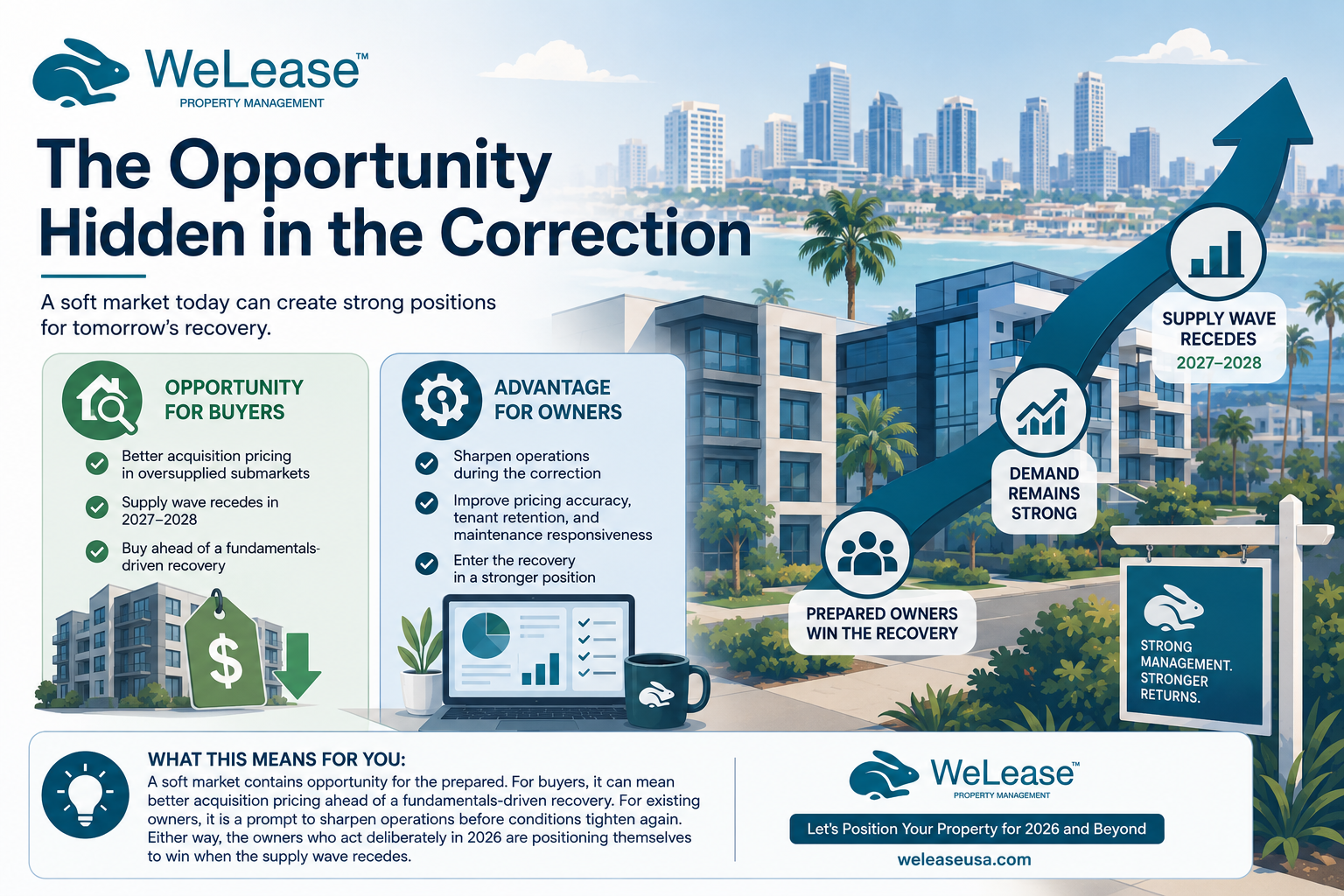
It is worth naming directly: for prepared owners, a soft market is not only a challenge. It contains real opportunity.
Softer conditions can mean better acquisition pricing for investors looking to buy, especially in submarkets hit hardest by oversupply. With the supply wave set to recede into 2027 and 2028, buying into a temporarily soft market ahead of a fundamentals-driven recovery is a classic long-term play, the kind of hold-and-improve strategy we explored in neighborhood cycles.
Landlords are also looking to property management for more than financial performance. The PM Trends Report 2026 found that stress relief and maximizing cash flow were tied as the top reasons owners hire a property manager, at 32% each.
For existing owners, the correction is a prompt to sharpen operations, exactly the discipline that pays off most when conditions eventually tighten again. The owner who uses 2026 to improve pricing accuracy, tenant retention, and maintenance responsiveness enters the recovery in a far stronger position than the one who simply waits and hopes.
The correction rewards the prepared and punishes the passive. That has always been true. In 2026, it is just more visible.
What this means for you: A soft market contains opportunity for the prepared. For buyers, it can mean better acquisition pricing ahead of a fundamentals-driven recovery. For existing owners, it is a prompt to sharpen operations before conditions tighten again. Either way, the owners who act deliberately in 2026 are positioning themselves to win when the supply wave recedes.
The Bottom Line for San Diego Landlords in 2026
The market has turned, but the sky has not fallen.
Rents have softened, vacancy has risen, and tenants have leverage they have not had in years. But the cause is a temporary supply wave that is already receding, against demand fundamentals that remain intact. This is a correction with a visible end, not a structural decline.
What has genuinely changed is that management now matters in a way it did not when everything leased itself. The properties that are priced accurately, marketed well, maintained responsively, and managed for retention are holding their performance. The ones relying on a hot market to cover operational gaps are feeling the softness acutely.
2026 is, in the clearest terms, the year that good management separates the winners from the losers. The market will recover. The question is which owners will be positioned to benefit when it does.
Talk to Yesenia and Billy

If you are feeling the softness in your own property, or you simply want to make sure you are positioned to hold performance through this correction and benefit from the recovery, that is exactly the conversation we have with owners every day.
At WeLease, we work with San Diego property owners across the county. We track the market closely, we know what is actually leasing right now and at what price, and we manage for exactly the things that matter most in a soft market: accurate pricing, tenant retention, fast maintenance, and professional marketing. In a market where management is the deciding factor, that is precisely where we focus.
If you want a clear read on how your property is positioned for the current market and the recovery ahead, reach out.
www.WeLeaseUSA.com | (619) 876-0753
Key Takeaways
- For the first time in fifteen years, San Diego rents fell. Vacancy has risen to around 5.7%, the highest since 2009, with downtown reaching roughly 10%.
- The cause is a supply wave, not a demand collapse. San Diego absorbed about 6,200 new units in 2025, more than double the prior year and well above the historic average.
- This is a turn, not a permanent trend. Units under construction fell 24% year over year in Q1 2026, and pressure is expected to ease in 2027 and 2028.
- In a soft market, execution matters far more. Overpricing, slow maintenance, weak marketing, and high turnover all carry real costs that a hot market forgave.
- Winning landlords are pricing accurately, prioritizing retention, responding to maintenance fast, marketing professionally, and meeting rising tenant expectations.
- The correction contains opportunity: better acquisition pricing for buyers ahead of recovery, and a prompt for existing owners to sharpen operations before conditions tighten again.
- 2026 is the year good management separates the winners from the losers. The market will recover, and the prepared owners will benefit most.
Frequently Asked Questions
Are San Diego rents going down in 2026?
Yes, modestly. San Diego saw its first annual rent decline in fifteen years, with rents falling month-over-month for six consecutive months through late 2025. The declines are not dramatic, but the direction has clearly reversed from the double-digit growth of 2021 and 2022. The cause is a wave of new supply, not a collapse in demand.
Why is vacancy rising in San Diego?
Because of new supply. San Diego County absorbed around 6,200 new multifamily units in 2025, more than double the prior year and well above the roughly 3,000 it historically absorbs annually. These buildings were greenlit during the low-vacancy years of 2020 to 2022 and came online into a cooling market. Vacancy has risen to about 5.7%, the highest since 2009.
Is the San Diego rental market going to recover?
Most indicators point to yes. The current softness is driven by a temporary supply wave that is already receding, units under construction fell 24% year over year in early 2026, while demand fundamentals like the job market, universities, and coastal desirability remain intact. Pressure is expected to ease in 2027 and 2028 as the oversupply is absorbed.
How can landlords protect their returns in a soft market?
By focusing on execution. Price accurately to current market data rather than last year’s rents, prioritize keeping good tenants, respond to maintenance quickly, and market the property professionally across every channel. In a soft market, these operational fundamentals are the difference between a property that holds its performance and one that sits vacant.
Is 2026 a good time to buy San Diego rental property?
It can be, for a prepared long-term investor. Softer conditions can mean better acquisition pricing, especially in submarkets hit hardest by oversupply. With the supply wave expected to recede into 2027 and 2028 against intact demand fundamentals, buying into a temporarily soft market ahead of a recovery is a classic long-term strategy. As always, the specific property and numbers determine whether a given deal makes sense.
Disclaimer: This article is intended for general informational purposes only and draws on publicly available market data as of mid-2026. It does not constitute legal, financial, or investment advice. Market conditions change frequently and forecasts are inherently uncertain. For guidance specific to your property and situation, please consult a qualified real estate or financial professional, or contact us at www.weleaseusa.com.
Reviewed by Yesenia Colestock, Co-Founder, WeLease Property Management
Yesenia Colestock is the Co-Founder of WeLease, a locally owned and operated property management company serving landlords and investors throughout San Diego County. She leads WeLease’s day-to-day operations and client relationships, with a focus on delivering responsive, practical property management that protects owners’ investments and keeps tenants satisfied for the long term. Under her leadership, WeLease has been recognized as San Diego’s Best Property Management Company by the San Diego Union-Tribune (Winner 2022, 2024; Finalist 2023, 2025) and named a Top 10 Property Management Company in El Cajon and Chula Vista by Expertise.com in 2026. WeLease Credentials: NARPM® Member, BBB Accredited, MLS Participant, Equal Housing Opportunity. DRE: 02047533.

Ivana M. Janakieva is a Property Management Marketer and SEO Content Manager who turns confusing real estate jargon into practical, actionable advice. She’s the type who reads maintenance reports like morning news and can make lease agreement clauses sound (almost) fun. With years of experience writing about everything from tenant turnover and landlord-tenant laws to climate risks and curb appeal ROI, Ivana creates content for people who want straight answers about protecting and profiting from their most valuable asset, their property.