Point Loma Rentals: Military Demand, Waterfront Premiums, and a Built-Out Market Reinventing Itself
Home / Point Loma Rentals: Military Demand, Waterfront Premiums, and a Built-Out Market Reinventing Itself
Point Loma Rentals: Military Demand, Waterfront Premiums, and a Built-Out Market Reinventing Itself
Most San Diego neighborhoods have one story. Point Loma has three running at once.
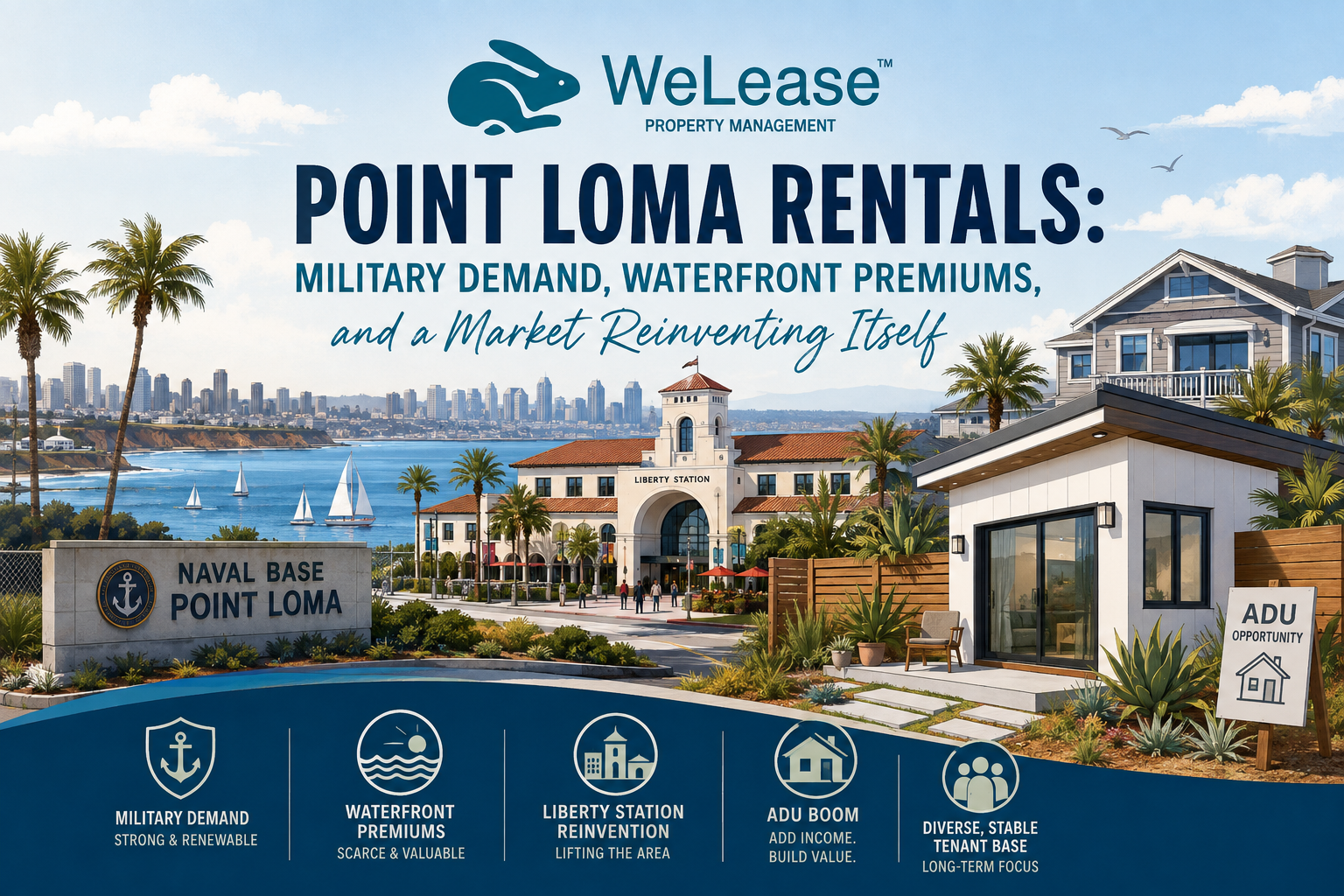
There is the waterfront story: a peninsula wrapped by the Pacific on one side and San Diego Bay on the other, with view premiums that few neighborhoods in the county can match. There is the military story: a large, steady, renewable base of Navy renters anchored by Naval Base Point Loma. And there is the reinvention story: a mature, built-out neighborhood that owners are actively upgrading, converting, and adding to, from Liberty Station’s transformation to a wave of new backyard units.
For landlords, that combination is rare and durable. Point Loma is not a market that swings wildly. It is a market with deep, diversified demand and fundamentals that hold through cycles. Understanding all three of its stories is the key to owning well here. Here is what you need to know in 2026.
Point Loma at a Glance
| Factor | Point Loma 2026 |
|---|---|
| Median detached home price | ~$1.78M |
| Median condo/townhome price | ~$1.1M |
| Inventory | Tight (~2.3 months) |
| Location | Coastal peninsula between the Pacific and San Diego Bay |
| Typical tenant profile | Military (Navy), professionals, families, long-term renters |
| Key demand drivers | Naval Base Point Loma, waterfront, Liberty Station |
| Notable trend | ADU boom, ~75 ADU permits issued in a recent 12-month span |
| Best fit | Durable long-term hold, view-premium and military-demand positioning |
Source: WeLease Team, updated 2026. Home price and permit data via San Diego Association of REALTORS FastStats and City of San Diego permit records.
Those numbers describe a premium, supply-constrained coastal market. Point Loma is not an affordable submarket, and it is not trying to be. It is a durable, high-value peninsula with demand drivers that most neighborhoods simply do not have.
Why Military Demand Makes Point Loma Different
The single most distinctive feature of the Point Loma rental market is the military demand anchored by Naval Base Point Loma. For landlords, this is a genuine and underappreciated advantage.
Military renters bring a set of qualities that landlords value highly. Their housing is supported by the Basic Allowance for Housing (BAH), a dependable, government-backed source of income that adjusts with the market. According to Department of Defense figures, 2026 BAH rates rose an average of 4.2% nationwide, effective January 1, and BAH counts as qualifying income during screening. That means a service member’s ability to pay is backed by a stable, predictable allowance rather than fluctuating employment income.
Military demand is also renewable. The permanent change of station (PCS) cycle means a steady flow of incoming service members needing housing, year after year, regardless of the broader economy. Education and defense demand tend to be recession-resistant, and Point Loma benefits from both.
There are considerations that come with military tenancies, most notably the federal Servicemembers Civil Relief Act (SCRA), which provides certain protections, including the ability to terminate a lease early under qualifying orders. Landlords who understand and plan for these rules do well with military renters. Those who are caught off guard by them sometimes struggle.
Here is how Billy Colestock, WeLease Co-Founder and REALTOR®, frames the military-demand advantage:
“As an investor, the military demand in Point Loma is one of the most reliable things you can build around. BAH is a dependable, government-backed source of income that adjusts with the market, so you’re not betting on one tenant’s job staying steady. And the PCS cycle refills the demand every single year. The tradeoff is that you have to know the rules, the SCRA lease-termination protections especially, and build them into how you operate. Handle that well, and it’s some of the most durable demand in all of San Diego.”
What this means for you: Military demand gives Point Loma a stable, renewable, government-backed source of tenants that few neighborhoods can match. The key is understanding the rules that come with it, especially the SCRA. Handled well, a military tenant base is one of the most dependable foundations a landlord can have.
The Waterfront and View Premium
Point Loma’s coastal geography creates real, quantifiable value that landlords should understand and price for.
The peninsula’s position between the ocean and the bay means a meaningful share of its properties have water views, bay views, or coastal proximity, and tenants pay a premium for them. Ocean-view and bay-view properties command higher rents than comparable inland units, and the closer a property sits to the water with a clear sightline, the stronger that premium.
This is the same dynamic we explored in depth in our piece on Sunset Cliffs rentals, which sits within the broader Point Loma area. The lesson is the same across the peninsula: a genuine water-view property should be priced against other view properties, not against inland comparables. Anchoring a view property to inland pricing usually leaves money on the table.
The waterfront appeal also supports demand stability. Coastal desirability is one of the most durable demand drivers in San Diego real estate. People want to live near the water, and the supply of water-adjacent property on a built-out peninsula cannot expand. That scarcity protects both value and pricing power over time.
What this means for you: If your Point Loma property has a water view or genuine coastal proximity, that is a scarce and valuable asset. Price it against other view properties, feature it prominently in listings, and recognize that the coastal desirability underpinning it is one of the most durable demand drivers in the county.
The Reinvention: Liberty Station, ADUs, and a Built-Out Market Upgrading Itself
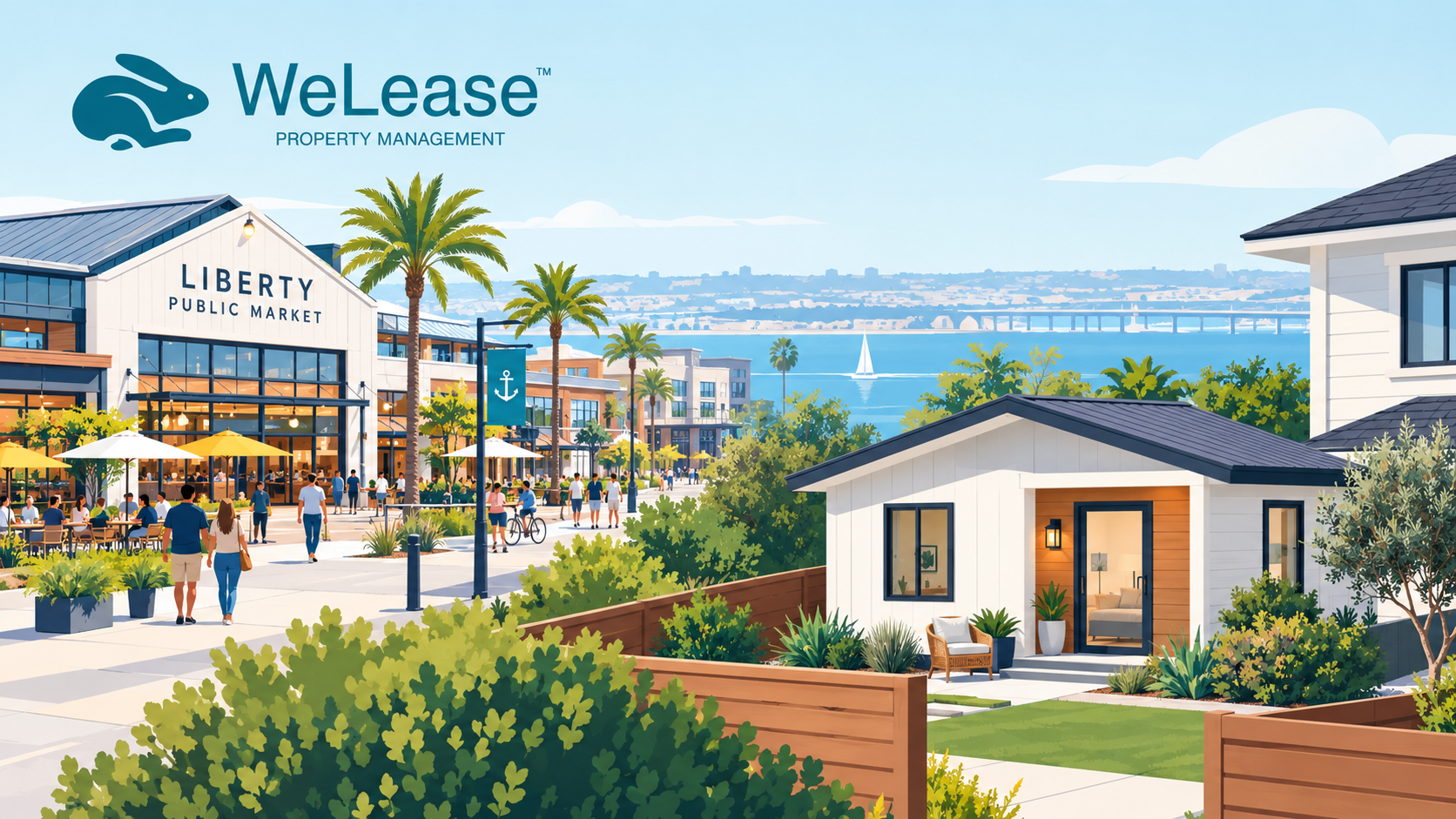
Here is the story that makes Point Loma genuinely interesting in 2026: a mature, built-out neighborhood is not standing still. It is actively reinventing itself, and that creates opportunity for owners.
Liberty Station is the clearest example. The former Naval Training Center has been transformed into a mixed-use district anchored by Liberty Public Market, a food hall in a former Navy mess hall that is celebrating its 10th anniversary in 2026. Liberty Station has become a genuine destination, adding dining, arts, retail, and residential appeal that lifts the desirability of the surrounding area.
The ADU boom is the other major reinvention story. Even in a built-out neighborhood, owners are finding ways to add housing and income. According to City of San Diego permit records, roughly 75 ADU permits were issued in the Peninsula community planning area over a recent 12-month span, a notable number that signals owners adding guest houses, rental units, and detached offices on valuable lots. On a peninsula where land is scarce and expensive, adding an ADU to an existing lot is one of the few ways to expand rental income without buying more property.
This connects directly to our analysis of whether to add an ADU to your San Diego rental. In a high-value market like Point Loma, where the land is already owned and rents are strong, the ADU math can be especially compelling.
Yesenia Colestock, WeLease Co-Founder, on the reinvestment trend:
“What I love about Point Loma from an investment standpoint is that it’s a mature market that keeps finding ways to add value. You’ve got Liberty Station lifting the whole area, and you’ve got owners adding ADUs on lots they already own, which is one of the smartest ways to increase income and property value in a built-out neighborhood. When a property is this well-located and owners are actively reinvesting around you, that’s exactly the kind of long-term equity story a serious investor wants to be part of.”
What this means for you: Point Loma is a rare combination: a built-out, premium coastal market that is also actively reinventing and upgrading itself. Liberty Station lifts the whole area, and the ADU trend offers a genuine path to add income on land you already own. For a long-term owner, that reinvestment momentum is a real tailwind.
Who Rents in Point Loma
The tenant base here is diverse, high-quality, and stable, which is exactly what supports the neighborhood’s durable performance.
- Military renters from Naval Base Point Loma, backed by BAH and renewed through the PCS cycle
- Professionals drawn by the coastal lifestyle, Liberty Station, and proximity to downtown
- Families attracted to the schools, the peninsula’s residential character, and the space
- Long-term renters who have chosen the coastal lifestyle and tend to stay for years
This is not a high-churn, transient renter base. Point Loma tenants tend to be financially stable and oriented toward longer tenancies, whether they are military families on a multi-year assignment or professionals who have deliberately chosen the peninsula lifestyle. That stability is a meaningful advantage, and it connects directly to why long-term tenants stabilize rental income over time.
What this means for you: Point Loma’s renter base is diverse, financially stable, and oriented toward longer tenancies. Military families, professionals, and long-term coastal renters all tend to stay, which supports predictable income and lower turnover, exactly the profile that rewards management focused on retention.
Staying Compliant in Point Loma
Point Loma sits within City of San Diego limits and, for much of the peninsula, within the California Coastal Zone. That combination means the full stack of rules applies, with an extra coastal layer.
The City of San Diego’s Tenant Protection Ordinance applies here, with its day-one just-cause eviction protections and elevated relocation assistance requirements. AB-1482 applies to most properties built before 2011. The Coastal Zone adds considerations around property modifications and certain rental decisions. And any owner considering short-term rental use faces the STRO ordinance and its caps, which we covered in detail in the STRO and Coastal Zone rules.
Military tenancies add the federal SCRA layer on top of all of this. Understanding how these frameworks interact, city ordinance, state law, Coastal Zone, and federal military protections, is essential for owning here without creating unnecessary exposure. This is the same multi-layered compliance picture we mapped in how local ordinances override state law in San Diego rentals.
What this means for you: Point Loma carries more compliance layers than most San Diego neighborhoods: the City ordinance, state law, the Coastal Zone, and, for military tenancies, the federal SCRA. None of it is unmanageable, but it does require staying current and knowing exactly which rules apply to your specific property and tenant.
The Long-Term Outlook for Point Loma Rentals
The fundamentals here are among the most durable in San Diego.
The military demand is permanent and renewable. The waterfront and coastal desirability cannot be replicated or expanded. The neighborhood is actively reinvesting in itself through Liberty Station and the ADU trend. And the supply is fundamentally constrained by the peninsula’s built-out geography.
Like the rest of San Diego, Point Loma has felt some of the broader market softening in 2026, but its diversified, high-quality demand base and irreplaceable location make it one of the neighborhoods best positioned to hold performance and recover as the countywide supply wave recedes. For a landlord focused on a durable, long-term hold with a stable and diversified tenant base, Point Loma remains one of the most compelling coastal options in the county.
Talk to Yesenia and Billy

If you own a rental in Point Loma or are considering investing on the peninsula, we would be glad to talk through the specifics, including the military-demand dynamics, the view-premium pricing, and the ADU opportunity.
At WeLease, we work with San Diego property owners across the county, including the coastal and military-adjacent neighborhoods where the demand drivers and compliance requirements are most distinctive. We know how to position a Point Loma property, price its coastal premium accurately, manage a military tenant base under the SCRA, and keep quality tenants in place for the long term.
If you want a clear read on how your Point Loma property is positioned, reach out.
www.WeLeaseUSA.com | (619) 876-0753
Key Takeaways
- Point Loma has three overlapping demand stories: waterfront premiums, a large military renter base, and an active reinvention through Liberty Station and the ADU trend.
- Military demand anchored by Naval Base Point Loma is stable and renewable, backed by BAH (up 4.2% on average in 2026) and refreshed each year through the PCS cycle. The federal SCRA applies to military tenancies.
- Waterfront and view premiums are real. Water-view properties should be priced against other view properties, not inland comparables. Coastal desirability is a durable demand driver.
- The neighborhood is reinventing itself. Liberty Station lifts the whole area, and roughly 75 ADU permits were issued in the Peninsula planning area in a recent 12-month span, offering a path to add income on existing lots.
- Median detached home prices sit around $1.78M with tight inventory. This is a premium, supply-constrained market, not an affordable one.
- The renter base, military, professional, family, and long-term, is diverse, financially stable, and oriented toward longer tenancies.
- Point Loma carries multiple compliance layers: the City ordinance, state law, the Coastal Zone, and the federal SCRA for military tenancies.
Frequently Asked Questions
Is Point Loma a good neighborhood to own a rental property in 2026?
Yes, for a landlord focused on a durable, long-term coastal hold. Point Loma combines a stable, renewable military renter base, genuine waterfront premiums, and an active reinvestment trend through Liberty Station and ADUs. It is a premium, supply-constrained market with diversified demand that positions it to hold performance and recover well as the broader market stabilizes.
Why is military demand important for Point Loma landlords?
Naval Base Point Loma anchors a large, renewable base of military renters whose housing is supported by the Basic Allowance for Housing (BAH), a dependable, government-backed source of income that counts as qualifying income during screening. The permanent change of station (PCS) cycle renews this demand every year. Military tenancies do carry the federal Servicemembers Civil Relief Act (SCRA), so landlords should understand those protections, but the demand itself is exceptionally stable.
How much does it cost to rent or buy in Point Loma?
Point Loma is a premium market. The median detached home price is around $1.78 million and condos and townhomes around $1.1 million, with tight inventory. Rents reflect this premium, especially for water-view and coastal-proximity properties. It is not an affordable submarket, but its durable demand and constrained supply support strong long-term fundamentals.
Can I add an ADU to my Point Loma property?
Often yes, and many owners are doing exactly that, with roughly 75 ADU permits issued in the Peninsula planning area in a recent 12-month span. On a built-out, high-value peninsula where land is scarce, adding an ADU to an existing lot is one of the few ways to expand rental income without buying more property. The 2026 rule changes, including the end of owner-occupancy requirements for standard ADUs, have made this especially attractive. Coastal Zone considerations may apply to your specific lot.
What compliance rules apply to Point Loma rentals?
Point Loma sits within City of San Diego limits and largely within the California Coastal Zone, so the City’s Tenant Protection Ordinance, AB-1482 (for most pre-2011 properties), and Coastal Zone considerations all apply. Short-term rentals face the STRO ordinance. Military tenancies also carry the federal Servicemembers Civil Relief Act. Understanding how these layers interact is essential for compliant ownership.
Disclaimer: This article is intended for general informational purposes only and draws on publicly available market data as of mid-2026. It does not constitute legal, financial, or tax advice. Market conditions, Coastal Zone rules, and military housing regulations change frequently. For property-specific guidance, please consult a qualified California real estate professional or licensed legal advisor, or contact us at www.weleaseusa.com.
Reviewed by Billy Colestock, Co-Founder & Executive Officer, WeLease | REALTOR® DRE# 01771188
Billy Colestock brings over 20 years of real estate experience to his leadership role at WeLease Property Management. As a licensed REALTOR® and Co-Founder of WeLease, he is a trusted voice in the San Diego real estate community and regularly leads educational sessions at the San Diego Association of REALTORS® (SDAR) on topics including evictions, tenant screening, maintenance, and housing regulations. He is a member of the National Association of REALTORS® and the California Association of REALTORS®, and serves as President of his HOA. WeLease has been recognized as San Diego’s Best Property Management Company by the San Diego Union-Tribune (Winner 2022, 2024; Finalist 2023, 2025) and named a Top 10 Property Management Company in El Cajon and Chula Vista by Expertise.com in 2026. WeLease Credentials: NARPM® Member, BBB Accredited, MLS Participant, Equal Housing Opportunity. DRE: 02047533.

Ivana M. Janakieva is a Property Management Marketer and SEO Content Manager who turns confusing real estate jargon into practical, actionable advice. She’s the type who reads maintenance reports like morning news and can make lease agreement clauses sound (almost) fun. With years of experience writing about everything from tenant turnover and landlord-tenant laws to climate risks and curb appeal ROI, Ivana creates content for people who want straight answers about protecting and profiting from their most valuable asset, their property.