How to Screen Tenants Without Creating Legal Risk
Home / How to Screen Tenants Without Creating Legal Risk
How to Screen Tenants Without Creating Legal Risk
Here is a scenario that has cost San Diego landlords real money in 2026.
A landlord runs a credit check on one applicant, skips it for another because they “seemed fine,” and approves the second person on a good feeling. Three months later, the first applicant, who was denied, files a fair housing complaint. The landlord had no discriminatory intent. But they cannot prove they applied the same standard to both people, because they did not.
That is how most fair housing violations happen. Not through open discrimination, but through inconsistency. A rule applied to one applicant and not another. A verbal exception with no paper trail. A well-meaning judgment call that becomes impossible to defend later.
Tenant screening is one of the highest-stakes things a landlord does, and in 2026 the legal rules around it are stricter than ever. The good news is that compliant screening is not complicated. It comes down to a few principles applied consistently and documented properly. Here is how to screen well without creating legal risk.
Why Is Tenant Screening Such a Legal Minefield in 2026?
The short version: California has some of the strictest fair housing laws in the country, enforcement is complaint-driven, and the penalties are severe.
California’s Fair Employment and Housing Act (FEHA) goes well beyond federal protections. It covers the standard federal protected classes and adds more, including source of income, veteran and military status, and others. On top of that, the City of San Diego layers its own protections.
The critical thing to understand about enforcement is that it is not audit-based. It is complaint-driven. The biggest risk is not a government inspector showing up. It is a denied applicant who felt they were treated unfairly and files a complaint. And they can do so months, sometimes years, after the denial.
What is at stake when screening goes wrong:
- Fair housing complaints and investigations
- Statutory penalties and damages
- Attorney’s fees, which under some statutes are mandatory
- Reputational damage in a competitive rental market
At the same time, a single bad tenant, one who requires an eviction, damages the property, or stops paying, can cost tens of thousands of dollars. So landlords are caught between two risks: screen too loosely and get a bad tenant, or screen inconsistently and create legal exposure.
The solution to both is the same: a rigorous, consistent, documented process.
What this means for you: Screening risk in 2026 is not about intent. It is about consistency and documentation. The landlord who applies the same written criteria to everyone and keeps records is protected. The one who makes case-by-case judgment calls is exposed, even when acting in good faith.
The Foundation: Written Criteria Applied Consistently
Everything in compliant screening rests on one principle: establish your screening criteria in writing before you advertise, and apply them identically to every single applicant.
This is the single most important thing a landlord can do. When criteria are documented and applied consistently, most fair housing risk evaporates. When they are applied inconsistently, even unintentionally, the exposure is significant.
What legally defensible screening criteria look like:
- Credit standards: A minimum score (most landlords set between 600 and 680) applied to everyone
- Income requirements: A standard ratio, typically 2.5 to 3 times the monthly rent, applied uniformly
- Rental history: Verified references from prior landlords, requested for every applicant
- Background checks: Conducted consistently and within legal limits (more on this below)
The rule is simple to state and essential to follow: if you require a 650 credit score and 3x income from one applicant, you require it from every applicant. If you check one person’s rental references, you check everyone’s. Selectivity is where the legal exposure lives.
“Every applicant goes through the exact same process, in the same order, measured against the same written criteria. That consistency is the whole point. If we ever had to defend a decision, we can show that the person who was approved and the person who was declined were evaluated against identical standards. Document everything, apply it to everyone, and the fair housing risk mostly takes care of itself.”
Yesenia Colestock
What this means for you: Write your criteria down before you list the property. Apply them to everyone, no exceptions. This one habit is the strongest legal protection available to a landlord, and it costs nothing but discipline.
The Source of Income Rule That Trips Up So Many Landlords
This is one of the most common and costly screening mistakes in California, and it is worth being very clear about.
Under SB 329, source of income is a protected class in California. That means a landlord cannot reject an applicant simply because they use a housing voucher, such as Section 8, or other lawful government assistance. A blanket “no Section 8” policy is illegal, and writing it in a listing is a clear violation.
But here is the part landlords often miss, in both directions:
Source of income protection does not mean you must accept unqualified voucher holders. You can still apply your standard screening criteria, credit, rental history, background, to a voucher applicant. What you cannot do is reject them because of the voucher.
There is also a specific calculation rule. When an applicant uses a voucher, you must calculate their income requirement based only on the portion of the rent they are personally responsible for, not the full contract rent. Applying your 3x income standard to the full rent, when the tenant only pays a fraction of it, is a violation.
What this means for you: You can screen a voucher holder against the same credit, rental history, and background standards as anyone else. You cannot reject them for using the voucher, and you must calculate income based on their portion of the rent. Getting this wrong is one of the most frequent fair housing violations in California.
Criminal History: Individualized Assessment, Not Blanket Bans
The rules around criminal history in screening have tightened significantly, and blanket policies are now legally indefensible.
HUD guidance established that blanket criminal record bans can violate the Fair Housing Act through disparate impact, because criminal records disproportionately affect certain protected groups. California requires an individualized assessment rather than an automatic rejection.
What this means in practice:
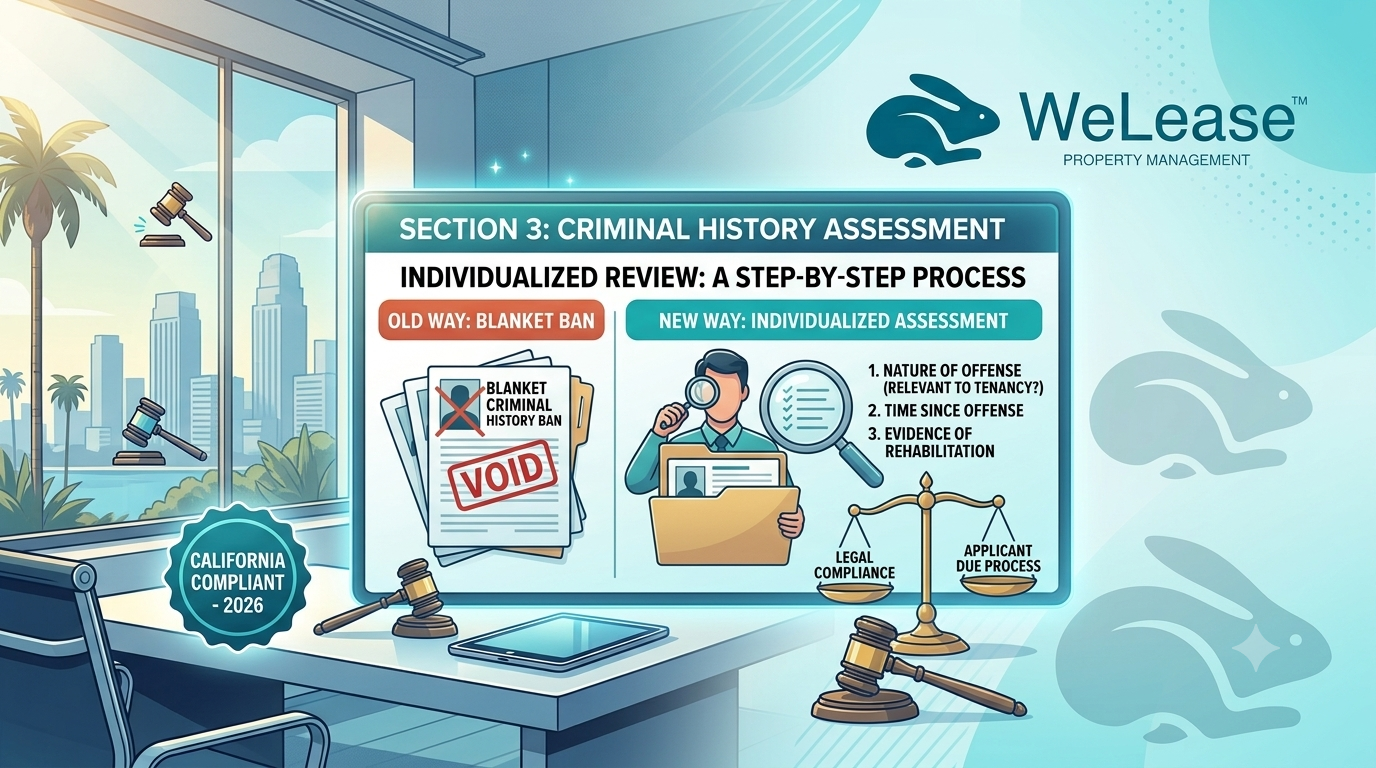
- “We don’t rent to anyone with any conviction” is legally indefensible
- You may consider criminal history, but the assessment must be individualized
- Relevant factors include the nature and severity of the offense, how long ago it occurred, and whether it bears on tenancy risk
- You cannot consider arrests that did not lead to conviction
A decades-old minor offense is materially different from a recent conviction directly relevant to tenancy risk, and the law expects landlords to make that distinction rather than applying a one-size-fits-all rule.
“Blanket bans are gone, and honestly, they were never good risk management anyway. What I care about as an investor is whether this person is likely to pay rent and take care of my property. That’s an individualized question. Look at what the offense actually was, how long ago it happened, and whether it has any real bearing on tenancy. Focus on the criteria that predict a good tenancy, credit, income, verified rental history, and let those do the work.”
Billy Colestock
What this means for you: Blanket criminal history bans are off the table in California. If you consider criminal history at all, it must be an individualized assessment tied to genuine tenancy risk, and you cannot consider arrests without convictions. When in doubt, focus on the criteria most directly predictive of a successful tenancy: credit, income, and verified rental history.
The FCRA Steps Most DIY Landlords Skip
When you screen using credit reports and background checks, federal law, the Fair Credit Reporting Act (FCRA), imposes specific requirements that many self-managing landlords do not know about.
The FCRA essentials:
Written consent. You must have signed authorization from the applicant before running a credit or background check. An oral “okay” is not enough and creates a violation.
Adverse action notice. If you deny an applicant based on information in a credit or screening report, you must send a proper adverse action notice. This identifies the reporting agency, explains the applicant’s right to dispute the information, and includes the required Summary of Rights. This is not optional.
The penalties are real. FCRA violations can carry statutory damages, punitive damages, and mandatory attorney’s fees. That attorney’s fee provision is what makes these claims aggressive.
The protection is straightforward: consistent written consent, consistent criteria, and compliant adverse action procedures essentially eliminate this category of risk. The cost is a few extra forms and disciplined record-keeping. The legal protection is comprehensive.
This connects directly to the broader theme of compliance mistakes that trigger audits, complaints, or lawsuits: most exposure comes not from bad intent but from missing a procedural step that a system would have caught.
Advertising: Where Discrimination Claims Often Start
Fair housing risk does not begin at screening. It often begins with the listing itself.
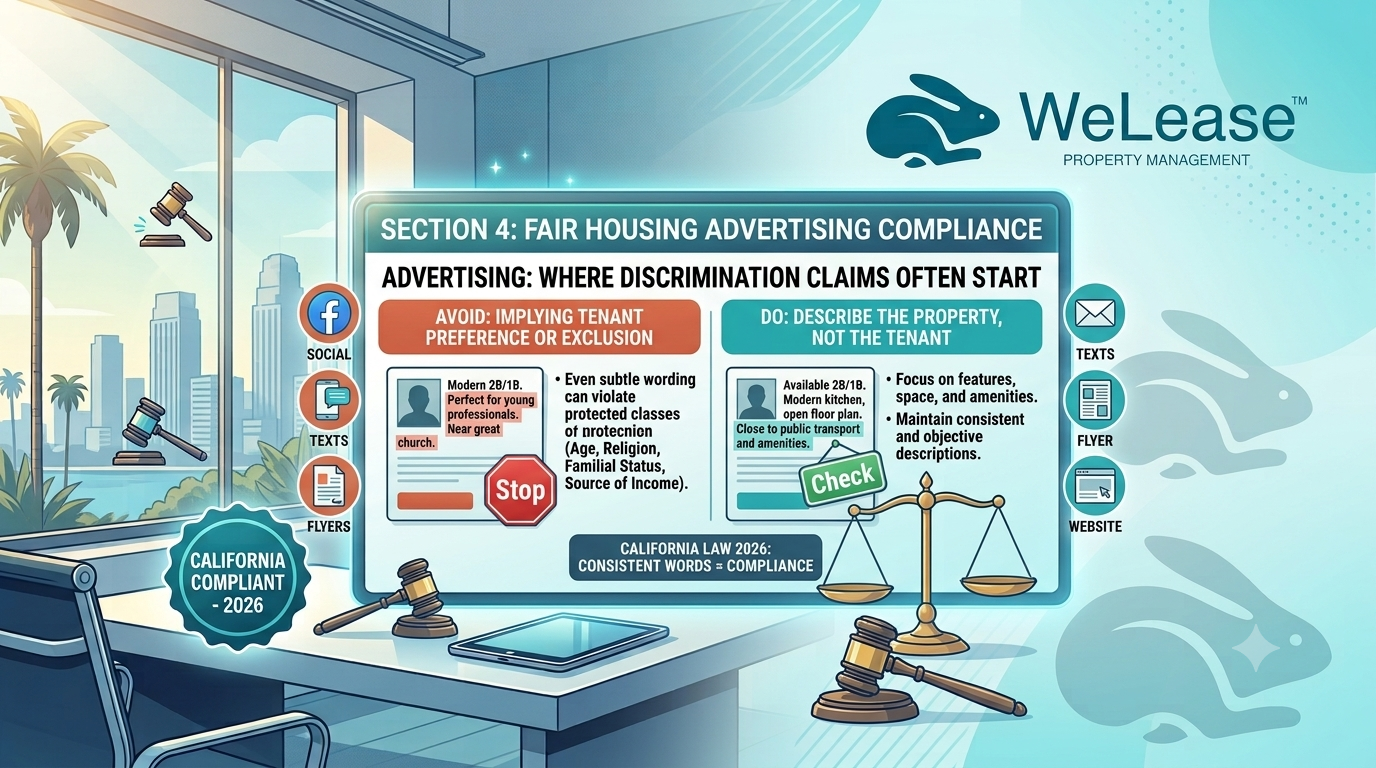
California law in 2026 requires that all marketing, online listings, social media, texts, flyers, and website content, does not imply preference or exclusion based on a protected class. Even subtle or well-intentioned wording can create exposure.
Language that creates risk:
| Problematic Phrase | Why It Is a Problem |
|---|---|
| “Perfect for young professionals” | Implies age discrimination |
| “Great for families” | May discriminate against non-families |
| “No children” | Violates familial status protection |
| “Close to church” | Implies religious preference |
| “No Section 8” | Violates source of income protection |
Source: WeLease Team, updated 2026
The safe approach: Describe the property, not the tenant. “Two-bedroom unit near public transit.” “Spacious backyard and updated kitchen.” “Top-floor unit with natural light.” Let prospective tenants self-select based on their needs, rather than signaling who you think should apply.
What this means for you: Review every listing before it goes live. Stick to describing the property, its features, its location, and its terms. The moment a listing describes the ideal tenant rather than the property, it creates risk.
First-Come, First-Served: A Simple Protection
One practical habit provides meaningful legal protection: evaluate applicants in the order they apply, and accept the first qualified applicant.
Processing applications out of order, or holding qualified applications to compare candidates, creates an opening for a claim that you selected based on a protected characteristic. A first-come, first-served workflow, documented with timestamps, is much easier to defend.
If you skip a qualified early applicant for a later one without a documented, non-discriminatory reason, you are exposed. A digital timestamp system that records when each application arrived is the cleanest way to prove your process was fair.
What this means for you: Accepting the first qualified applicant, and documenting the order applications arrived, removes a whole category of risk. It also happens to be faster, which reduces vacancy. Good compliance and good business align here.
Documentation: Your Only Defense If a Claim Comes
If there is one theme that runs through every part of compliant screening, it is documentation.
Fair housing complaints can be filed months or even years after a denial. When one comes, your records are your only defense. A landlord who can produce written criteria, dated applications, screening reports, and a clear record of consistent decision-making is in a fundamentally different position than one relying on memory.
What to keep, and for how long:
- Written screening criteria (dated, from before you advertised)
- Every application, accepted and rejected
- All screening reports
- Records of every decision and the criteria it was based on
- Adverse action notices
- Correspondence with applicants
Retain these records for at least four years, which aligns with the statute of limitations for fair housing claims, and store them securely, since they contain sensitive personal information.
“We keep everything: the written criteria, every application, every screening report, and a record of what each decision was based on. We hold those records for years, because a fair housing complaint can come long after the fact, and the documentation is the only thing that protects the owner. If it isn’t written down, it didn’t happen, as far as a dispute is concerned.”
Yuliana Nogales
What this means for you: In a complaint-driven enforcement system, documentation is everything. The landlord who kept records wins disputes the landlord who did not keep records loses, even when both acted identically and in good faith.
Why This Is One of the Strongest Cases for Professional Management
Screening is where the case for professional property management is clearest, because the stakes are high and the requirements are technical.
A professional manager applies written criteria consistently to every applicant, runs credit and background checks in compliance with the FCRA, handles source of income and criminal history rules correctly, verifies income and rental history directly, sends proper adverse action notices, and documents every step. That combination protects the owner from the most common and costly sources of screening liability.
It also produces better tenants. The same rigor that keeps screening compliant, verifying income, checking references, catching fraudulent paystubs, is what keeps bad tenants out. This connects directly to why stable, well-screened tenants are worth more than top-dollar rent: getting the right tenant in the first place is the foundation of everything that follows.
For self-managing landlords, the legal exposure alone is often reason enough to consider professional property management in San Diego. One screening mistake can cost far more than years of management fees.
Talk to Yesenia and Billy

If you are not certain your screening process would hold up to a fair housing challenge, or if you simply want to make sure you are placing the best possible tenants while staying compliant, that is a conversation worth having.
At WeLease, we screen every applicant against consistent, written, legally compliant criteria, and we document every step. We know how to spot fraudulent applications, how to handle source of income and criminal history rules correctly, and how to protect owners from the screening mistakes that create the most exposure.
If you want a clear read on your current process, or want to hand screening off entirely, reach out.
www.WeLeaseUSA.com | (619) 876-0753
Key Takeaways
- Most fair housing violations are unintentional and stem from inconsistent screening, not open discrimination. Consistency and documentation are the strongest legal defenses.
- California’s FEHA protections go beyond federal law and include source of income. Enforcement is complaint-driven, so a denied applicant is the biggest risk.
- Establish written screening criteria before advertising and apply them identically to every applicant. This single habit removes most fair housing risk.
- Source of income is protected. You cannot reject an applicant for using a voucher, and you must calculate income based on the tenant’s portion of the rent, not the full contract rent.
- Blanket criminal history bans are legally indefensible in California. Criminal history requires an individualized assessment, and arrests without convictions cannot be considered.
- The FCRA requires written consent before screening and a proper adverse action notice when denying based on a report. Violations carry statutory damages and mandatory attorney’s fees.
- Advertising must describe the property, not the ideal tenant. Keep all screening records for at least four years, since complaints can be filed long after a denial.
Frequently Asked Questions
Can a landlord reject a tenant with a housing voucher in California?
No. Source of income is a protected class in California under SB 329, so you cannot reject an applicant simply because they use a Section 8 or other housing voucher. You can still apply your standard screening criteria, credit, rental history, background, but the voucher itself cannot be the reason for denial. You must also calculate income requirements based only on the tenant’s portion of the rent.
What is the biggest fair housing risk in tenant screening?
Inconsistency. Applying screening criteria differently from one applicant to another, especially undocumented exceptions, is the most common trigger for fair housing complaints. Enforcement is complaint-driven, so a denied applicant who felt treated unfairly is the primary risk. Written criteria applied identically to everyone, with documentation, is the strongest protection.
Can I run a background check on a tenant in California?
Yes, but with rules. You need written consent before running any credit or background check. Criminal history requires an individualized assessment rather than a blanket ban, and you cannot consider arrests without convictions. If you deny an applicant based on a report, the FCRA requires you to send a proper adverse action notice.
How long should I keep tenant screening records?
At least four years, which aligns with the statute of limitations for fair housing claims. Keep records for every applicant, both accepted and rejected, including applications, screening reports, the criteria each decision was based on, and any adverse action notices. Store them securely, since they contain sensitive personal information. This documentation is your primary defense if a complaint is ever filed.
What screening criteria are legal in California?
You may legally screen based on credit history and score, income (typically 2.5 to 3 times the monthly rent), rental history and landlord references, eviction history, and criminal background within legal limits. The key is that all criteria must be written, applied consistently to every applicant, and directly related to tenancy qualifications, not to any protected characteristic.
Disclaimer: This article is intended for general informational purposes only and reflects California and San Diego rental law as of mid-2026. It does not constitute legal advice. Fair housing and screening laws change frequently and are strictly enforced. For guidance specific to your situation, consult a qualified California real estate attorney or licensed property management professional, or contact us at www.weleaseusa.com.
Reviewed by Yesenia Colestock, Co-Founder, WeLease Property Management
Yesenia Colestock is the Co-Founder of WeLease, a locally owned and operated property management company serving landlords and investors throughout San Diego County. She leads WeLease’s day-to-day operations and client relationships, with a focus on delivering responsive, practical property management that protects owners’ investments and keeps tenants satisfied for the long term. Under her leadership, WeLease has been recognized as San Diego’s Best Property Management Company by the San Diego Union-Tribune (Winner 2022, 2024; Finalist 2023, 2025) and named a Top 10 Property Management Company in El Cajon and Chula Vista by Expertise.com in 2026. WeLease Credentials: NARPM® Member, BBB Accredited, MLS Participant, Equal Housing Opportunity. DRE: 02047533.

Ivana M. Janakieva is a Property Management Marketer and SEO Content Manager who turns confusing real estate jargon into practical, actionable advice. She’s the type who reads maintenance reports like morning news and can make lease agreement clauses sound (almost) fun. With years of experience writing about everything from tenant turnover and landlord-tenant laws to climate risks and curb appeal ROI, Ivana creates content for people who want straight answers about protecting and profiting from their most valuable asset, their property.