How Local Ordinances Override State Law in San Diego Rentals
Home / How Local Ordinances Override State Law in San Diego Rentals
How Local Ordinances Override State Law in San Diego Rentals
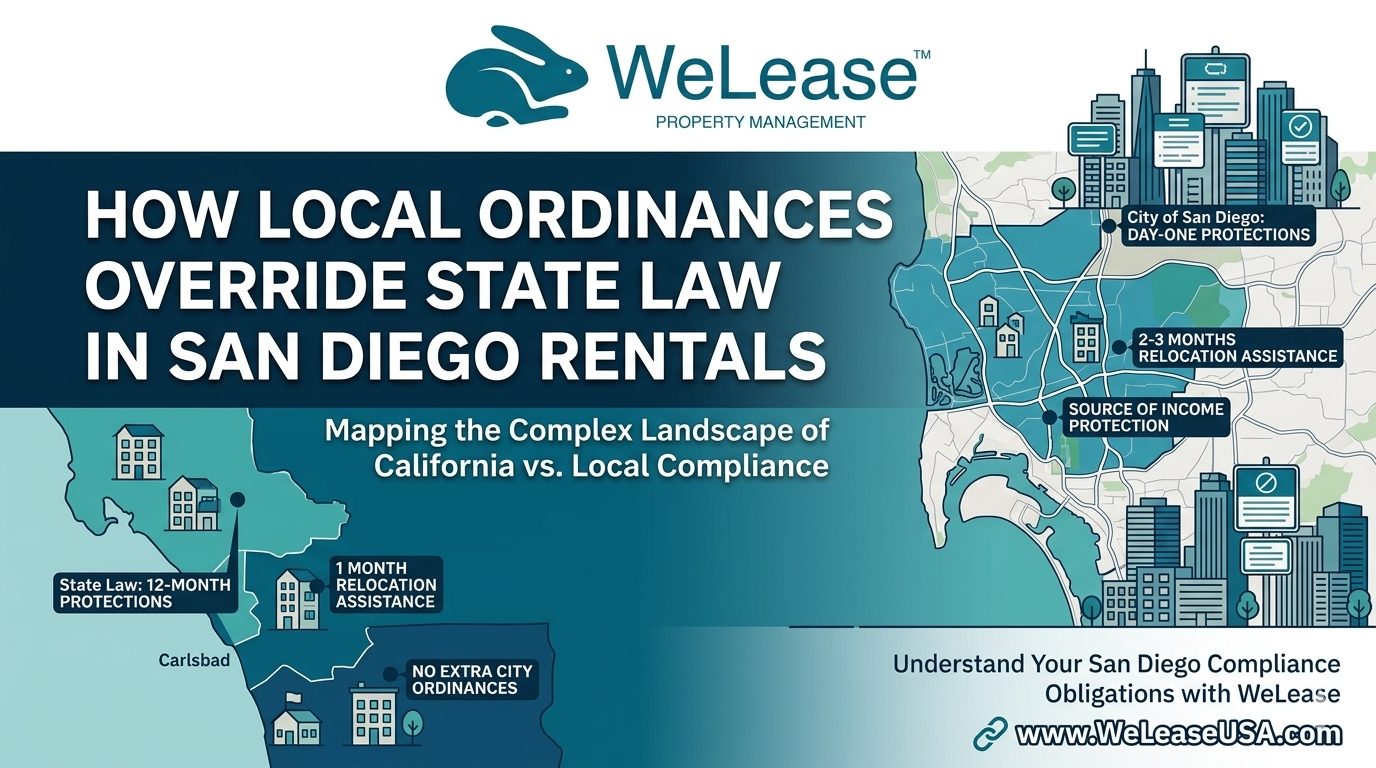
A landlord in Carlsbad and a landlord in the City of San Diego can own near-identical properties, charge similar rents, and be living under completely different rules.
Same county. Same state law in the background. Entirely different compliance obligations on the ground.
That gap is not a technicality. It is where expensive mistakes get made – usually by owners who assumed that knowing California law meant knowing their obligations.
It does not. California sets the floor. Local ordinances build on it. And in San Diego County, what you are actually required to do depends on which city your address falls under, when your building was constructed, and what type of property it is.
This article explains how the layers work, where they diverge, and what it costs when owners get them wrong.
Quick Summary: What San Diego Landlords Need to Know
If you want the short version before reading the full breakdown, here it is.
California state law (AB-1482) applies to everyone. It sets the baseline for rent increases, just-cause evictions, and notice requirements.
Local ordinances can add more. They cannot reduce tenant protections below state law – but they can require significantly more.
The City of San Diego has done exactly that. Its Tenant Protection Ordinance changes three things in ways that catch landlords off guard:
- Just-cause eviction protections start on Day 1 of the lease (not after 12 months)
- Relocation assistance is 2 months’ rent for most no-fault evictions (state law requires only 1)
- Getting it wrong can mean triple damages plus attorney’s fees
Most other San Diego County cities have not added local ordinances. In Carlsbad, Encinitas, Chula Vista, and most North County cities, AB-1482 is the full framework.
The strictest applicable rule always governs. When state law and a local ordinance both apply, follow whichever one protects the tenant more.
State Law vs. City of San Diego Ordinance: Side-by-Side
This is the comparison most landlords wish they had seen earlier.
| California State Law (AB-1482) | City of San Diego Ordinance (SDMC §§ 98.0701–98.0709) | |
|---|---|---|
| Just-cause eviction applies | After 12 months of tenancy | From Day 1 of the lease |
| Relocation assistance (no-fault) | 1 month’s rent | 2 months’ rent (most tenants) |
| Relocation – elderly/disabled | 1 month’s rent | 3 months’ rent |
| Penalty for getting it wrong | Repayment of excess + damages | 3x the required amount + attorney’s fees |
| Source of income discrimination | Not uniformly prohibited | Prohibited (housing vouchers protected) |
| Tenant Protection Guide required | No | Yes – must be given at lease signing |
| Termination Notice Registry | No | Yes – file within 3 business days |
| Properties covered | Most units built before 2011 | Most units in City of San Diego limits |
Source: WeLease Team, updated 2026
Bottom line: If your property is inside City of San Diego limits, you are following both columns simultaneously. Missing the right column is where the liability starts.
Layer 1: What California State Law Actually Requires
Before local ordinances add anything, state law establishes what every California landlord must follow.
The main law is AB-1482 – the Tenant Protection Act of 2019.
It applies to most residential rental properties where the certificate of occupancy was issued at least 15 years ago. As of 2026, that means properties built before 2011.
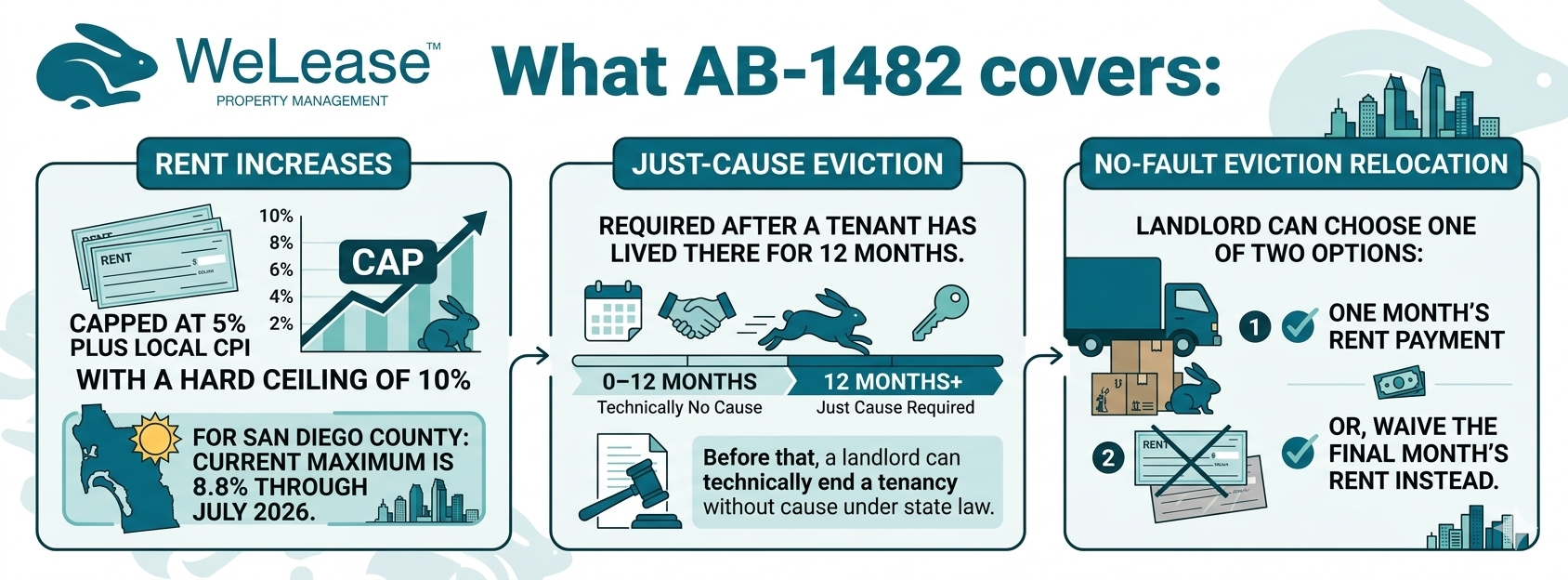
What AB-1482 covers:
- Rent increases: Capped at 5% plus local CPI, with a hard ceiling of 10%. For San Diego County, the current maximum is 8.8% through July 2026.
- Just-cause eviction: Required after a tenant has lived there for 12 months. Before that, a landlord can technically end a tenancy without cause under state law.
- No-fault eviction relocation: One month’s rent, or the landlord waives the final month’s rent instead.
State law also covers notice requirements, habitability standards, security deposit rules, and – as of January 1, 2026 – a requirement to provide a working stove and refrigerator in most residential rentals.
The important thing to understand:
These are minimums. Local jurisdictions can exceed them. Several San Diego cities do.
Layer 2: What the City of San Diego Adds on Top
This is where most landlords inside City of San Diego limits get tripped up.
The City of San Diego’s Residential Tenant Protections Ordinance took effect on June 24, 2023. It applies to properties within City of San Diego limits – not the broader county. That distinction matters enormously and is frequently confused.
Here is what it changes – and why it costs landlords money when missed.
Just-Cause Eviction Starts on Day One
Under state law, a landlord can end a tenancy during the first 12 months without providing a specific reason.
Under the City of San Diego ordinance, that 12-month window does not exist. Just-cause protections apply from the very first day of the lease.
A tenant who moved in last week has the same termination protections as one who has lived there for three years.
A landlord who attempts a no-cause termination during the first year of a covered tenancy faces a civil action for wrongful eviction – with damages of at least three times the tenant’s actual economic losses.
Relocation Assistance Is Higher Than State Law Requires
State law requires one month’s rent for no-fault evictions.
The City of San Diego requires:
- 2 months’ rent for most tenants
- 3 months’ rent for tenants who are elderly (62+) or disabled
On a $2,500 per month Mission Valley or North Park rental, the gap between state and city requirements is $2,500 to $5,000 per no-fault eviction – in additional required payments alone.
Failing to pay the full required amount creates separate civil liability of at least three times the shortfall, plus actual damages and attorney’s fees.
Source of Income Discrimination Is Prohibited
Unde the City ordinance, landlords cannot reject a prospective tenant solely because they use a housing voucher.
A blanket “no Section 8” policy on a property inside City of San Diego limits is not an informal preference. It is a violation – with its own enforcement consequences.
Documentation Requirements at Lease Signing
Every new lease in City of San Diego limits must include:
- A copy of the Tenant Protection Guide from the San Diego Housing Commission
- Required disclosure language about just-cause protections
- Notification of the tenant’s right to relocation assistance
Missing these is a documentation gap. It does not void the lease – but it complicates any future enforcement action involving that tenancy.
What this means for you: If your property is inside City of San Diego limits, your lease template needs to be City-specific. A generic California lease – or one written for a Carlsbad or El Cajon property – is missing required content that matters the moment a dispute arises.
Which San Diego Cities Have Local Ordinances?
San Diego County contains 18 incorporated cities plus unincorporated areas. Each has the authority to enact local ordinances beyond state law. Here is where things stand in 2026.
| Area | Local Ordinance Beyond AB-1482? | Framework |
|---|---|---|
| City of San Diego | ✅ Yes – SDMC §§ 98.0701–98.0709 | State law + City ordinance |
| Carlsbad | ❌ No | AB-1482 only |
| Chula Vista | ❌ No | AB-1482 only |
| Encinitas | ❌ No | AB-1482 only |
| El Cajon | ❌ No | AB-1482 only |
| La Mesa | ❌ No | AB-1482 only |
| Escondido | ❌ No | AB-1482 only |
| Most North County cities | ❌ No | AB-1482 only |
| Unincorporated County areas | ❌ No | County regulations (not city rules) |
Source: WeLease Team, updated 2026
One detail that catches landlords off guard:
Unincorporated San Diego County areas follow county regulations – not the rules of whatever city is nearby. A property just outside City of San Diego limits is not subject to the City’s ordinance, even if it is one block away from the boundary.
Knowing which side of that line your property falls on is the starting point for understanding what you are actually required to do.
When Both Layers Apply, Which One Wins?
The answer is always the same: the stricter rule governs.
California’s preemption doctrine allows cities to exceed state law protections for tenants. It does not allow them to provide fewer protections.
So when state law and a local ordinance both apply to a property, you follow whichever provision protects the tenant more. State compliance does not offset a local gap – and a local gap does not excuse a state violation.
A practical example:
A City of San Diego landlord follows AB-1482 perfectly – correct rent cap, correct notice period, correct relocation calculation under state law.
But they serve a termination notice to a tenant in month eight of the lease, without just cause, because they did not know the city ordinance removed the 12-month window.
The state compliance does not help them. The city ordinance violation stands. And the liability for wrongful eviction starts from the moment the notice was served.
What this means for you: You are always following multiple rules at once. For City of San Diego properties, that means checking both the state framework and the city ordinance before any rent increase, termination notice, or lease renewal. Not one or the other. Both.
The Compliance Mistakes That Actually Cost Landlords Money
Most compliance failures here are not dramatic. They are quiet. And they tend to cluster in the same predictable places.
Using a lease template written for a different jurisdiction. A lease built for a Carlsbad or El Cajon property is missing City of San Diego-specific addenda and disclosure language. Using it for a City of San Diego property is not a minor formatting issue. It is a structural gap in legal documentation that surfaces at the worst possible time.
Serving a termination notice without day-one just-cause language. In the City of San Diego, termination notices must include specific content required by the ordinance – including a description of the basis for termination and a statement of the tenant’s right to relocation assistance. A notice missing any element is defective when served. Courts do not extend grace periods for defective notice language.
Calculating relocation assistance using state law on a city property. A landlord who pays one month’s rent for a no-fault eviction on a City of San Diego property has underpaid by one to two months, depending on the tenant profile. The civil liability for that shortfall is at least three times the amount owed.
Assuming exemptions apply without checking the documentation. Single-family homes and condos can be exempt from AB-1482 – but only if the tenant received the required written exemption notice at the start of the tenancy. Without that documentation, delivered at the right time, the exemption is not enforceable. A landlord who did not provide the notice cannot claim it retroactively.
Managing Properties in Multiple San Diego Jurisdictions? Read This.
Some landlords own rentals in multiple San Diego cities. This is where the variation in local ordinances creates the most complexity.
The compliance checklist for a City of San Diego property is genuinely different from the checklist for a Carlsbad property – even though both are in the same county and subject to the same state law.
The safest approach:
- Jurisdiction-specific lease documentation for each property
- A compliance review each time a renewal or new tenancy begins
- Current tracking of how local ordinances are evolving – not relying on what was accurate two years ago
This structure is difficult to maintain without systems. And the systems are difficult to build without real-time knowledge of how local ordinances change.
It is one of the clearest practical reasons why working with a property management team active across San Diego County changes the risk profile of ownership in a meaningful way.
Talk to Yesenia and Billy

Navigating state law is manageable. Navigating state law plus a local ordinance that modifies it in several significant ways, applied correctly to a specific property at a specific address, is where most landlords need support.
At WeLease, we manage properties across San Diego County every day. We know which ordinances apply to which properties, we track how local rules are evolving, and we build compliance into the lease and management process from the start. If you are not certain whether your current lease documentation reflects the rules that actually govern your property, that is a conversation worth having before a dispute makes it urgent.
Reach out to us at the contact information below. No obligation, just clarity.
www.WeLeaseUSA.com | (619) 876-0753
Disclaimer: This article is intended for general informational purposes only and reflects California and City of San Diego landlord-tenant law as of early 2026. It does not constitute legal advice. Laws and local ordinances change frequently. For guidance specific to your property and situation, consult a qualified California real estate attorney or licensed property management professional, or contact us at www.weleaseusa.com.
Key Takeaways
- California state law (primarily AB-1482) sets the baseline for all San Diego rentals, but local ordinances can and do add requirements that significantly exceed state law.
- The City of San Diego’s Residential Tenant Protections Ordinance (SDMC §§ 98.0701-98.0709), effective June 24, 2023, applies just-cause eviction protections from day one of the tenancy, unlike state law’s 12-month threshold.
- Relocation assistance under the City of San Diego ordinance is two months’ rent for most no-fault evictions, and three months for elderly or disabled tenants. State law requires only one month.
- Failing to provide required relocation assistance under the city ordinance carries civil liability of at least three times the required amount, plus actual damages and attorney’s fees.
- Cities like Carlsbad, Encinitas, and most North County municipalities have not enacted local tenant protection ordinances, meaning AB-1482 is the full framework there.
- Unincorporated San Diego County areas follow county regulations, not city ordinances, regardless of proximity to a city.
- When state law and a local ordinance both apply, the more protective provision always governs.
- Landlords managing properties in multiple San Diego jurisdictions need jurisdiction-specific lease documentation and compliance tracking, not a single template across all properties.
Frequently Asked Questions
Does San Diego have its own rent control on top of state law?
The City of San Diego does not have a separate rent cap ordinance. AB-1482 controls the rent increase limits for covered properties, currently 8.8% through July 2026 for San Diego County. What the city does have is its own Tenant Protection Ordinance that modifies just-cause eviction rules and relocation assistance requirements beyond what state law requires.
When do just-cause eviction protections start in the City of San Diego?
From day one of the tenancy. The City of San Diego’s ordinance eliminates the 12-month window that state law allows before just-cause protections apply. A landlord attempting to terminate a covered tenancy without just cause on day 30, day 90, or day 300 faces the same exposure as one doing so after 12 months.
How much relocation assistance does a San Diego landlord have to pay for a no-fault eviction?
It depends on where the property is. Under state law, one month’s rent is required. Under the City of San Diego ordinance, the requirement is two months’ rent for most tenants, and three months for tenants who are elderly (62 or older) or disabled. If your property is inside city limits, the city rule controls.
What happens if I use the wrong lease template for a City of San Diego property?
A lease missing required disclosures or addenda does not automatically void the tenancy, but it creates a documentation gap that can complicate enforcement actions, termination notices, and any dispute that reaches a hearing. Courts look at what notice was given and when. A defective notice is evaluated at the time it was served, and starting over is the usual outcome.
Do these local ordinance rules apply to single-family homes in San Diego?
It depends on the specific property and how the exemption documentation was handled. AB-1482 exempts separately-titled single-family homes owned by individuals (not corporations), but only if the tenant was properly notified of the exemption in writing at the start of the tenancy. The City of San Diego ordinance has its own applicability criteria under SDMC §98.0701. Assuming you are exempt without verifying the documentation is one of the more common and costly errors in this area.
What is the Tenant Termination Notice Registry?
It is a registry being established by the San Diego Housing Commission under the City of San Diego’s Tenant Protection Ordinance. Landlords are required to file a written notice with the Commission within three business days of serving a termination notice to a tenant. The submission portal is still being implemented as of 2026, but the obligation exists and will carry enforcement weight once the portal is live.
Reviewed by Billy Colestock Co-Founder & Executive Officer, WeLease REALTOR® | DRE# 01771188: Billy Colestock brings over 20 years of experience in real estate to his leadership role at WeLease Property Management. As a licensed REALTOR® and Co-Founder of WeLease, he is a trusted voice in the San Diego real estate community and frequently leads educational sessions at the San Diego Association of REALTORS® (SDAR), covering key topics such as evictions, tenant screening, maintenance, and housing regulations. Billy is also a member of the National Association of REALTORS®, California Association of REALTORS®, and serves as President of his HOA. His depth of expertise ensures WeLease remains proactive, compliant, and highly effective in serving homeowners and investors throughout Southern California | WeLease Credentials: NARPM® Member, BBB Accredited, MLS Participant, Equal Housing Opportunity. Recognized as San Diego’s Best Property Management Company – Union-Tribune Winner (2022, 2024); Finalist (2023, 2025). DRE: 02047533

Ivana M. Janakieva is a Property Management Marketer and SEO Content Manager who turns confusing real estate jargon into practical, actionable advice. She’s the type who reads maintenance reports like morning news and can make lease agreement clauses sound (almost) fun. With years of experience writing about everything from tenant turnover and landlord-tenant laws to climate risks and curb appeal ROI, Ivana creates content for people who want straight answers about protecting and profiting from their most valuable asset, their property.