Get Your San Diego Rental Ready for El Niño (Landlord Checklist)
Home / Get Your San Diego Rental Ready for El Niño (Landlord Checklist)
Get Your San Diego Rental Ready for El Niño (Landlord Checklist)
This winter is not shaping up to be a normal one, and your rental property should be ready for that before the first big storm rolls in off the Pacific.
As of early October, NOAA’s Climate Prediction Center has a strong El Niño advisory in effect, and it is still strengthening. Forecasters expect a strong-to-very-strong El Niño to hold through the heart of winter, and the national winter outlook tilts the odds toward a wetter season across the Southwest. For San Diego, that is the setup that historically brings heavier, more frequent storms and a real jump in flood and water-damage risk.
If you own a rental here, the smart move is to treat the next few weeks as prep time. A roof you patch in October is a few hundred dollars. The same roof failing in January, soaking a tenant’s belongings and feeding mold behind the drywall, is a multi-thousand-dollar emergency with an unhappy tenant attached. Here is what El Niño means for San Diego landlords this year, and exactly what to check before the rain arrives.
What does El Niño actually mean for San Diego this winter?
El Niño is a warming of the central and eastern Pacific that shifts the jet stream and, in strong years, steers more storm systems toward Southern California. NOAA’s current readings put this event firmly in strong territory, with the Climate Prediction Center giving a strong-to-very-strong El Niño a greater than 83% chance of lasting through early 2027. The national winter outlook calls for above-average precipitation to be most likely across the Southwest.
Two caveats worth saying plainly. First, a seasonal outlook is a tilt in the odds, not a promise of any single storm. Second, even a “normal” San Diego winter can do real damage, because the region’s hard, dry soil and aging storm drains struggle to absorb sudden heavy rain. You do not need a record year to have a problem. You need one bad atmospheric river hitting a property that was not ready.
The reason to care this year is simple: the odds of those heavy events are elevated, and the cost of being caught unprepared is almost always higher than the cost of preventing it.
Why does this matter so much for a rental specifically?
Because water damage is one of the most expensive and preventable problems a rental owner faces, and because the clock and the law both work against you once a leak starts.
San Diego’s own recent history makes the point. In January 2024, a single storm became the wettest January day on record for the city, triggered a state of emergency, and flooded homes across Southcrest, Mission Valley, and the Tijuana River Valley. Properties that had never flooded before took on water. For owners, that meant displaced tenants, emergency remediation, and in many cases insurance fights that dragged on for months.
Now layer in your legal obligations. Under California law, a rental has to be “waterproofed and weather-protected,” with a sound roof, intact exterior walls, and unbroken doors and windows. That is not optional, and it is not seasonal. If a tenant reports a leak and it is not addressed within a reasonable time, you are exposed on habitability grounds, a theme we cover in depth in our piece on how local ordinances and state law shape your obligations. A storm does not pause the warranty of habitability. It tests it.
And then there is the quieter cost. Deferred maintenance that turns into storm damage is exactly the kind of avoidable expense we flagged in the hidden costs that quietly kill rental returns. A clogged gutter is free to clear in the fall. The water intrusion it causes in January is not.
The owners who get through storm season without a crisis are the ones who did the boring work in October. We walk the roof, we clear every drain, we check the seals, and we write it all down with dates and photos. When a big storm hits, that documentation is the difference between a quick, defensible repair and a dispute about who knew what and when.
Yuliana, Operations Manager, WeLeaseUSA
The rain-season prep checklist
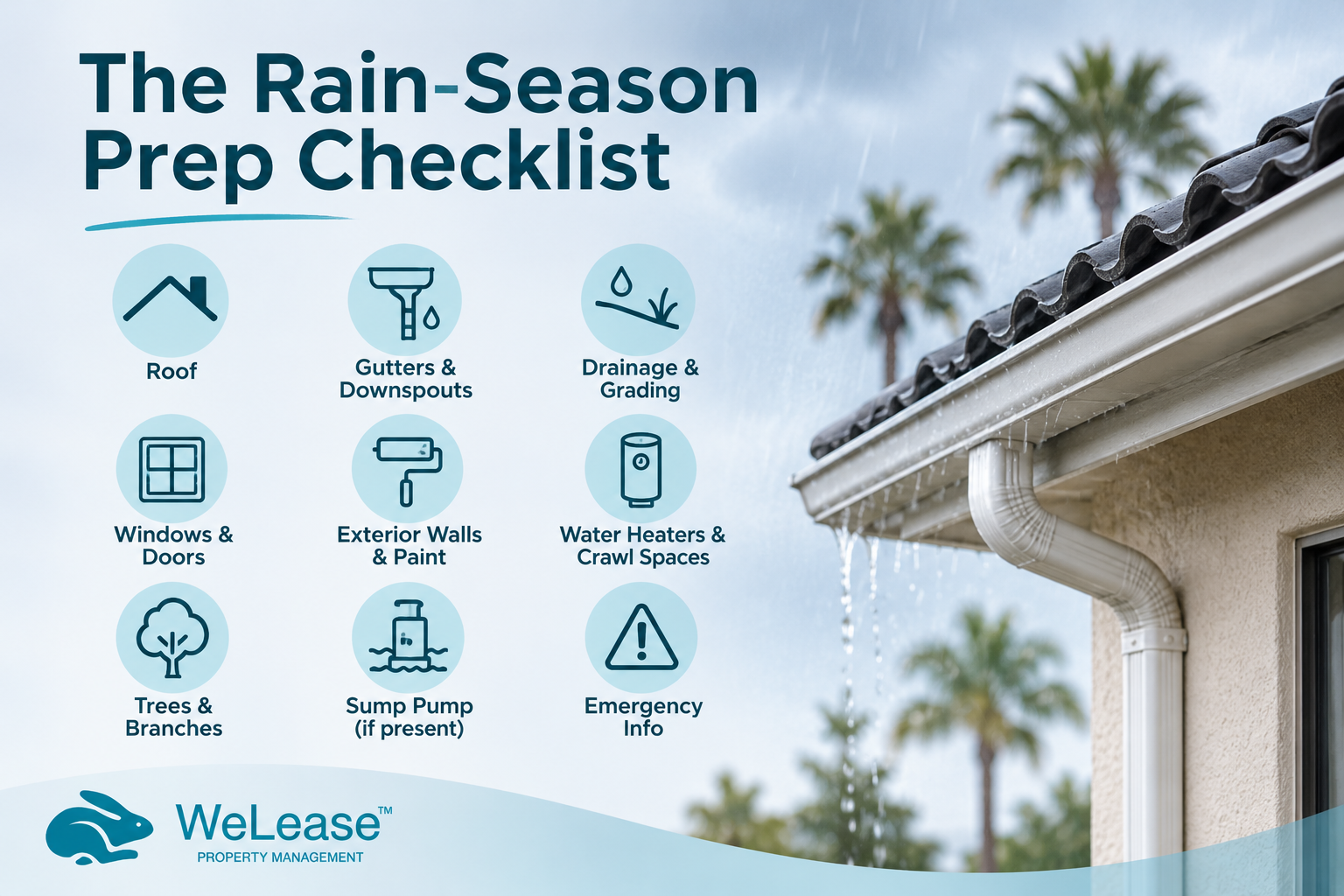
Here is the practical list. Most of it is low-cost and can be knocked out in a weekend or a single vendor visit. The goal is to move water away from the building and keep it out.
| Area | What to check | Why it matters before El Niño |
|---|---|---|
| Roof | Missing, cracked, or lifted shingles or tiles; worn flashing around vents and chimneys | The single biggest source of interior water damage; small gaps fail fast under sustained rain |
| Gutters & downspouts | Clear out leaves and debris; confirm downspouts carry water well away from the foundation | Clogged gutters overflow against walls and pool at the base of the building |
| Drainage & grading | Soil should slope away from the structure; check yard drains and area drains are clear | Standing water against a foundation is how it gets inside |
| Windows & doors | Re-seal gaps, replace cracked caulk and worn weatherstripping | Wind-driven rain finds every gap; also a direct habitability item |
| Exterior walls & paint | Look for cracks, bare wood, or peeling paint that lets moisture in | Weather protection is a legal requirement, not just cosmetic |
| Water heaters & crawl spaces | Elevate water heaters where flooding is possible; check crawl space and garage drainage | Protects costly equipment and prevents hidden standing water |
| Trees & branches | Trim limbs overhanging the roof or near power lines | High winds bring branches down on roofs and lines |
| Sump pump (if present) | Test it now and confirm it actually moves water | A pump you never tested is a pump you cannot rely on |
| Emergency info | Give tenants your after-hours maintenance contact and the local emergency number | Fast reporting keeps a small leak from becoming a big claim |
Source: WeLease Team, updated 2026
What this means for you
If you do nothing else, do these three: clear the gutters and drains, have a roofer check flashing and any suspect shingles, and re-seal windows and doors. Those three address the overwhelming majority of real-world storm leaks, and all three are cheap relative to what they prevent.
How fast you respond during a storm matters as much as the prep
Prevention is most of the battle, but not all of it. When rain is actively coming down, the speed of your response to a tenant’s report is what decides whether a leak becomes a stain or a gut-and-remediate job. Water spreads fast, and mold can start forming within a day or two of moisture getting trapped.
This is where having a real system, or a management company that does, pays for itself. A tenant who can reach someone at 9 p.m. on a Sunday during a downpour, and get a tarp up and a bucket down, is a tenant whose unit, and whose goodwill, you protect. We walk through why that responsiveness drives retention in our article on maintenance response times and tenant retention, and the logic is only sharper in a storm. The tenant you keep through a hard winter is worth far more than the one you lose to a mishandled leak, a point we make the full case for in why stable tenants are worth more than top-dollar rent.
I view storm preparation like any other capital decision: comparing the cost of prevention to the cost of repair. Spending a few hundred dollars in the fall to protect a property worth hundreds of thousands, and the income it generates, is one of the easiest decisions a property owner can make all year. The mistake is treating preparation as optional until the water is already inside.
Billy Colestock, Co-Founder, WeLeaseUSA
What about flood insurance and bigger risks?
Worth a direct word, because owners often assume they are covered when they are not. Standard landlord and homeowner policies typically exclude flood damage, which is treated as a separate line of coverage. If your property sits in or near a flood-prone area, now is the time to check your policy and talk to your agent, not after a storm when a new flood policy may carry a waiting period before it takes effect.
Beyond insurance, know your property’s specific vulnerabilities. A unit near a canyon, a slope, or a known drainage trouble spot deserves extra attention. The City of San Diego publishes storm-readiness guidance and sandbag locations each season, and it is worth knowing where your property stands before the forecast turns.
This is general guidance, not a substitute for advice from your own insurance and legal professionals on your specific property and policy.
How should you budget for storm season before year-end?
Prep is not only a to-do list. It is a line item, and the last weeks of the year are the right time to get ahead of it on both the calendar and the books.
Start with a reserve. A good rule of thumb is to set aside roughly 1% of the property’s value each year for maintenance, or about one dollar per square foot, and to treat storm readiness as a first claim on that fund rather than an afterthought. An owner who has that reserve in place treats a failed water heater or an emergency tarping as a planned expense. An owner who does not treats it as a crisis, and crises get solved at crisis prices.
Timing matters too. Good roofers, gutter crews, and drainage vendors book up fast once the first storm hits and the panic calls start. Scheduling that work now, in the dry weeks, means you get it done on your schedule and often at a better rate than the emergency premium you will pay in January. It is the same principle behind every avoidable expense we flagged in the hidden costs that quietly kill rental returns: the cost of planning ahead is almost always lower than the cost of reacting.
Finally, use the year-end window to plan the bigger items. If the roof is near the end of its life, or a chronic drainage problem keeps resurfacing, map out when you will address it and talk to your tax professional about how repairs and improvements are treated differently, a distinction that can matter for your return. The point is to decide on your terms, with a budget, rather than have a storm decide for you.
What this means for you
Before the year closes, do two financial things: confirm you have a real maintenance reserve, and book your prep vendors now while they are available and before emergency pricing kicks in. Both cost you nothing today and save you real money later.
Talk to Billy and Yesenia

A wet winter does not have to mean a stressful one. The owners who sail through storm season are simply the ones who did the quiet prep work before the forecast turned, and who have someone ready to answer the phone when a tenant calls about a leak at nine on a Sunday night.
If you would rather not spend El Niño season watching the radar and wondering whether your roof will hold, let WeLeaseUSA handle it. Billy, Yesenia, and the team will get your property storm-ready and stay on call through every system that rolls through. Reach out at WeLeaseUSA.com.
Be at ease, WeLease.
Key Takeaways
- NOAA has a strong El Niño advisory in effect for winter 2026-2027, and the odds tilt toward a wetter-than-average season for the Southwest, which historically means heavier storms for San Diego.
- You do not need a record year to have a problem. One strong storm on an unprepared property is enough, as San Diego’s January 2024 flooding showed.
- California law requires rentals to be waterproofed and weather-protected, and a storm does not pause your habitability obligations. Unaddressed leaks create legal exposure.
- Most effective prep is cheap: clear gutters and drains, check the roof and flashing, and re-seal windows and doors. Prevention almost always costs less than repair.
- Response speed during a storm matters as much as prep. Fast handling of a leak protects both the property and the tenant relationship.
- Check your insurance now. Standard policies usually exclude flood, and new flood coverage can carry a waiting period.
- Budget for it before year-end. Keep a maintenance reserve (about 1% of value a year) and book prep vendors now, before storm season drives up prices and wait times.
Frequently Asked Questions
Is San Diego really going to get a wet winter in 2026-2027? The odds favor it. NOAA’s Climate Prediction Center has a strong El Niño advisory in effect, and strong El Niño winters historically steer more storms toward Southern California. A seasonal outlook is a tilt in probability, not a guarantee of any single storm, but the smart move for an owner is to prepare for an active season rather than bet against it.
What is the most important thing to do to get my rental ready for rain? Start with water management: clear the gutters and downspouts, make sure drainage carries water away from the foundation, and have a roofer check flashing and any worn shingles or tiles. Those steps prevent the large majority of real storm leaks and cost very little compared with repairing water damage.
Am I legally required to fix leaks and weatherproofing issues as a landlord? Yes. California’s habitability standards require a rental to be waterproofed and weather-protected, with a sound roof and intact doors and windows. If a tenant reports a leak or water intrusion, you are expected to address it within a reasonable time. Ignoring it can expose you to habitability claims and rent remedies.
Does my landlord insurance cover flood damage? Usually not. Standard landlord and homeowner policies typically exclude flooding, which requires separate flood coverage. If your property is in or near a flood-prone area, review your policy with your agent now, because a newly purchased flood policy can have a waiting period before it is active.
What should I tell my tenants before storm season? Give them a clear way to report problems fast, including an after-hours maintenance contact, and ask them to report any leak, pooling, or window seepage immediately. Quick reporting is what keeps a minor leak from becoming a major remediation job, and it protects both their belongings and your property.
How much should I budget for rental maintenance and storm prep? A common guideline is to reserve about 1% of the property’s value per year, or roughly one dollar per square foot, for maintenance, and to treat storm readiness as a priority use of that fund. Beyond the reserve, schedule your prep work now rather than during storm season, when vendors are booked solid and charge emergency rates. Planning the expense almost always costs less than reacting to it.
Disclaimer: This article is for general informational purposes and does not constitute legal, insurance, or financial advice. Weather forecasts are probabilistic and conditions vary by property. Review your specific obligations, coverage, and risks with qualified professionals.
Reviewed by Billy Colestock, Co-Founder & Executive Officer, WeLease | REALTOR® DRE# 01771188
Billy Colestock brings over 20 years of real estate experience to his leadership role at WeLease Property Management. As a licensed REALTOR® and Co-Founder of WeLease, he is a trusted voice in the San Diego real estate community and regularly leads educational sessions at the San Diego Association of REALTORS® (SDAR) on topics including evictions, tenant screening, maintenance, and housing regulations. He is a member of the National Association of REALTORS® and the California Association of REALTORS®, and serves as President of his HOA. WeLease has been recognized as San Diego’s Best Property Management Company by the San Diego Union-Tribune (Winner 2022, 2024; Finalist 2023, 2025) and named a Top 10 Property Management Company in El Cajon and Chula Vista by Expertise.com in 2026. WeLease Credentials: NARPM® Member, BBB Accredited, MLS Participant, Equal Housing Opportunity. DRE: 02047533.

Ivana M. Janakieva is a Property Management Marketer and SEO Content Manager who turns confusing real estate jargon into practical, actionable advice. She’s the type who reads maintenance reports like morning news and can make lease agreement clauses sound (almost) fun. With years of experience writing about everything from tenant turnover and landlord-tenant laws to climate risks and curb appeal ROI, Ivana creates content for people who want straight answers about protecting and profiting from their most valuable asset, their property.