Should You Add an ADU to Your San Diego Rental? The 2026 Numbers
Home / Should You Add an ADU to Your San Diego Rental? The 2026 Numbers

Should You Add an ADU to Your San Diego Rental? The 2026 Numbers
There is a strategy that lets a San Diego property owner add a whole new stream of rental income without buying a second property, and in 2026, the rules around it got dramatically friendlier.
It is the accessory dwelling unit, the ADU. The backyard cottage, the garage conversion, the granny flat. And thanks to a wave of California law changes that took effect on January 1, 2026, ADUs went from a promising idea to one of the most compelling moves available to San Diego property owners.
The most important change: owner-occupancy requirements are gone for standard ADUs. You no longer have to live on the property to rent one out. That single shift opened the ADU strategy to investors in a way that was not possible before.
But an ADU is a significant investment, and it does not make sense for every property or every owner. This article walks through the real 2026 numbers, the rules, the costs, the income potential, so you can decide whether adding an ADU is the right move for your San Diego rental.
What Exactly Is an ADU, and Why Does It Matter Now?
An ADU is a secondary, fully independent living unit on the same lot as a primary home. It has its own kitchen, bathroom, and entrance. It can be a detached backyard cottage, a garage conversion, a basement apartment, or an attached addition.
For property owners, ADUs have become one of the fastest-growing real estate investment strategies in California, because they let you create additional housing and rental income without purchasing another property. San Diego has been one of the state’s most active ADU markets, with thousands permitted in recent years.
What changed in 2026 that matters most:
- Owner-occupancy requirements ended. Under AB 976, standard ADUs permitted after January 1, 2026 no longer require the owner to live on-site. Investors can now rent both the primary home and the ADU.
- The standard package remains ministerial. On a single-family lot, you can generally build one detached ADU (up to 1,200 sq ft), one conversion ADU, and one Junior ADU (JADU), reviewed administratively without a public hearing.
- Streamlined permitting continues. Applications are handled through the Development Services Department without a public hearing for standard projects.
This combination, no owner-occupancy requirement, a clear ministerial path, and strong rental demand, is what makes 2026 a genuine decision window for San Diego property owners.
What this means for you: The end of owner-occupancy requirements is the game-changer. An ADU is no longer just for homeowners housing family. It is now a legitimate investment strategy that lets you add rental income to a property you may not even live on. For investors, that reopens the entire ADU question.
The Income Side: What Can an ADU Actually Earn?
This is the part that makes ADUs compelling. A well-placed ADU in San Diego can generate meaningful monthly rental income.
Depending on size, location, and finish, San Diego ADUs commonly rent in a range that adds a substantial second income stream to a property. A detached unit in a desirable neighborhood can command rent comparable to a small apartment, and because the land is already owned, the return on the construction cost can be attractive.
The income advantages of an ADU:
- No land acquisition cost. You already own the lot, which is usually the most expensive part of adding housing.
- A second income stream. The ADU rents independently of the primary unit, diversifying your income.
- Increased property value. An income-producing ADU can meaningfully raise the overall value of the property.
- Flexible strategy. ADUs can be rented long-term or mid-term (30+ days). Note that the City of San Diego requires ADU rentals to have a minimum 30-day term, so nightly short-term rental of an ADU is not permitted without going through the STRO framework, and newer ADUs generally cannot be used for short-term rental at all.
That minimum 30-day rule is important. As we covered in our piece on the STRO and Coastal Zone rules, ADUs are steered toward long-term and mid-term rental rather than nightly stays, which actually aligns well with the stable-income strategy most owners are better served by anyway.
“The reason an ADU can pencil so well is that you’ve already paid for the most expensive part, the land. You’re only funding the build, and you’re adding a whole second income stream on a lot you already own. When the construction cost is controlled and the local rent supports it, the return on that build cost can beat a lot of other real estate moves. But it only works if you run the actual numbers. An ADU is an investment, not a hobby, and it has to pencil like one.”
Billy Colestock
What this means for you: The income case for an ADU rests on a simple advantage: you already own the land. That makes the return on construction cost potentially attractive, adds a diversified second income stream, and raises the property’s overall value. The 30-day minimum steers ADUs toward stable long-term or mid-term rental, which suits most owners well.
The Cost Side: What You Need to Budget
An ADU is a real construction project, and the numbers need to work before the income potential means anything.
ADU costs in San Diego vary widely based on type, size, finishes, and site conditions. A garage conversion is typically the least expensive path, since the structure already exists. A detached new-construction unit costs more but offers the most flexibility and often the highest rent. Site factors, utility connections, grading, access, can significantly affect the final number.
The main cost categories to budget for:
| Cost Category | Notes |
|---|---|
| Design and permitting | Plans, permit fees, city review |
| Construction | The largest cost; varies by type and size |
| Utility connections | Water, sewer, electrical; can be significant |
| Site work | Grading, access, foundation depending on the lot |
| Financing costs | Interest on a construction loan or HELOC |
| Contingency | A buffer for the unexpected, always advisable |
Source: WeLease Team, updated 2026. Costs vary significantly by project.
The financing piece matters as much as the construction cost. Many owners fund ADUs through a home equity line of credit, a cash-out refinance, a construction loan, or a renovation loan. The cost of that financing directly affects the return, so it belongs in the analysis from the start.
This is where the discipline from reading your property’s true ROI applies directly. The right way to evaluate an ADU is not “how much rent will it earn” in isolation, but the full return on the total invested cost, including financing, measured over a realistic time horizon.
What this means for you: An ADU is a construction investment, and the costs, design, permitting, construction, utilities, site work, and financing, all have to be budgeted realistically before the income potential means anything. Always build in a contingency, and evaluate the return on the full invested cost, not just the rent in isolation.
The Break-Even Question: Does an ADU Pay for Itself?
The central question for most owners is simple: how long until the ADU pays back its cost, and is the return worth it?
The answer depends on three variables: the total cost to build (including financing), the monthly rent the ADU commands, and the operating expenses. Divide the net annual income into the total cost, and you get a rough payback period and an effective return on the investment.
Because the land is already owned, ADU returns can be genuinely attractive, but only when the construction cost is controlled and the rent supports it. A modestly priced garage conversion renting at a solid monthly rate can pay back relatively quickly. An expensive detached build in a lower-rent area may take much longer to justify.
Factors that make an ADU pencil:
- Lower-cost construction path (conversion vs. new build, where feasible)
- Strong local rental demand and rent levels
- Favorable financing terms
- A property in a neighborhood where the added value is recognized at resale
Factors that make it harder to justify:
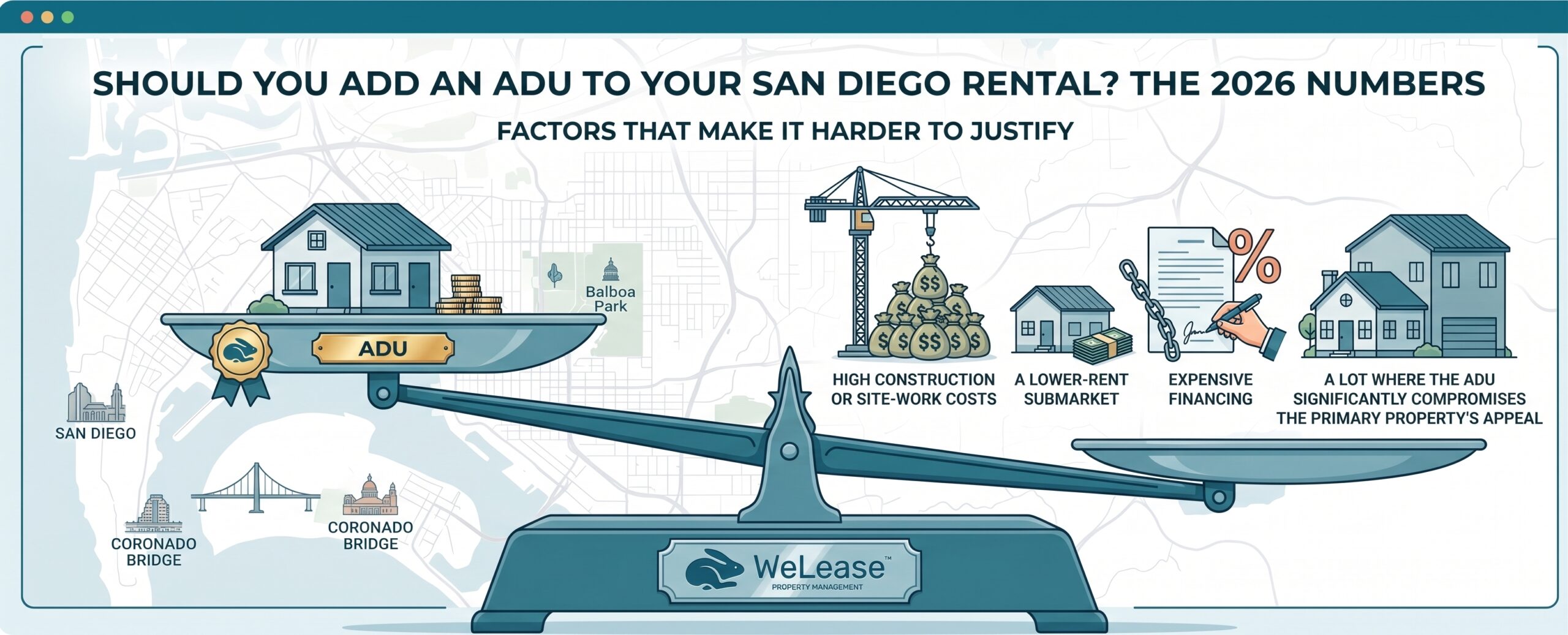
- High construction or site-work costs
- A lower-rent submarket
- Expensive financing
- A lot where the ADU significantly compromises the primary property’s appeal
“The way I help an owner decide is simple: what does it cost all-in, what will it rent for, and how long until it pays itself back. A garage conversion in a strong rental pocket can pay off fast. An expensive detached build in a lower-rent area might take years you don’t want to wait. The 2026 rule changes opened the door for a lot more owners, but the door being open doesn’t mean you walk through it on every property. The numbers on your specific lot decide that.”
Billy Colestock
What this means for you: An ADU pays off when the construction cost is controlled, the local rent supports the investment, and the financing is favorable. It is not automatically a good deal on every property. Run the real break-even math for your specific lot, cost, and rent before committing, because the difference between a great ADU investment and a mediocre one comes down to those specific numbers.
The Management Reality: A Second Unit Is a Second Responsibility
Here is the part owners often underestimate: an ADU is not just a construction project, it is an ongoing second rental to manage.
Once the ADU is built and occupied, you have a second tenant, a second lease, a second set of maintenance responsibilities, and a second set of compliance obligations. All the rules that apply to your primary rental, screening, the lease, habitability standards, the City of San Diego ordinance where applicable, apply to the ADU too.
For an owner already managing one unit, adding a second can be the difference between a manageable side investment and a genuine time commitment. This is where the operational reality of the ADU strategy meets the day-to-day work of being a landlord.
The 2026 compliance environment applies fully to ADUs. The new habitability standards, the security deposit rules, the notice requirements, all of it covers the ADU just as it covers the main unit. This is the same landscape we covered in how professional property management reduces legal exposure, now applied to a second unit on your property.
“Owners think about the build and forget about the day after the tenant moves in. Now you’ve got a second lease, a second tenant, a second set of maintenance and compliance obligations, all under the same 2026 rules as your main unit. It’s very manageable, but only if you treat it like a real rental from day one: proper screening, a proper lease, documentation on everything. The owners who get surprised are the ones who treated the ADU casually because it’s in their backyard.”
Yuliana Nogales
What this means for you: An ADU is a second rental, which means a second tenant, a second lease, and a second set of compliance obligations, all under the full 2026 regulatory framework. Factor the ongoing management reality into your decision, not just the construction cost and the rent. For many owners, this is where professional management turns an ADU from a time burden into a clean second income stream.
So, Should You Build One?
An ADU makes strong sense when several things line up:
- You own a property with a suitable lot, and ideally a lower-cost path like a garage conversion.
- The local rental demand and rent levels support the investment.
- You can finance the project on reasonable terms.
- You have a plan for managing the second unit, whether yourself or through professional management.
An ADU makes less sense when the construction and site costs are high relative to the rent it would earn, when the financing is expensive, or when adding the unit would significantly compromise the primary property.
The 2026 rule changes, especially the end of owner-occupancy requirements, have genuinely widened the range of owners for whom an ADU makes sense. But it remains a property-specific decision that comes down to the numbers on your particular lot. The strategy is powerful. Whether it is right for you depends on the details.
Talk to Yesenia and Billy

If you are weighing whether to add an ADU to your San Diego property, we would be glad to help you think through the numbers and the management reality.
At WeLease, we work with San Diego property owners across the county, and we understand both sides of the ADU decision: the investment math that determines whether it pencils, and the day-to-day management that determines whether it runs smoothly once built. We can help you evaluate whether an ADU fits your property and your goals, and manage the second unit once it is in place.
If you want a clear, honest read on whether an ADU makes sense for your property, reach out.
www.WeLeaseUSA.com | (619) 876-0753
Key Takeaways
- An ADU lets a San Diego property owner add a second rental income stream without buying another property, since the land is already owned.
- The biggest 2026 change is the end of owner-occupancy requirements under AB 976. Investors can now rent both the primary home and the ADU without living on-site.
- On a single-family lot, the standard package (one detached ADU up to 1,200 sq ft, one conversion ADU, and one JADU) is generally ministerial, reviewed without a public hearing.
- ADU income potential is attractive because there is no land cost, but the return depends on controlling construction cost and matching it to local rent levels.
- Costs include design, permitting, construction, utility connections, site work, and financing. Financing cost directly affects the return and belongs in the analysis from the start.
- The City of San Diego requires ADU rentals to have a minimum 30-day term, steering ADUs toward long-term and mid-term rental rather than nightly stays.
- An ADU is a second rental to manage, with a second tenant, lease, and full set of 2026 compliance obligations. Factor the ongoing management reality into the decision.
Frequently Asked Questions
Can I rent out an ADU in San Diego without living on the property?
Yes, as of 2026. Under California AB 976, owner-occupancy requirements ended for standard ADUs permitted after January 1, 2026. This means investors can now rent out both the primary home and the ADU without living on-site. (Junior ADUs, or JADUs, retain some owner-occupancy requirements, so those are treated differently.)
How much does it cost to build an ADU in San Diego?
Costs vary widely based on the type of ADU, its size, finishes, and site conditions. A garage conversion is typically the least expensive path since the structure already exists, while a detached new-construction unit costs more but offers the highest flexibility and often the highest rent. Beyond construction, budget for design and permitting, utility connections, site work, financing, and a contingency buffer.
Is building an ADU a good investment in San Diego?
It can be a strong investment, because you avoid land acquisition cost, add a diversified income stream, and increase property value. Whether it pays off on your specific property depends on the construction cost, the local rent levels, and your financing terms. An ADU pencils best with a lower-cost construction path, strong local rent, and favorable financing. Always run the real break-even numbers for your particular lot before committing.
Can I use my San Diego ADU as a short-term rental?
Generally no. The City of San Diego requires ADU rentals to have a minimum 30-day term, and newer ADUs typically cannot be used for nightly short-term rental at all. ADUs are steered toward long-term and mid-term (30+ day) rental, which aligns well with a stable-income strategy. This is separate from the STRO short-term rental framework that governs nightly rentals.
Do the same landlord rules apply to my ADU as to my main rental?
Yes. Once your ADU is rented, it is a full rental unit subject to the same rules as any other: tenant screening, lease requirements, habitability standards, security deposit rules, and the City of San Diego Tenant Protection Ordinance where applicable. The 2026 compliance framework applies fully, so an ADU means a second set of legal and management responsibilities.
Disclaimer: This article is intended for general informational and educational purposes only and does not constitute legal, financial, investment, tax, or construction advice. ADU costs, returns, and regulations vary significantly by property and change frequently. For guidance specific to your situation, consult qualified real estate, financial, legal, and construction professionals, or contact us at www.weleaseusa.com.
Reviewed by Billy Colestock, Co-Founder & Executive Officer, WeLease | REALTOR® DRE# 01771188
Billy Colestock brings over 20 years of real estate experience to his leadership role at WeLease Property Management. As a licensed REALTOR® and Co-Founder of WeLease, he is a trusted voice in the San Diego real estate community and regularly leads educational sessions at the San Diego Association of REALTORS® (SDAR) on topics including evictions, tenant screening, maintenance, and housing regulations. He is a member of the National Association of REALTORS® and the California Association of REALTORS®, and serves as President of his HOA. WeLease has been recognized as San Diego’s Best Property Management Company by the San Diego Union-Tribune (Winner 2022, 2024; Finalist 2023, 2025) and named a Top 10 Property Management Company in El Cajon and Chula Vista by Expertise.com in 2026. WeLease Credentials: NARPM® Member, BBB Accredited, MLS Participant, Equal Housing Opportunity. DRE: 02047533.

Ivana M. Janakieva is a Property Management Marketer and SEO Content Manager who turns confusing real estate jargon into practical, actionable advice. She’s the type who reads maintenance reports like morning news and can make lease agreement clauses sound (almost) fun. With years of experience writing about everything from tenant turnover and landlord-tenant laws to climate risks and curb appeal ROI, Ivana creates content for people who want straight answers about protecting and profiting from their most valuable asset, their property.