What San Diego Landlords Need to Know About the New STRO and Coastal Zone Rules
Home / What San Diego Landlords Need to Know About the New STRO and Coastal Zone Rules
What San Diego Landlords Need to Know About the New STRO and Coastal Zone Rules
If you own a rental in one of San Diego’s coastal neighborhoods and you have thought about renting it short-term, even part of the year, the rules you need to follow got both stricter and more automated in 2026.
The days of quietly listing a property on Airbnb and hoping no one notices are over. San Diego’s Short-Term Residential Occupancy (STRO) ordinance now sits on top of aggressive, technology-driven enforcement. As of January 2026, state law requires booking platforms to share host and listing data directly with the city, and unlicensed operators face fines starting at $1,000 per day.
For coastal landlords especially, the stakes are high and the rules are genuinely complex. Whether you rent short-term, long-term, or are trying to decide between them, understanding the current STRO and Coastal Zone framework is not optional. Here is what you actually need to know in 2026.
What Counts as a Short-Term Rental in San Diego?
The definition is precise, and it matters more than most owners realize.
A short-term rental in San Diego is any rental of a dwelling unit for less than one month, defined as fewer than 31 consecutive nights. Any rental that falls under that threshold requires a city-issued STRO license, along with transient occupancy tax collection and ongoing compliance obligations.
Anything of 31 or more consecutive nights is not a short-term rental. It falls under standard residential landlord-tenant law and does not require an STRO license. This 31-night line is the single most important number in the entire framework, and we will come back to why it matters strategically.
The quick version:
| Rental Length | Governed By | STRO License Needed? |
|---|---|---|
| Under 31 nights | STRO ordinance | Yes |
| 31+ consecutive nights | Standard landlord-tenant law | No |
Source: WeLease Team, updated 2026
What this means for you: The 31-night threshold is the dividing line between two completely different regulatory worlds. Which side of it your rental falls on determines your licensing obligations, your tax obligations, and much of your compliance burden.
The Four STRO License Tiers Explained
If you do rent short-term, San Diego’s STRO ordinance uses a four-tier license system. Each tier has different requirements based on how often you rent and whether the property is your primary residence.
| Tier | What It Covers | Key Limits |
|---|---|---|
| Tier 1 | Part-time, limited hosting | Up to 20 days per year |
| Tier 2 | Home sharing, host lives onsite | Owner-occupied, host present |
| Tier 3 | Whole-home, non-primary residence (outside Mission Beach) | Capped at ~1% of city housing stock |
| Tier 4 | Mission Beach whole-home rentals | Separate allocation, capped at ~30% of Mission Beach stock |
Source: WeLease Team, updated 2026
A few rules apply across all tiers and catch owners off guard:
- One license per host. You may hold only one license and operate only one dwelling unit for STRO at a time.
- Licenses are not transferable. They do not transfer between owners or between properties. This is critical when buying or selling.
- The license number must appear in every listing. Platforms are now required to verify it.
- ADUs built after 2017 cannot be used for short-term rental under the ordinance.
What this means for you: The tier you fall into depends on your property and how you intend to use it. Most investors looking at whole-home coastal rentals are looking at Tier 3, and as the next section explains, that is exactly where the availability problem lives.
The Tier 3 Scarcity Problem
This is the single most important market dynamic in San Diego short-term rentals right now, and it has real implications for property values.
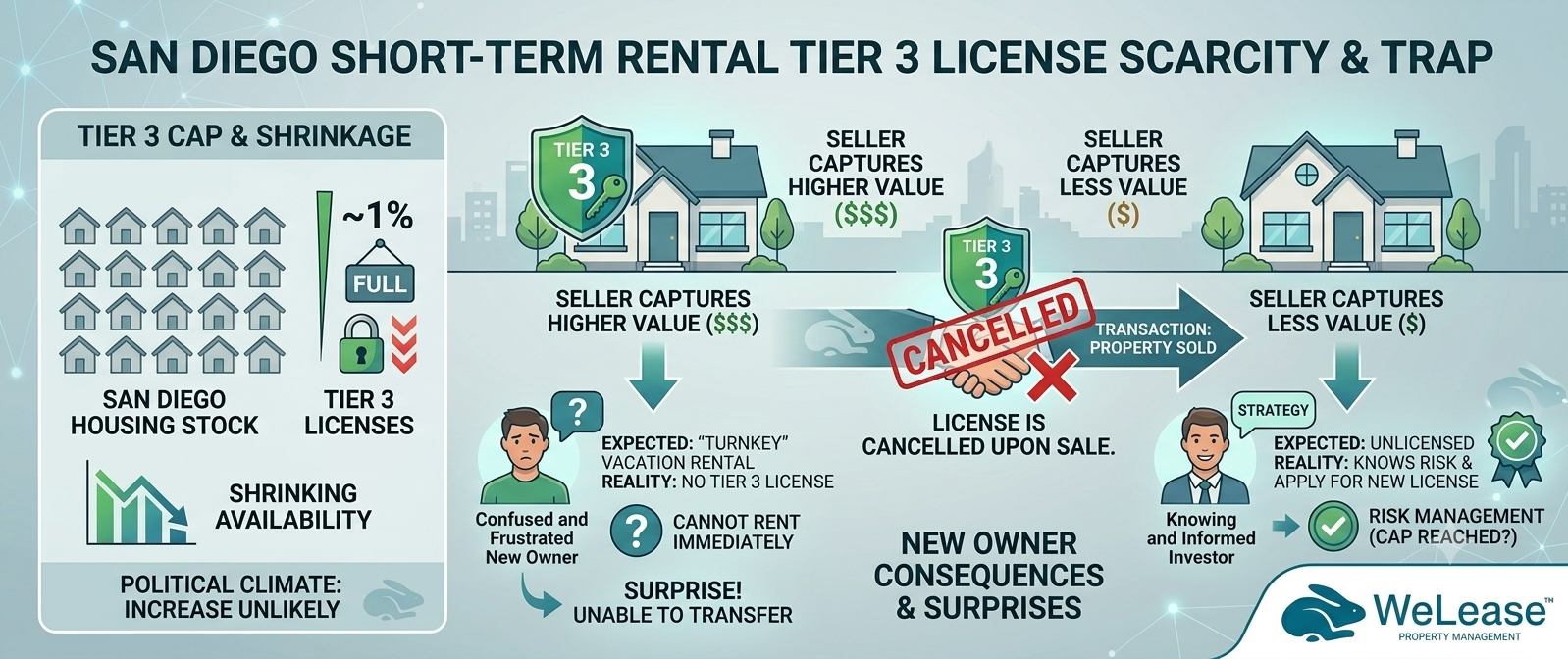
Tier 3 licenses, the whole-home, non-primary-residence category that most coastal investors want, are capped at roughly 1% of the city’s total housing stock. That cap is often reached, and the number of available licenses has been shrinking. As availability tightens, the political climate makes a cap increase unlikely.
Here is the consequence that surprises people: because licenses are non-transferable and capped, a property that already holds a Tier 3 license can be more valuable than an otherwise identical property without one. When an owner with a licensed short-term rental sells, the license does not go with the property. The new owner has to obtain their own, and if the cap has been reached, that may not be possible.
Some investors are now specifically seeking out properties with licenses already in place, and others are being caught off guard when they buy a “turnkey vacation rental” only to discover the license cannot transfer to them.
“The biggest misunderstanding I see is a buyer assuming the short-term rental license comes with the house. It doesn’t. Those licenses are capped and non-transferable, so when you buy a ‘turnkey vacation rental,’ you may be buying a property you legally can’t operate the way the seller did. Before you write an offer on a coastal property with STR income in the pro forma, you verify the license situation. That one check can completely change what the property is worth.”
Billy Colestock
What this means for you: If you are buying a coastal property with the intention of renting it short-term, never assume the existing license transfers. It does not. Confirm the license situation before you buy, because a non-transferable license can materially change the value and viability of the investment.
The Coastal Zone Adds Another Layer
For properties in San Diego’s beach communities, the California Coastal Zone creates considerations that inland owners never face.
The STRO ordinance itself was approved by the California Coastal Commission before taking effect, which reflects how seriously coastal access and land use are treated in these areas. Properties in the Coastal Zone can face additional considerations around property modifications, land use, and certain rental decisions, layered on top of the standard city rules.
It is also worth knowing that not every coastal neighborhood follows the same rules. Most of La Jolla sits within City of San Diego limits and follows the STRO ordinance, but some unincorporated pockets fall under county rules instead. And neighboring coastal cities, Carlsbad, Oceanside, Encinitas, operate under entirely separate frameworks with their own licensing, fees, and enforcement.
This connects to a theme we covered in depth in our piece on how local ordinances override state law in San Diego rentals: in San Diego County, your specific address determines which rules apply, and the differences between jurisdictions are significant.
What this means for you: In the Coastal Zone, the STRO ordinance is not the only rulebook. Coastal Act considerations can affect what you can do with the property, and the rules change from one coastal jurisdiction to the next. Knowing exactly which frameworks apply to your specific address is essential.
Enforcement Got Serious in 2026
The biggest practical change for landlords is not a new rule. It is how aggressively the existing rules are now enforced.
The city’s Building and Land Use Enforcement (BLUE) team investigates complaints and, critically, uses automated data-sharing to match platform listings against the city’s licensing database. This is not a manual, complaint-only system anymore. It is systematic cross-referencing.
As of January 1, 2026, California Senate Bill 346 strengthened this further. It requires booking platforms like Airbnb and VRBO to share host and listing data with the city and to remit transient occupancy tax, with platforms facing fines up to $10,000 per day for noncompliance. Platforms are also required to remove unlicensed listings.
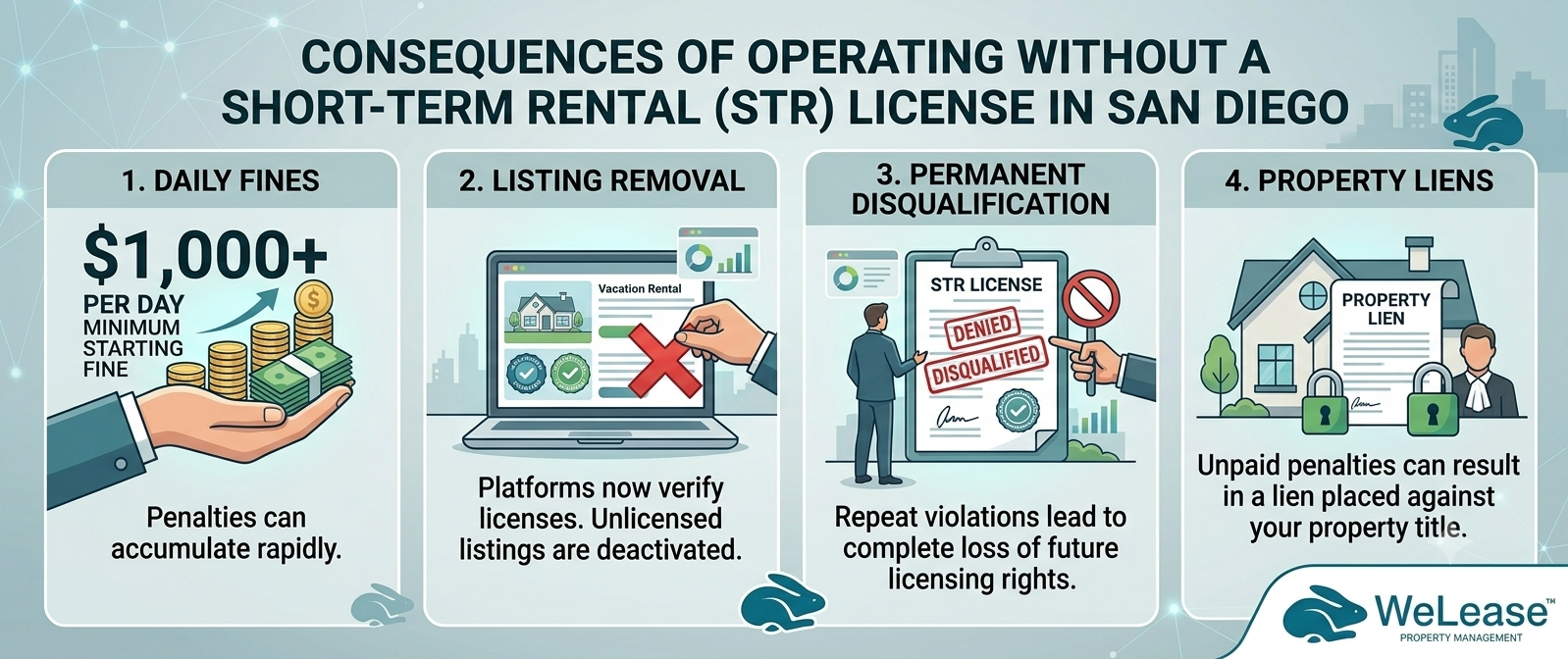
The consequences of operating without a license:
- Fines starting at $1,000 per day
- Listing removal from platforms (which are now required to verify licenses)
- Potential permanent disqualification from future licensing for repeat violations
- Possible property liens for unpaid penalties
Transient occupancy tax itself runs to 10.5% or more of gross rental revenue, including cleaning fees, and hosts must maintain a valid TOT certificate and stay current.
“Getting the license is the easy part. Staying compliant is where owners get caught. You’ve got the transient occupancy tax, the good-neighbor requirements, the one-hour local contact rule, the annual renewals, and now the platforms reporting your data straight to the city. We keep meticulous records on every property, TOT filings, license renewals, guest logs, because with automated enforcement, the city already has the data. You need yours to match.”
Yuliana Nogales
What this means for you: In 2026, operating an unlicensed short-term rental is not a low-risk gamble. Automated platform data-sharing means the city can match your listing to its license database directly. The old approach of flying under the radar simply does not work anymore.
The Mid-Term Rental Alternative
Here is where that 31-night threshold becomes a genuine strategy, not just a definition.
For owners who cannot obtain a Tier 3 license because the cap has been reached, or who own properties where HOA rules prohibit short-term rentals, mid-term rentals offer a fully legal alternative. A rental of 31 or more consecutive nights does not fall under the STRO ordinance at all. No STRO license, no TOT collection, no tier system.
Mid-term rentals operate under standard residential landlord-tenant law and serve a real and growing tenant base: traveling professionals, corporate employees on temporary assignments, insurance and relocation clients, and residents in transition between leases.
The revenue picture is more competitive than many owners expect. A well-managed mid-term rental in a coastal neighborhood can produce monthly revenue that approaches short-term rental income, particularly in the off-season when short-term occupancy drops but demand for furnished monthly rentals from corporate and relocation clients stays steady.
This is especially relevant for scarce, high-value coastal markets. In our piece on Sunset Cliffs rentals, we looked at how the STRO caps push some owners toward exactly this kind of longer-term strategy.
What this means for you: If a Tier 3 license is unavailable, or if you want to avoid the STRO compliance burden entirely, the mid-term (31+ night) model is a legitimate and often profitable alternative. It sidesteps the licensing problem while still serving furnished-rental demand, and it operates under the more familiar landlord-tenant framework.
What This Means for Different Types of Owners
The right approach depends on what kind of owner you are and what you are trying to accomplish.
If you already hold a Tier 3 or Tier 4 license: You hold a genuinely scarce and valuable asset. Protect it. Stay in strict compliance, keep your TOT current, maintain your good-neighbor obligations, and renew on time. A violation can cost you a license that may be impossible to replace.
If you are considering buying a coastal property to rent short-term: Verify the license situation before you buy. Never assume a license transfers, because it does not. Factor the license availability, or unavailability, into your valuation and your plan.
If you cannot get a license: Seriously consider the mid-term rental model. It is legal, it avoids the STRO burden, and it can produce competitive revenue in coastal markets.
If you rent long-term (a year or more): The STRO ordinance largely does not apply to you, but the Coastal Zone considerations still can, and all the standard City of San Diego rental compliance rules apply in full.
“I look at it purely as a returns question. Short-term can produce the highest gross, but only if you can get a license and you’re prepared for the operational load and the seasonality. If a license isn’t available, mid-term at thirty-plus nights is often the smarter play, steadier income, corporate and relocation demand, and none of the STRO burden. The right model isn’t the one with the flashiest peak-season number. It’s the one that produces the best risk-adjusted return for that specific property.”
Yesenia Colestock
Talk to Yesenia and Billy

The STRO and Coastal Zone rules are among the most complex in San Diego rental ownership, and the enforcement environment in 2026 leaves very little room for error.
At WeLease, we work with San Diego property owners across the county, including the coastal communities where STRO licensing, Coastal Zone considerations, and the short-term-versus-mid-term-versus-long-term decision all come into play. We can help you understand exactly which rules apply to your specific property, and which rental model fits your goals.
If you own a coastal rental, or are considering buying one, and want a clear read on your options and obligations, reach out.
www.WeLeaseUSA.com | (619) 876-0753
Key Takeaways
- A short-term rental in San Diego is any rental under 31 nights and requires a city-issued STRO license. Rentals of 31 or more consecutive nights fall under standard landlord-tenant law with no STRO license needed.
- The STRO ordinance uses a four-tier license system. Tier 3 (whole-home, non-primary residence) is what most coastal investors want and is capped at roughly 1% of the city’s housing stock.
- STRO licenses are not transferable between owners or properties. A property with an existing license can be more valuable than one without, and buyers should never assume a license transfers.
- The California Coastal Zone adds another layer of considerations for beach-community properties, and neighboring coastal cities have entirely separate rules.
- Enforcement is now automated. Under SB 346, effective January 2026, platforms must share host data with the city. Unlicensed operation carries fines starting at $1,000 per day plus listing removal.
- The mid-term rental model (31+ nights) is a legal alternative that avoids STRO licensing entirely and can produce competitive revenue in coastal markets.
- The right strategy depends on the owner: protect an existing license, verify before buying, consider mid-term if no license is available, and follow all standard rules if renting long-term.
Frequently Asked Questions
Do I need a license to rent my San Diego property short-term?
Yes. Any rental of less than 31 nights within City of San Diego limits requires a Short-Term Residential Occupancy (STRO) license. You must select the correct tier based on your property and usage, collect transient occupancy tax, and include your license number in every listing. Operating without a license carries fines starting at $1,000 per day.
What is the difference between a short-term and mid-term rental in San Diego?
The dividing line is 31 nights. A rental of less than 31 consecutive nights is a short-term rental and requires an STRO license. A rental of 31 or more consecutive nights is a mid-term (or long-term) rental, does not require an STRO license, and operates under standard landlord-tenant law. This distinction makes mid-term rentals a legal alternative when STRO licenses are unavailable.
Can I transfer my STRO license when I sell my property?
No. STRO licenses are not transferable between owners or between properties. If you sell a licensed short-term rental, the license does not go with the property, and the buyer must obtain their own. Because Tier 3 licenses are capped and often unavailable, this is a critical point for anyone buying or selling a coastal rental.
How does San Diego enforce short-term rental rules in 2026?
Enforcement is now largely automated. The city’s Building and Land Use Enforcement (BLUE) team cross-references platform listings against the licensing database, and under California SB 346, effective January 2026, platforms like Airbnb and VRBO must share host and listing data with the city and remove unlicensed listings. Unlicensed operators face fines starting at $1,000 per day and possible permanent disqualification from future licensing.
Can I use my ADU as a short-term rental in San Diego?
Generally no. The San Diego Municipal Code prohibits using Accessory Dwelling Units built after 2017 for short-term rental. Some companion units permitted before the September 2017 prohibition may still qualify, but new ADUs cannot be used for STRO. They can, however, be used for standard long-term or mid-term rentals.
Disclaimer: This article is intended for general informational purposes only and reflects San Diego STRO and Coastal Zone regulations as of mid-2026. It does not constitute legal advice. Short-term rental rules and enforcement change frequently and vary by jurisdiction. For guidance specific to your property, consult a qualified California real estate attorney or licensed property management professional, or contact us at www.weleaseusa.com.
Reviewed by Billy Colestock, Co-Founder & Executive Officer, WeLease | REALTOR® DRE# 01771188
Billy Colestock brings over 20 years of real estate experience to his leadership role at WeLease Property Management. As a licensed REALTOR® and Co-Founder of WeLease, he is a trusted voice in the San Diego real estate community and regularly leads educational sessions at the San Diego Association of REALTORS® (SDAR) on topics including evictions, tenant screening, maintenance, and housing regulations. He is a member of the National Association of REALTORS® and the California Association of REALTORS®, and serves as President of his HOA. WeLease has been recognized as San Diego’s Best Property Management Company by the San Diego Union-Tribune (Winner 2022, 2024; Finalist 2023, 2025) and named a Top 10 Property Management Company in El Cajon and Chula Vista by Expertise.com in 2026. WeLease Credentials: NARPM® Member, BBB Accredited, MLS Participant, Equal Housing Opportunity. DRE: 02047533.

Ivana M. Janakieva is a Property Management Marketer and SEO Content Manager who turns confusing real estate jargon into practical, actionable advice. She’s the type who reads maintenance reports like morning news and can make lease agreement clauses sound (almost) fun. With years of experience writing about everything from tenant turnover and landlord-tenant laws to climate risks and curb appeal ROI, Ivana creates content for people who want straight answers about protecting and profiting from their most valuable asset, their property.