

When Raising Rent Hurts More Than It Helps
Here is a scenario that plays out more often than most San Diego landlords would admit.
A good tenant. Two and a half years in place. Pays on time, every month. Takes reasonable care of the property. No drama. At renewal time, you check what comparable units are listing for and decide to raise the rent by $200 a month. You are legally allowed to. The math looks straightforward.
The tenant gives notice. They found something similar two blocks away for $150 less.
Now you are looking at one to two months of lost rent. A cleaning fee. Touch-up repairs. New listing photos. Three to five weeks of showings in a market where tenants have more choices than they did two years ago. And a re-let price that ends up slightly below what you were charging before the increase.
The $200 monthly raise cost you somewhere between $4,000 and $7,000 in real, non-recoverable money.
You would have needed 20 to 35 months of the higher rent just to break even.
The Quick Math Most Landlords Skip Before Sending a Renewal Notice
Before going further, here is the calculation that changes the decision for most landlords who run it honestly.
| Scenario | Monthly Gain | Turnover Cost if Tenant Leaves | Months to Break Even |
|---|---|---|---|
| $100 increase, tenant stays | +$1,200/year | , | , |
| $100 increase, tenant leaves | +$100/month | $3,000–$5,500 | 30–55 months |
| $200 increase, tenant stays | +$2,400/year | , | , |
| $200 increase, tenant leaves | +$200/month | $4,000–$6,900 | 20–35 months |
| $300 increase, tenant stays | +$3,600/year | , | , |
| $300 increase, tenant leaves | +$300/month | $4,500–$7,500 | 15–25 months |
Source: WeLease Team, updated 2026. Turnover cost includes lost rent, cleaning, repairs, and leasing time.
The question is never whether you can raise the rent.
It is whether the math on the increase is better than the math on keeping the tenant.
Why Raising Rent in Today’s San Diego Market Requires More Strategy Than It Used To
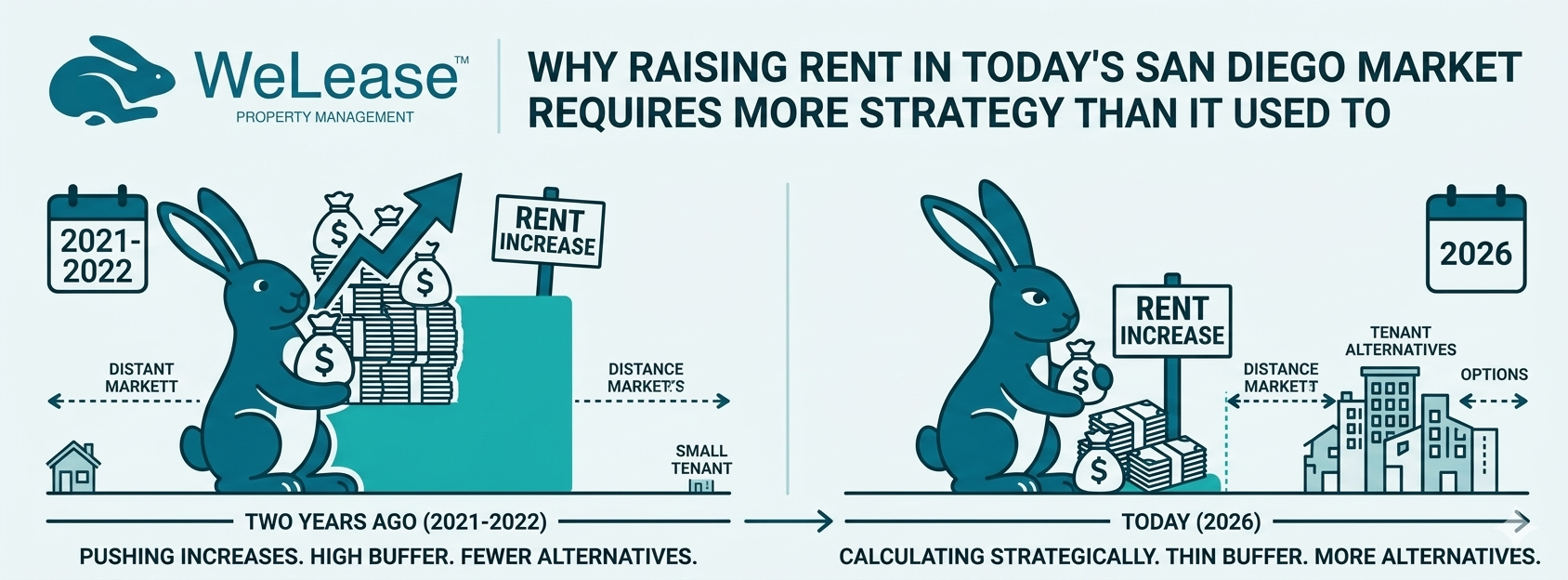
Two years ago, a landlord could push a rent increase beyond what was comfortable and hold most tenants. Moving was expensive. Alternatives were scarce. The urgency of the 2021 and 2022 market gave landlords leverage they may not have fully realized they had.
That buffer is significantly thinner in 2026.
Here is what changed:
- San Diego County vacancy has climbed to 5.4% as of Q1 2026, up from a historic low of 2.6% in 2021
- Approximately 6,200 new units hit the market in 2025, with another 4,000 projected through 2026
- In neighborhoods like Mission Valley, newer buildings are actively offering weeks of free rent as a concession to attract tenants
- Tenants who find an increase above market now have more realistic alternatives, and they are finding them faster
A tenant who was mildly uncomfortable with an increase in 2022 probably stayed anyway.
A tenant who is mildly uncomfortable with an increase in 2026 opens an app and starts comparing options the same afternoon.
What this means for you: The increase that felt conservative two years ago may carry a very different risk profile today. The market has shifted in ways that make tenant comparison-shopping faster, easier, and more likely to result in departure when the number does not feel right.
How Much Can You Legally Raise Rent in California?
Before deciding whether to raise rent, it is worth confirming what you are legally permitted to do.
Not sure what the rent increase limit is for your San Diego property in 2026? Billy explains exactly how the AB-1482 cap works, how to calculate the maximum allowable increase, and which properties are covered or exempt.
https://www.youtube.com/watch?v=Ga_14duETkc
The legal framework in plain terms:
| Property Type | Rent Cap | Notes |
|---|---|---|
| Covered by AB-1482 (built before 2011) | 8.8% through July 2026 | = 5% + San Diego Metro CPI |
| Single-family home or condo (exempt) | No state cap | Written exemption notice required at lease inception |
| Built 2011 or later | No state cap | California notice requirements still apply |
| All properties | , | 30 days’ notice for increases up to 10%; 60 days for increases above 10% |
Source: WeLease Team, updated 2026
The exemption detail most landlords miss:
Single family homes and condos can be exempt from the AB-1482 cap, but only if the tenant received specific written notice of the exemption at the start of the tenancy. Without that documentation delivered at the right time, the exemption is not enforceable retroactively.
If you are not certain the exemption notice was properly delivered in your original lease, check before your next increase.
Five Situations Where Raising Rent Almost Always Costs More Than It Earns
Not every rent increase carries the same risk. Some are straightforward. Others are almost guaranteed to trigger a turnover that erases the gain before it starts.
These are the five situations where landlords most consistently get this wrong.
Situation 1: The tenant is already within 5% of market rate
A tenant paying $2,600 on a $2,700 market-rate unit is close enough that a full increase attempt risks a $100 per month gain, at the cost of a vacancy that takes 27 months to recover.
This is not generosity. It is arithmetic.
Situation 2: The increase arrives as a large jump after a long flat period
A tenant who has absorbed two or three gradual increases over four years has normalized the pattern. A sudden large correction, even if it is technically market rate, breaks the psychological expectation of predictability.
Small, consistent annual increases retain tenants far more reliably than periodic large jumps, even when the total collected over the same period is similar.
Situation 3: The tenant is showing signs of financial stress
A tenant who has recently started paying rent later in the month, or who has communicated a job change or other financial difficulty, is already a higher non-renewal risk.
Layering a significant rent increase onto a tenant who is clearly stretching is not just financially risky. It is likely to accelerate a departure you were already at risk of facing.
Situation 4: The renewal notice arrives in the slow leasing season
A vacancy that opens in November or December faces a meaningfully slower leasing season than one that opens in spring or early summer.
A rent increase that prompts a December departure on a $2,500 per month property can leave a unit sitting for six to eight weeks instead of two to three. The same increase with the same tenant in March carries a very different risk profile.
Timing matters. Always factor in the time of year before deciding whether an increase is worth the risk of departure.
Situation 5: The pricing decision is based on outdated market data
“Market rate” is not a fixed number. It changes month to month, neighborhood to neighborhood, and unit type to unit type.
A landlord who last checked comparable rents six months ago is pricing against a market that may have moved significantly in that period. In neighborhoods where new supply has come online recently, what counted as market rate in the fall may be above the current competitive range by spring.
Pricing accurately requires current data, not last year’s renewal conversation, not what a neighbor claims to be charging.
How to Raise Rent Without Losing a Good Tenant
The goal is not to avoid raising rent. The goal is to raise rent in a way that balances your legitimate need to keep up with rising costs against the real financial risk of triggering a turnover that erases the gain.
Raising rent is necessary, but how and when you do it determines whether your best tenants stay or start looking. Billy walks through the approach that works in today’s San Diego market.
https://www.youtube.com/watch?v=_sUjZiSmkU4
A few principles that consistently produce better outcomes:
Increase gradually and annually, not in large periodic jumps.
A tenant who sees rent go up 3 to 4% every year has time to adjust their budget and normalize the pattern. A tenant who gets an 8% increase after two years of flat rent reads it as a shock, even if it is legal and market-rate.
| Approach | Year 1 | Year 2 | Year 3 | Total Increase | Tenant Risk |
|---|---|---|---|---|---|
| Annual 4% increases | +4% | +4% | +4% | +12.5% | Low |
| Flat then large jump | 0% | 0% | +8% | +8% | High |
| Flat then large jump | 0% | 0% | +12% | +12% | Very high |
Small, predictable increases collect more rent over time, and keep better tenants.
Start the renewal conversation 60 to 90 days out, not 30.
A renewal notice arriving 30 days before expiration with an increase attached does not give a tenant enough time to feel consulted. It gives them just enough time to start looking.
A landlord who opens the conversation 60 to 90 days out, explains the increase clearly, and signals that the relationship is valued is more likely to get a yes.
Use current market data, not historical benchmarks.
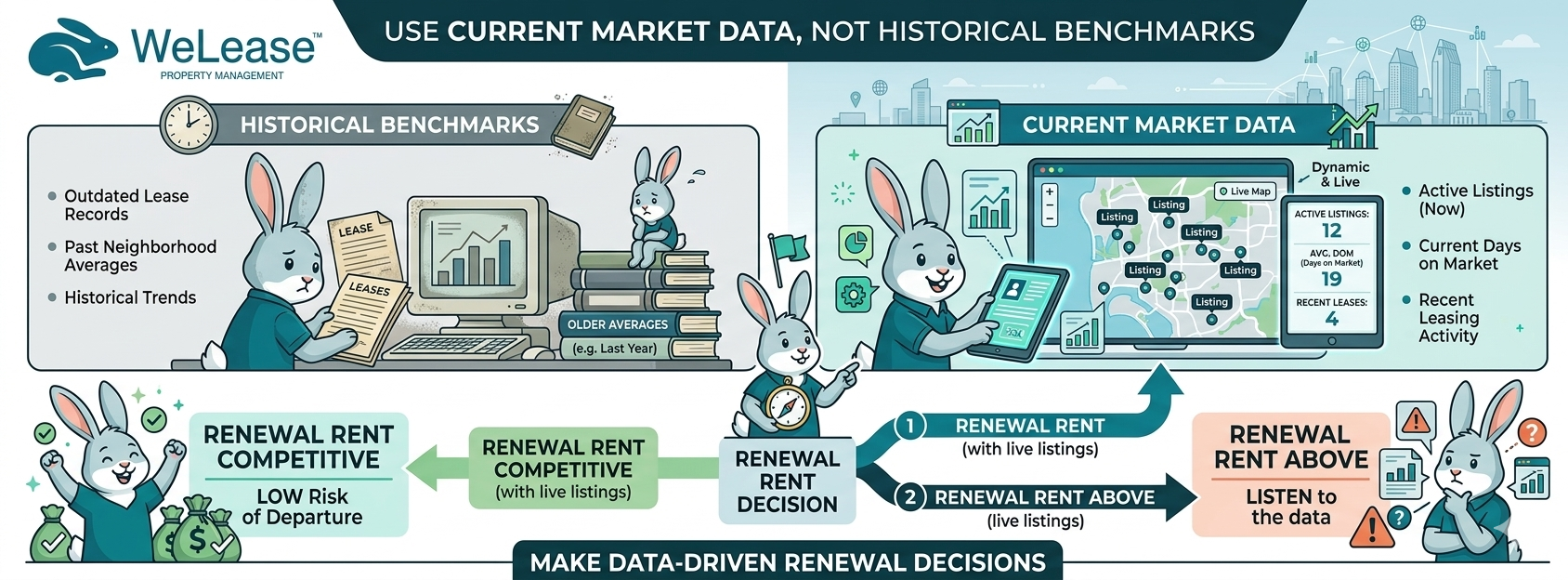
Before any renewal, check what comparable units in the same neighborhood are actually available for right now. Active listings, current days on market, and recent leasing activity in your specific submarket are the right references.
If your proposed renewal rent is competitive with those listings, the risk of a market-driven departure is low. If it is above them, the data is telling you something worth listening to.
Want to Know How to Handle Your Specific Renewal?
Every renewal situation is different. The right increase, or the right decision not to increase, depends on the specific tenant, the specific unit, the current comparable listings, and the time of year.
This one covers the practical communication side, how to frame the conversation, what to say, and how to present a rent increase in a way that does not immediately put a good tenant on the defensive.
https://www.youtube.com/watch?v=mwpNgnyQFDk
Talk to Yesenia and Billy

If you are approaching a lease renewal and are not sure whether your proposed increase is positioned well for the current market, that is exactly the kind of conversation we have every day.
At WeLease, we track the San Diego rental market closely across every submarket we manage. We know what comparable units are actually available for right now, what tenants are comparing your property against, and what the full cost of a turnover looks like for a property like yours at this time of year. If you want a clear, data-based read on your renewal decision, reach out.
www.WeLeaseUSA.com | (619) 876-0753
Disclaimer: This article is intended for general informational purposes only and draws on publicly available market data and regulatory information as of early 2026. It does not constitute legal, financial, or property management advice. AB-1482 rules, local ordinances, and market conditions change frequently. For guidance specific to your property, please consult a qualified California real estate attorney or licensed property management professional, or contact us at www.weleaseusa.com.
Key Takeaways
- Raising rent triggers a risk of tenant departure. Before sending any renewal increase, calculate the full cost of a turnover for that specific property at that time of year. In most cases, that number is significantly larger than landlords expect.
- In San Diego’s current market, vacancy has climbed to 5.4% and active listings are up meaningfully. Tenants who find an increase above market have more realistic alternatives than they did in 2021 or 2022.
- A tenant paying within 5% of market rate is almost never worth the turnover risk of pushing to full market. The math on retention beats the math on the maximum increase.
- Gradual, predictable annual increases retain tenants far more reliably than periodic large corrections, even when the total amount collected over a multi-year period is similar.
- Timing matters. A rent increase that prompts a November or December departure adds weeks of vacancy during San Diego’s slowest leasing season.
- For AB-1482 covered properties, the maximum allowable increase is 8.8% through July 2026. Increases above that carry legal exposure including potential repayment and damages.
- California notice requirements are 30 days for increases up to 10%, and 60 days for any increase above 10%. Notice timing starts from receipt, not from the date sent.
Frequently Asked Questions
When does raising rent actually hurt a landlord’s bottom line?
When the cost of the resulting turnover exceeds the gain from the higher rent. This happens most often when the increase is large enough to prompt a tenant to compare alternatives, when it arrives at a slow leasing season, or when the unit is already close to market rate and the incremental gain is small. A four-week vacancy on a $2,500-per-month unit costs more than two years of a $100 monthly increase.
How much can a landlord raise rent in San Diego in 2026?
For properties covered by AB-1482 – generally those built before 2011 – the cap is 8.8% through July 31, 2026. This is calculated as 5% plus the San Diego Metro CPI. Properties built in 2011 or later, and properly documented exempt properties, are not subject to this cap, though California notice requirements still apply to all rent increases.
How much notice do I have to give for a rent increase in California?
30 days’ written notice for any increase up to 10%. 60 days’ written notice for any increase above 10%. The notice period begins when the tenant receives the notice, not when it is sent. Failure to provide correct notice can invalidate the increase entirely.
Is it ever worth raising rent even if the tenant might leave?
Yes – when the unit is significantly below market, when the tenant has a track record that suggests they would accept a reasonable increase, and when the current leasing season makes a re-let straightforward. The decision should be based on the actual math of the turnover risk weighed against the income gain, not on principle or habit.
How do property managers decide how much to raise rent?
Professional property managers use current comparable listing data – active units of similar size, condition, and location – to identify where the market actually sits at the time of renewal. That data is combined with turnover cost estimates and seasonal leasing timing to produce a recommendation that is financially optimized for that specific property and moment, not based on a generic rule or last year’s benchmark.
Reviewed by
Yesenia Colestock & Billy Colestock, Co-Founders, WeLease Property Management
Yesenia and Billy Colestock are the co-founders of WeLease, a locally owned and operated property management company serving landlords and investors throughout San Diego County. Together, they bring over 20 years of hands-on real estate experience, from tenant screening and lease compliance to maintenance coordination, eviction proceedings, and investment strategy.
Billy is a licensed REALTOR® (DRE# 01771188) and a recognized educator in the San Diego real estate community, regularly leading sessions at the San Diego Association of REALTORS® (SDAR) on topics including evictions, housing regulations, and tenant screening. He is a member of the National Association of REALTORS® and the California Association of REALTORS®.
Yesenia leads WeLease’s day-to-day operations and client relationships, with a focus on delivering responsive, practical property management that protects owners’ investments and keeps tenants satisfied.
WeLease has been recognized as San Diego’s Best Property Management Company by the San Diego Union-Tribune (Winner 2022, 2024; Finalist 2023, 2025), named a Top 10 Property Management Company in El Cajon and Chula Vista by Expertise.com in 2026, and holds accreditation from the BBB, NARPM®, and MLS. DRE: 02047533.

Ivana M. Janakieva is a Property Management Marketer and SEO Content Manager who turns confusing real estate jargon into practical, actionable advice. She’s the type who reads maintenance reports like morning news and can make lease agreement clauses sound (almost) fun. With years of experience writing about everything from tenant turnover and landlord-tenant laws to climate risks and curb appeal ROI, Ivana creates content for people who want straight answers about protecting and profiting from their most valuable asset, their property.