Mission Valley Rentals: Central Location, Complex Regulations
Home / Mission Valley Rentals: Central Location, Complex Regulations
Mission Valley Rentals: Central Location, Complex Regulations
Mission Valley sits at the geographic center of San Diego, and the regulatory center of its rental market.
Seven freeways converge within or near its boundaries. Two trolley lines run through it. Major employment corridors are 15 minutes away in almost every direction. By almost every measure of tenant demand, it should be one of the most straightforward neighborhoods to own a rental in San Diego County.
It is not. And the reason is not the market. It is the layers.
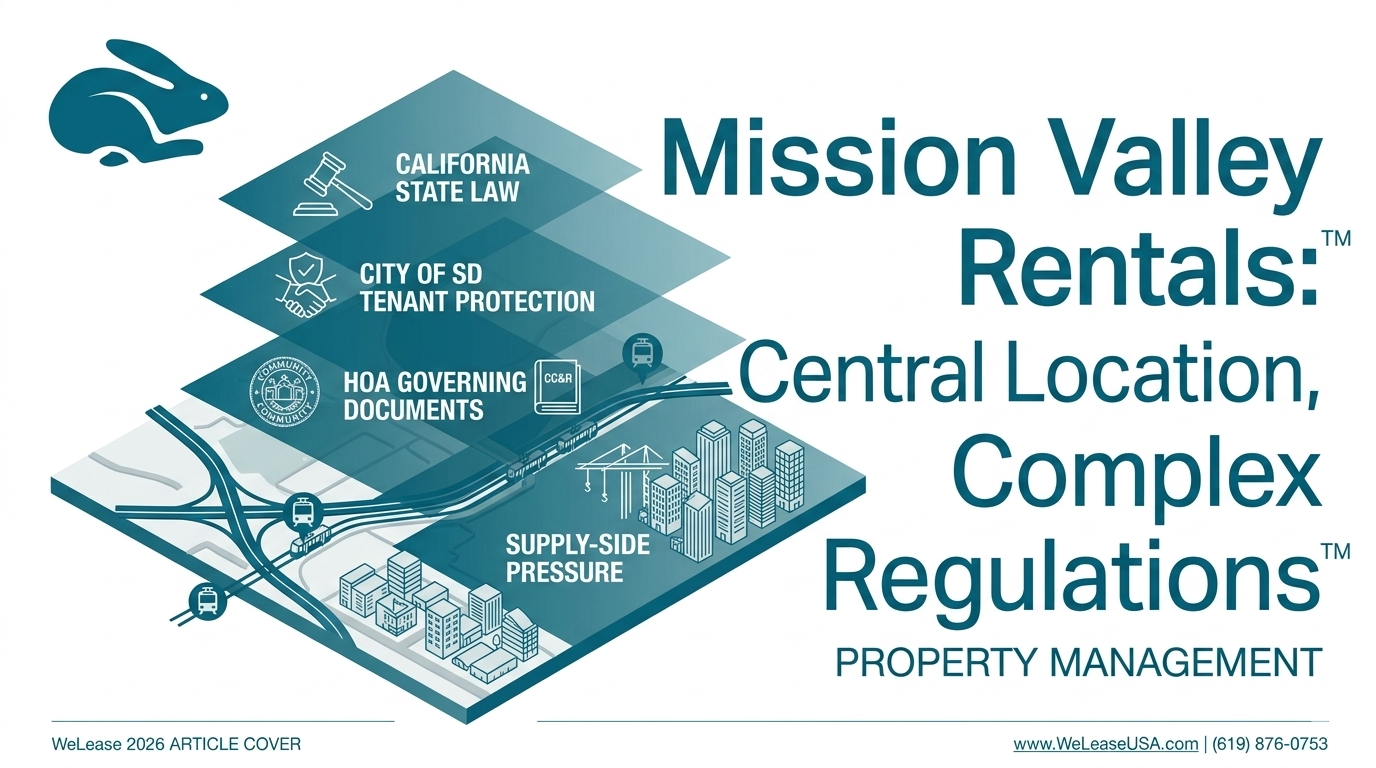
A Mission Valley landlord in 2026 is simultaneously navigating California state law, the City of San Diego’s Tenant Protection Ordinance, AB-1482 rent caps, and, if the property is in a condo community, HOA governing documents that can restrict rental activity independently of all three.
Each of those layers operates independently. None of them pause for each other.
Understanding all of them, before your next lease, renewal, or rent increase, is what separates owners who perform here from ones who are perpetually surprised.
Mission Valley at a Glance
| Factor | Mission Valley 2026 |
|---|---|
| Average rent | ~$2,950/month |
| Class A vacancy (new construction) | ~6.6%, with active concessions |
| Class B/C stabilized vacancy | 2.5–4% |
| New units delivered (2025) | ~6,200 across San Diego; Mission Valley absorbed a disproportionate share |
| Typical tenant profile | Young professionals, couples, relocating employees |
| Legal frameworks | State law + City of San Diego ordinance + HOA (if condo) |
| Transit access | Green Line + Orange Line trolley; I-8, I-15, I-163, SR-94 |
| Best fit | Professional tenant demand, transit-oriented, long-term hold |
Why Mission Valley’s Location Is a Genuine Competitive Advantage
What makes Mission Valley different from almost every other San Diego submarket is access, and not just freeway access.
The Green Line and Orange Line trolley routes connect Mission Valley directly to downtown San Diego, Mission San Diego station, and east toward La Mesa and El Cajon. Under AB-2097, parking minimums have been removed from new developments in transit priority areas, making car-free living increasingly viable for the tenants who want it.
Who does this location attract?
Primarily professional tenants. Young to mid-career workers who need access to multiple parts of the county. Couples and small households who value convenience over square footage. Professionals relocating to San Diego who want a central base while they get oriented.
This is a highly comparison-oriented tenant base. They are evaluating multiple options before applying. In 2026, they have significantly more options than they did two years ago.
Within 5 Minutes of Mission Valley: What Tenants Are Actually Comparing
One of the strongest selling points of any Mission Valley rental is not the unit itself, it is what surrounds it.
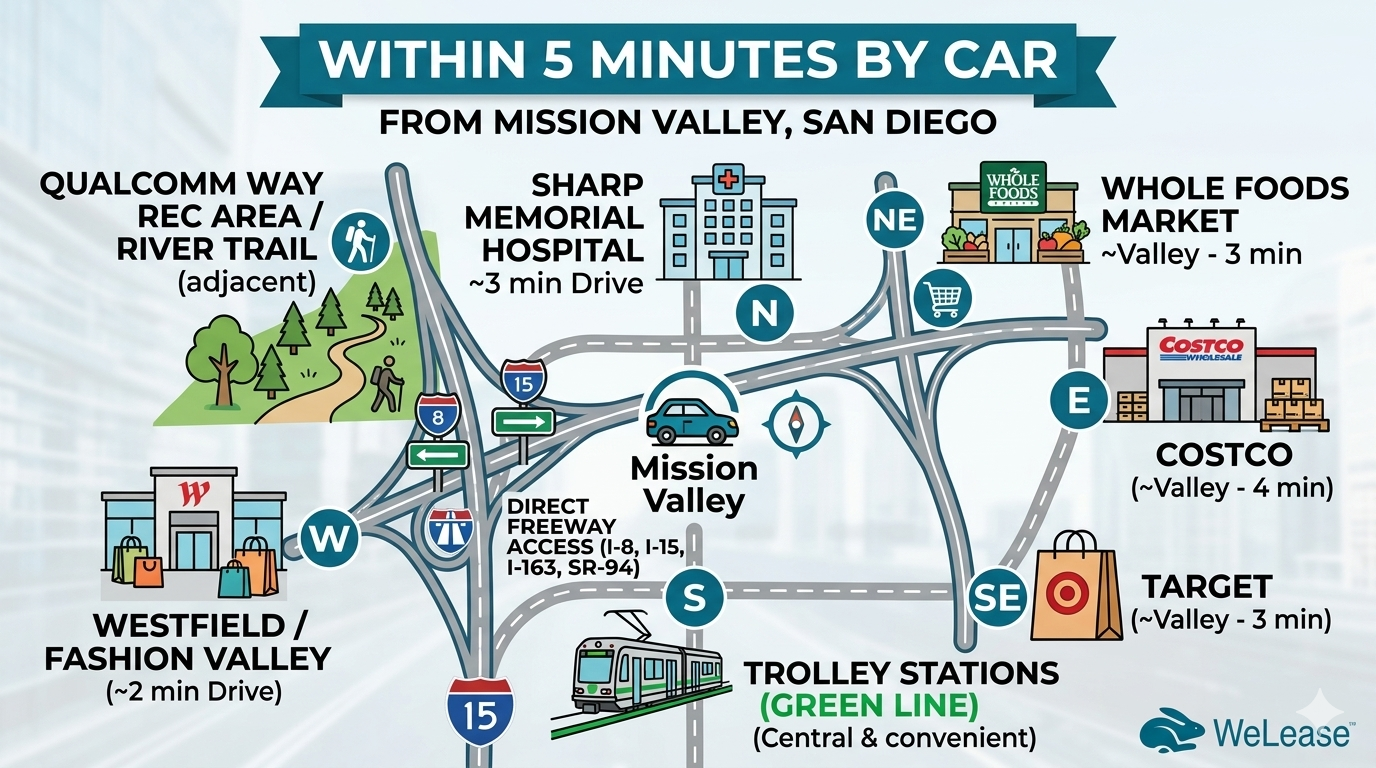
This context matters for the listing. Tenants who are comparing Mission Valley against Kearny Mesa, Midtown, or Hillcrest are making a value calculation. A unit that communicates its location advantages clearly, in photos, in the listing description, and in the showing, leases faster than one that leaves that work to the tenant’s imagination.
The New Supply Situation: What It Actually Means for Your Property
Is new construction hurting Mission Valley landlords?
It depends entirely on what type of property you own.
San Diego delivered approximately 6,200 new units in 2025, with another 4,000 projected through 2026. Mission Valley absorbed a disproportionate share of that inventory. These are Class A buildings with modern finishes, smart home technology, EV charging, and in-unit amenities that older buildings cannot replicate without capital investment.
The result is two very different markets running simultaneously:
- Class A luxury units: Vacancy around 6.6% countywide. Active concessions including weeks of free rent. Pricing pressure is real and ongoing.
- Class B/C stabilized properties: Holding at 2.5–4% vacancy. Less exposure to direct new supply competition. Better positioned for steady occupancy.
What does this mean for your pricing strategy?
If you own a newer luxury unit, you are competing against buildings offering free rent. Holding firm on a number that comparable units are undercutting will cost you significantly more in vacancy than a modest adjustment.
If you own an older, well-maintained building priced at value, you are in a more defensible position — but your tenants’ expectations for maintenance responsiveness and presentation quality have risen alongside their options.
What this means for you: The supply pressure is real but cyclical. New construction starts have slowed significantly as financing has tightened. The units already in the pipeline will continue arriving through 2027 — but the competitive environment will not last indefinitely. Landlords who adapt now will hold occupancy through the correction.
Three Legal Frameworks, One Property: How Mission Valley’s Regulations Stack
This is the part that surprises most Mission Valley landlords, especially investors who own properties in multiple markets.
In Mission Valley, you are not operating under one legal framework. You may be operating under three simultaneously.
| Framework | Who It Applies To | Key Requirements |
|---|---|---|
| California State Law (AB-1482) | Most units built before 2011 | Rent cap 8.8% through July 2026; just-cause eviction after 12 months |
| City of San Diego Ordinance | All properties in City of San Diego limits | Just-cause from Day 1; 2–3 months relocation assistance; Tenant Protection Guide required |
| HOA Governing Documents | All condo/planned community properties | Rental caps, tenant approval requirements, lease term minimums |
Source: WeLease Team, updated 2026
Each framework operates independently. Following two of the three correctly does not offset a violation of the third.
Does the City of San Diego Ordinance Apply to Your Mission Valley Property?
Yes, Mission Valley falls within City of San Diego limits.
That means the Residential Tenant Protections Ordinance (SDMC §§ 98.0701–98.0709) applies on top of state law. Here is what changes, and why it matters.
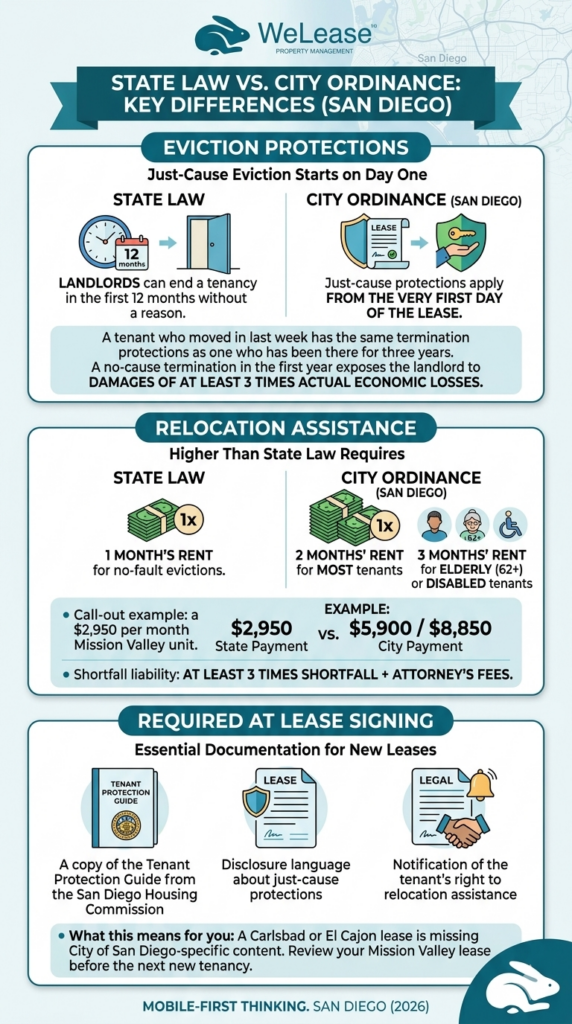
Difference 1: Just-Cause Eviction Starts on Day One
Under state law: landlords can end a tenancy in the first 12 months without providing a reason.
Under the City of San Diego ordinance: just-cause protections apply from the very first day of the lease.
A tenant who moved in last week has the same termination protections as one who has been there for three years. A no-cause termination during the first year of a covered tenancy exposes the landlord to civil action with damages of at least three times the tenant’s actual economic losses.
Difference 2: Relocation Assistance Is Higher Than State Law Requires
Under state law: one month’s rent for no-fault evictions.
Under the City ordinance:
- 2 months’ rent for most tenants
- 3 months’ rent for tenants who are elderly (62+) or disabled
On a $2,950 per month Mission Valley unit, the gap between state and city requirements is $2,950 in additional required payments per no-fault eviction. Failing to pay the correct amount creates liability of at least three times the shortfall, plus attorney’s fees.
Difference 3: Required Documentation at Lease Signing
Every new lease in City of San Diego limits must include:
- A copy of the Tenant Protection Guide from the San Diego Housing Commission
- Disclosure language about just-cause protections
- Notification of the tenant’s right to relocation assistance
Missing these does not void the lease, but it creates documentation gaps that complicate any future enforcement action.
What this means for you: A lease template written for a Carlsbad or El Cajon property is missing City of San Diego-specific content that matters the moment a dispute arises. If your Mission Valley lease was not written specifically for City of San Diego properties, it is worth reviewing before the next new tenancy.
Does Your Mission Valley Condo Have HOA Rental Restrictions?
If your Mission Valley rental is in a condominium community, you have a third legal framework to navigate, and it operates entirely independently of the first two.
What can an HOA actually restrict?
A lot. HOA governing documents, the CC&Rs, bylaws, and board-adopted rules, can regulate:
| HOA Restriction | What It Means for Landlords |
|---|---|
| Rental caps | Limits the % of units that can be leased at any time |
| Tenant approval requirements | HOA must review and approve tenants before lease signing |
| Lease term minimums | Prevents month-to-month or short-term rentals |
| Pet restrictions | Flow through to your lease restrictions |
| Move-in/move-out scheduling | Limited windows for tenant transitions |
| Parking allocation | May affect how many spaces a tenant can use |
Source: WeLease Team, updated 2026
None of these HOA restrictions are preempted by California landlord-tenant law. They operate in parallel.
A landlord who signs a lease with a tenant that violates the HOA’s rental cap is not protected by the fact that the lease itself is legally valid. The HOA can pursue enforcement action against the owner regardless.
The most common mistake here?
Failing to verify current HOA rental restrictions before listing the property. CC&Rs are amended. Boards pass new rules. Rental cap percentages change.
The version of the HOA rules a landlord read when they purchased the property may not be the version in effect at the next leasing cycle. Pulling current governing documents before each new lease is not excessive diligence. It is the minimum required to avoid an enforceable conflict between two legal obligations.
What this means for you: For Mission Valley condo landlords, HOA compliance is not a one-time task at purchase. It is an ongoing requirement at every new lease cycle. The documents change. The obligation to follow them does not.
Does AB-1482 Cover Your Mission Valley Property?
Whether AB-1482 applies to your specific unit depends on two things.
Question 1: When was the certificate of occupancy issued?
AB-1482 applies to properties built before 2011. Mission Valley has significant development from the 2000s through the present decade, so whether a specific unit is covered depends entirely on when its certificate of occupancy was issued.
Question 2: Does your condo qualify for an exemption, and was it documented correctly?
Condos owned by individuals (not corporations) can be exempt from AB-1482 under the Costa-Hawkins Rental Housing Act. But the exemption requires written notice to the tenant at the start of the tenancy, using specific statutory language.
A condo landlord who did not provide the required exemption notice cannot retroactively claim the exemption if a rent dispute arises.
| AB-1482 Status | Requirement |
|---|---|
| Covered (built before 2011) | Max increase 8.8% through July 2026 |
| Potentially exempt (condo/SFH) | Must have provided written exemption notice at lease inception |
| Not covered (built 2011 or later) | No rent cap, but California notice requirements still apply |
Source: WeLease Team, updated 2026
If you are uncertain whether the exemption notice was properly delivered in your original lease, review the lease documentation before your next rent increase. Assuming you are exempt without that verification is one of the most common and costly errors in Mission Valley condo ownership.
The Compliance Mistakes Most Mission Valley Landlords Make
Experienced ownership does not immunize against Mission Valley’s specific compliance risks. These are the errors that come up most consistently.
Using a single lease template across multiple jurisdictions. Mission Valley is inside City of San Diego limits. A lease written for El Cajon, Carlsbad, or any property outside the city is missing required content, the Tenant Protection Guide addendum, day-one just-cause disclosure, and relocation assistance notification. That is not a formatting issue. It is a structural gap.
Raising rent above the AB-1482 cap on a covered unit. The cap is 8.8% through July 2026. On a unit where the exemption notice was never properly delivered, the landlord does not have the exemption they think they have. A rent increase above the cap on a covered property creates liability that includes repayment of the excess plus potential additional damages.
Not checking current HOA rules before each new lease cycle. CC&Rs and board rules change. A rental cap that was 30% of units when the landlord purchased may be 20% today. Signing a lease without verifying the current rules can create an enforceable HOA violation that the lease itself does not protect against.
Missing the Tenant Termination Notice Registry filing. Under the City of San Diego ordinance, landlords must file a written notice with the San Diego Housing Commission within three business days of serving a termination notice. The portal is still being implemented, but the obligation exists and will carry enforcement weight once it is live.
The Long-Term Case for Mission Valley
Mission Valley is a designated Transit Priority Area, and that designation is actively shaping its long-term trajectory.
Areas near transit like Mission Valley are being targeted for upzoning, with the removal of parking minimums under AB-2097 already changing what new development looks like. Infrastructure investment and improved transit connectivity are structural demand drivers that take years to show up in rent data, but are already changing who is looking at this neighborhood.
The short-term supply pressure is real. But it is happening against a backdrop of fundamentals that remain positive for long-term owners.
Landlords who manage through the current competitive environment with accurate pricing, strong maintenance responsiveness, and airtight regulatory compliance will be well-positioned when the construction pipeline thins, which most market data suggests will happen through 2027.
Why Do Mission Valley Owners and Realtors Trust WeLease?

In 2026, WeLease was named a Top 3 Property Management Company in Mission Valley by BusinessRate, a recognition powered by verified Google Reviews.
That ranking is not built on advertising. It reflects the people who actually work with us: owners who trust us with their investments, Realtors who refer their clients, residents who call our properties home, and the local partners who help keep those properties running.
In a submarket this competitive and this tightly regulated, that kind of trust is earned one lease, one repair, and one compliance deadline at a time.
For owners, the signal is simple. Managing a Mission Valley rental means staying accurate on pricing, responsive on maintenance, and airtight across three overlapping legal frameworks. Recognition built on real reviews from real clients is one of the clearest ways to see whether a company delivers on all three, not just one.
What this means for you?
Choosing a property manager in Mission Valley is a decision about who you trust with a significant asset. Independent recognition, based on verified reviews rather than marketing spend, is one of the most reliable signals that a company does what it says it will.
Talk to Yesenia and Billy

Mission Valley is a genuinely strong rental market for owners who understand what they are working with. The location delivers consistent tenant demand. The transit infrastructure is improving. The long-term fundamentals are solid.
The complexity is real too. Three overlapping legal frameworks, a competitive supply environment, and a tenant base that is actively comparison-shopping all require a level of operational precision that is difficult to sustain without the right structure.
At WeLease, we work with San Diego property owners across the county every day, including Mission Valley. We know what compliance gaps look like before they become expensive, we track current market pricing across submarkets, and we know what separates properties that lease quickly from ones that sit. If you own a rental in Mission Valley and want a clear picture of how it is positioned, we would be glad to have that conversation.
www.WeLeaseUSA.com | (619) 876-0753
Disclaimer: This article is intended for general informational purposes only and draws on publicly available market data and regulatory sources as of early 2026. It does not constitute legal, financial, or property management advice. California state law, City of San Diego ordinances, and HOA governing documents change frequently. For guidance specific to your property, please consult a qualified California real estate attorney or licensed property management professional, or contact us at www.weleaseusa.com.
Key Takeaways
- Mission Valley’s central location, freeway access, and trolley connectivity deliver consistent professional tenant demand, but the neighborhood’s regulatory environment is among the most layered in San Diego County.
- Average rents in Mission Valley sit around $2,950 per month, reflecting the location premium and the quality of newer inventory competing for the same tenant pool.
- New supply has concentrated heavily in Mission Valley. Class A properties are experiencing vacancy around 6.6% countywide, with active concessions including free rent. Class B and C stabilized properties are holding tighter at 2.5 to 4% vacancy.
- Mission Valley condo landlords are operating under three simultaneous frameworks: California state law, the City of San Diego Tenant Protection Ordinance, and HOA governing documents that can restrict rental activity independently of both.
- AB-1482 coverage depends on the construction date of the specific unit. Properties built before 2011 are generally covered. Condo exemptions require written notice at lease inception or the exemption cannot be claimed retroactively.
- The City of San Diego ordinance applies just-cause eviction protections from day one, and requires two to three months of relocation assistance for no-fault evictions, significantly exceeding state law requirements.
- Mission Valley is a designated Transit Priority Area. Upzoning and transit investment create positive long-term fundamentals, but current owners need to manage through the supply correction with accurate pricing and strong operations.
Frequently Asked Questions
Is Mission Valley a good area to own a rental property in 2026?
Yes, with clear eyes about the current environment. The location delivers durable tenant demand from a professional renter base with strong income qualifications. The regulatory complexity and new supply competition require active, informed management. Owners who price accurately and maintain compliance across all three legal frameworks, state law, City ordinance, and HOA rules where applicable, will hold performance through the current supply correction.
What is the average rent in Mission Valley San Diego?
Average rents in Mission Valley sit around $2,950 per month as of late 2025 and into 2026. That figure reflects the location premium but also the competitive pressure from newer luxury units in the area. Actual achievable rent for a specific property depends heavily on unit type, condition, amenities, and current positioning relative to comparable listings.
Do HOA rules apply to Mission Valley rental properties?
Yes, for any property in a condominium or planned community governed by an HOA. HOA governing documents can impose rental caps limiting the percentage of units that can be leased, tenant approval requirements, lease term minimums, and other restrictions that operate independently of California state law. These rules must be verified against current governing documents before each new leasing cycle, as they can change by board vote without requiring an amendment to the CC&Rs.
Does AB-1482 apply to my Mission Valley condo?
It depends on two things: when the certificate of occupancy was issued, and whether the required written exemption notice was provided to the tenant at lease inception. Condos are generally exempt from AB-1482 under Costa-Hawkins, but the exemption requires specific documentation. If that notice was not delivered correctly at the start of the tenancy, the exemption may not be enforceable.
How does the City of San Diego Tenant Protection Ordinance affect Mission Valley landlords?
Mission Valley is within City of San Diego limits, so the ordinance applies fully. Just-cause eviction protections begin on day one of the tenancy. No-fault evictions require two months of relocation assistance for most tenants, and three months for elderly or disabled tenants. Every new lease must include the Tenant Protection Guide as an addendum. These requirements operate on top of, not instead of, state law.
How is new construction affecting rents in Mission Valley?
Significantly in the Class A luxury segment. New buildings with modern amenities are offering concessions including weeks of free rent to attract tenants, which has created downward pressure on asking rents for comparable units. Older, well-maintained properties priced at value are holding better than new luxury inventory, but the entire market has shifted toward greater tenant choice and more careful comparison-shopping than was typical two or three years ago.
Reviewed by
Yesenia Colestock & Billy Colestock — Co-Founders, WeLease Property Management
Yesenia and Billy Colestock are the co-founders of WeLease, a locally owned and operated property management company serving landlords and investors throughout San Diego County. Together, they bring over 20 years of hands-on real estate experience — from tenant screening and lease compliance to maintenance coordination, eviction proceedings, and investment strategy.
Billy is a licensed REALTOR® (DRE# 01771188) and a recognized educator in the San Diego real estate community, regularly leading sessions at the San Diego Association of REALTORS® (SDAR) on topics including evictions, housing regulations, and tenant screening. He is a member of the National Association of REALTORS® and the California Association of REALTORS®.
Yesenia leads WeLease’s day-to-day operations and client relationships, with a focus on delivering responsive, practical property management that protects owners’ investments and keeps tenants satisfied.
WeLease has been recognized as San Diego’s Best Property Management Company by the San Diego Union-Tribune (Winner 2022, 2024; Finalist 2023, 2025), named a Top 10 Property Management Company in El Cajon and Chula Vista by Expertise.com in 2026, and holds accreditation from the BBB, NARPM®, and MLS. DRE: 02047533.

Ivana M. Janakieva is a Property Management Marketer and SEO Content Manager who turns confusing real estate jargon into practical, actionable advice. She’s the type who reads maintenance reports like morning news and can make lease agreement clauses sound (almost) fun. With years of experience writing about everything from tenant turnover and landlord-tenant laws to climate risks and curb appeal ROI, Ivana creates content for people who want straight answers about protecting and profiting from their most valuable asset, their property.