Multifamily Property Management in San Diego: What Breaks at Scale in 2026 (And How Owners Stay Ahead)
Home / Multifamily Property Management in San Diego: What Breaks at Scale in 2026 (And How Owners Stay Ahead)
Multifamily Property Management in San Diego: What Breaks at Scale in 2026 (And How Owners Stay Ahead)
How many multifamily units can you realistically manage before small problems start costing real money?
In San Diego, that line shows up sooner than most owners expect. In 2026, multifamily ownership is less about effort and more about structure. Regulations are tighter, operating costs are higher, and tenant expectations are more defined than they were even a few years ago.
That does not mean growth is off the table. It means efficiency, compliance, and systems now matter more than optimism.
This article is not about whether multifamily is still a good investment. It is. It is about what actually starts to break as portfolios grow, and how experienced owners adapt before those cracks show up in their numbers.
Why Multifamily Feels Different in 2026
At a glance, the San Diego rental market still looks resilient. Demand remains strong, and well-located properties continue to perform. But the operating environment underneath has changed.
Multifamily owners are now juggling:
- Increased compliance oversight
- Slower leasing velocity in some submarkets
- More frequent inspections and documentation requirements
- Higher tenant expectations around communication and response times
What worked when you owned one or two units does not always scale cleanly to ten, twenty, or more. The friction doesn’t usually show up all at once. It shows up quietly, in missed emails, delayed repairs, or renewals that suddenly don’t go your way.
That’s why 2026 is shaping up to be less about aggressive growth and more about operational discipline.
The Difference Between Small Multifamily and Real Scale
There is a meaningful difference between owning a duplex and managing a true multifamily operation.
At smaller unit counts, effort can compensate for inefficiency. You remember the tenants. You know which vendor to call. You handle issues as they arise.
As unit counts grow, that approach starts to strain.
The first things to feel the pressure are:
- Maintenance coordination
- Vendor scheduling
- Leasing timelines
- Rent collection consistency
- Documentation and compliance tracking
These are not dramatic failures. They are slow leaks. And over time, they quietly reduce net operating income.
This is often where owners begin to notice why some landlords fail as portfolios grow, even when the properties themselves are solid.
Capacity Limits: How Many Units Can One Team Really Handle?
One of the most common questions multifamily owners ask is deceptively simple:
“How many units can one property manager realistically handle?”
There is no universal number. But there is a limit.
As unit counts increase, response time becomes more important than intention. A delayed maintenance response on one unit is manageable. The same delay across multiple units quickly turns into tenant dissatisfaction, deferred repairs, and higher turnover risk.
Operational stress points tend to appear when:
- Maintenance requests pile up faster than they are resolved
- Leasing follow-ups slow down
- Rent adjustments lag behind the market
- Communication becomes reactive instead of proactive
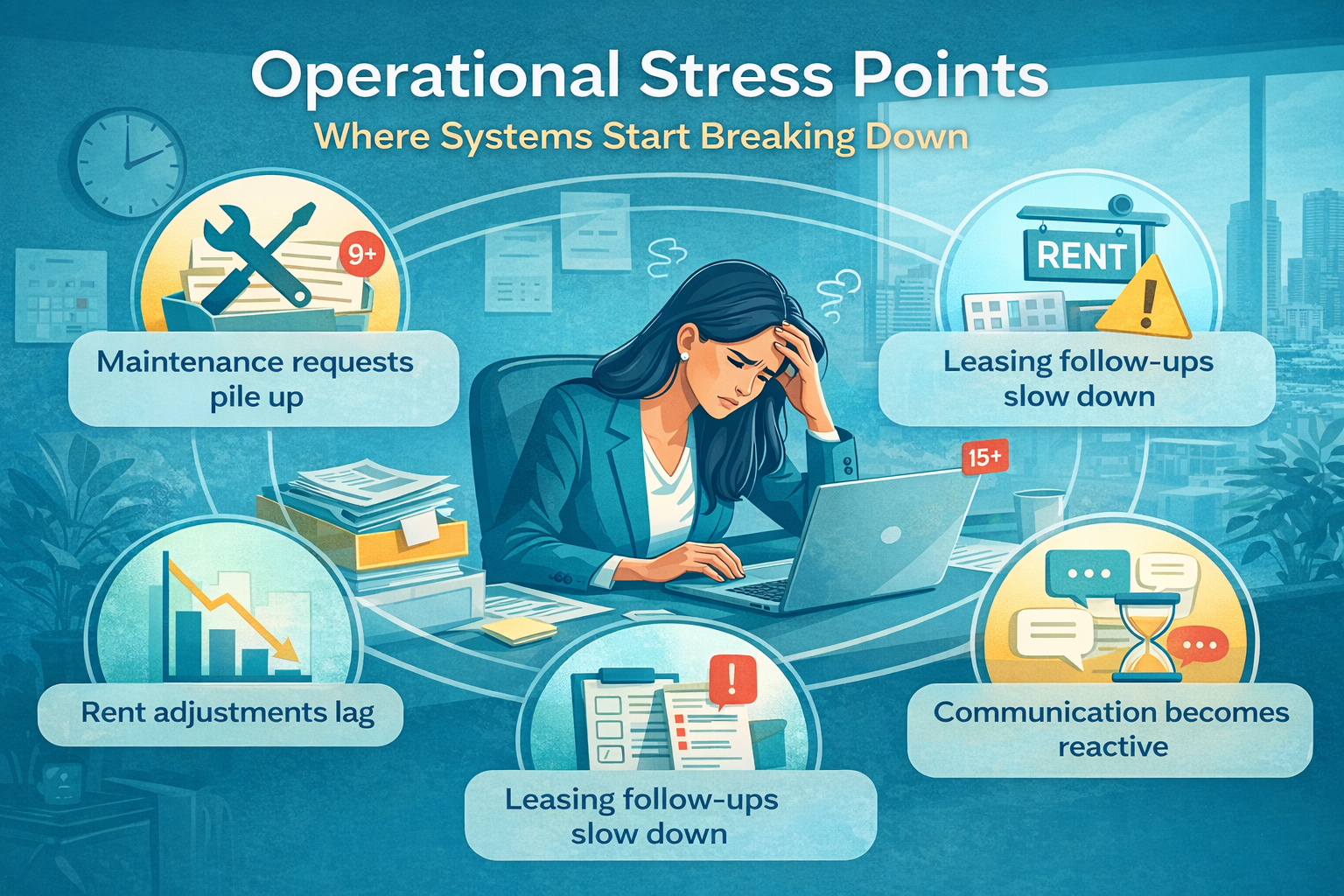
This is where systems start to matter more than individual effort. Clear workflows, defined authority levels, and reliable reporting make the difference between controlled growth and constant catch-up.
The Hidden Cost of Self-Managing Multifamily Properties
Self-managing multifamily properties can work. Until it doesn’t.
The cost is rarely measured in hours alone. It shows up in missed revenue and increased risk.
For many owners, this becomes the point where they start questioning whether self-managing a rental property in San Diego still makes sense, especially once unit counts increase.
Common hidden costs include:
- Vacancy stretching longer than expected
- Turnover expenses stacking up across multiple units
- Rent increases delayed because timing feels uncertain
- Compliance mistakes that only surface during inspections or disputes
A helpful way to frame this is to think in daily terms. Vacancy has a per-day cost. Even a short delay in leasing or pricing adjustments compounds quickly when applied across several units.
This is why how ignoring small issues becomes expensive later is not just a saying. At scale, it becomes math.
Compliance Pressure Is Heavier in Multifamily
In 2026, multifamily rental compliance California is no longer a background concern. For San Diego owners, it is a day-to-day operational responsibility that directly affects risk and performance.
Balcony inspections, habitability standards, notice requirements, and evolving rent control conversations all hit harder when multiple units are involved. Compliance timelines are less forgiving, and enforcement tends to move faster.
Owners who wait to “see how it plays out” often find themselves reacting instead of planning.
This is where understanding how San Diego rental regulations impact multifamily owners becomes operationally critical, not just legally relevant. Compliance is no longer a background concern. It is part of day-to-day management.
Concessions, Turnover, and Retention at Scale
In 2026, concessions are not a sign of weakness. They are a tactical tool.
Many multifamily operators are choosing to protect effective rent by offering short-term incentives rather than pushing rents beyond tenant comfort. Retention often delivers better results than constant re-leasing.
At scale, turnover hurts more than most owners expect. Each move-out triggers:
- Cleaning
- Repairs
- Leasing time
- Marketing costs
- Administrative work
Strong tenant communication and timely maintenance responses often do more to stabilize income than aggressive rent increases. This is where operational consistency quietly outperforms pricing bravado.
Scaling Decisions Multifamily Owners Face in 2026
Multifamily owners are approaching 2026 from very different positions.
Owners of 2–4 unit properties are often considering whether it’s time to move into 5+ unit assets. Meanwhile, existing multifamily owners are evaluating whether softening prices create opportunity or risk.
In both cases, the common thread is structure.

Scaling works best when:
- Systems are already in place
- Compliance processes are clear
- Reporting is accurate and timely
- Decision-making authority is defined
This is why how San Diego multifamily owners plan portfolio growth increasingly centers on operations, not just acquisitions.
When Professional Multifamily Property Management Pays Off
Professional management does not magically fix weak investments. But at scale, it often prevents avoidable losses.
Where multifamily owners tend to benefit most is not rent maximization, but risk reduction:
- Faster response times
- Better documentation
- Consistent enforcement of policies
- Clear vendor accountability
In San Diego, multifamily property management is less about convenience and more about control, which is why multifamily property management San Diego has become a risk-management decision as much as an operational one.
This is where working with a team experienced in professional property management in San Diego often becomes less about delegation and more about long-term control.
In multifamily properties, management is less about convenience and more about control. Control over time, risk, and long-term performance.
Final Thoughts on Multifamily Operations in 2026
Multifamily property ownership in San Diego remains compelling. But the rules of engagement have shifted.
In 2026, the owners who perform best are not necessarily the most aggressive. They are the most organized. They understand that scalability requires discipline, and that protecting ROI often means tightening operations before chasing growth.
Quiet efficiency is becoming the real advantage.
Talk to Billy & Yesenia

Multifamily decisions rarely hinge on a single factor. Pricing, turnover, compliance, and operational structure all intersect.
Billy and Yesenia work closely with San Diego multifamily owners to evaluate how portfolios are functioning today, not just how they look on paper. That includes reviewing operational bottlenecks, response capacity, compliance exposure, and how small adjustments can protect long-term returns.
If you are questioning whether your current setup is supporting your growth or quietly working against it, a conversation can help clarify where the real leverage points are.
Disclaimer: This article is intended for general informational purposes only and reflects common operational considerations in multifamily property management. It does not constitute legal, financial, or tax advice. Laws, regulations, and market conditions change frequently, and individual properties may be subject to different requirements. For guidance specific to your situation, consult a qualified California attorney, CPA, or licensed property management professional.
Key Takeaways
- Multifamily properties amplify both efficiency and inefficiency.
- Operational gaps tend to erode ROI quietly over time.
- Compliance pressure increases significantly at scale.
- Tenant retention often outperforms aggressive rent growth.
- Strong systems matter more than effort as portfolios grow.
FAQs
How many units can one property manager realistically handle?
A: There is no fixed number. Capacity depends on systems, support staff, and operational structure. Without systems, even moderate portfolios can strain.
Is self-managing multifamily properties still viable in 2026?
A; It can be, but risks increase as unit counts grow. The hidden costs of vacancy, compliance mistakes, and delayed responses often outweigh the savings.
Why does compliance matter more in multifamily properties?
A: Because inspections, enforcement, and tenant complaints scale with unit count. Mistakes impact multiple tenants at once.
Do concessions hurt long-term value?
A: Not necessarily. Strategic concessions can protect effective rent and reduce turnover, which often improves net income.
When does professional management make the most sense?
A: Typically when portfolios grow to the point where response times, documentation, or compliance start slipping. At that stage, management helps protect ROI rather than reduce it.
Reviewed by Yesenia Nogales Co-Founder & Commanding Officer, WeLease REALTOR® | DRE# 01487100: Yesenia Nogales is a licensed REALTOR® and Co-Founder of WeLease Property Management. She specializes in residential sales, investment properties, and property management. Yesenia served on the board of the NAHREP San Diego Chapter for four years and was President in 2017. She is an active member of both NAHREP and NARPM. She also leads the San Diego Women Real Estate Investors group and is a member of the Southern California Developers Creative Investors Association. In addition, she volunteers with Friends of Del Cerros; WeLease Credentials: NARPM® Member, BBB Accredited, MLS Participant, Equal Housing Opportunity. Recognized as San Diego’s Best Property Management Company – Union-Tribune Winner (2022, 2024); Finalist (2023, 2025). DRE: 02047533

Ivana M. Janakieva is a Property Management Marketer and SEO Content Manager who turns confusing real estate jargon into practical, actionable advice. She’s the type who reads maintenance reports like morning news and can make lease agreement clauses sound (almost) fun. With years of experience writing about everything from tenant turnover and landlord-tenant laws to climate risks and curb appeal ROI, Ivana creates content for people who want straight answers about protecting and profiting from their most valuable asset, their property.