San Diego Property Management: Your 2025 Year-End Ordinance Recap
Home / San Diego Property Management: Your 2025 Year-End Ordinance Recap
San Diego Property Management: Your 2025 Year-End Ordinance Recap
If you were a landlord or property manager in San Diego in 2025, it was a year that tested your resilience, but also reaffirmed the long-term value of real estate over time.
Between new tenant screening rules, security deposit photo requirements, utility fee restrictions, algorithmic pricing bans, emergency eviction pauses, and Imperial Beach deciding to create its own landlord rulebook, this year threw everything at you except a parade.
But here’s the good news: we made it through. And now, as we close out 2025 and head into 2026, it’s time to take stock of what actually changed, what you need to fix, and what’s coming next.
Prefer the quick version? We break down the biggest landlord law updates and what they mean for San Diego property owners heading into 2026. Watch the video –>
Here follows a very straightforward article with just the facts you need to know to keep your rental business compliant and (hopefully) profitable.
The Big Headlines: What Changed in 2025
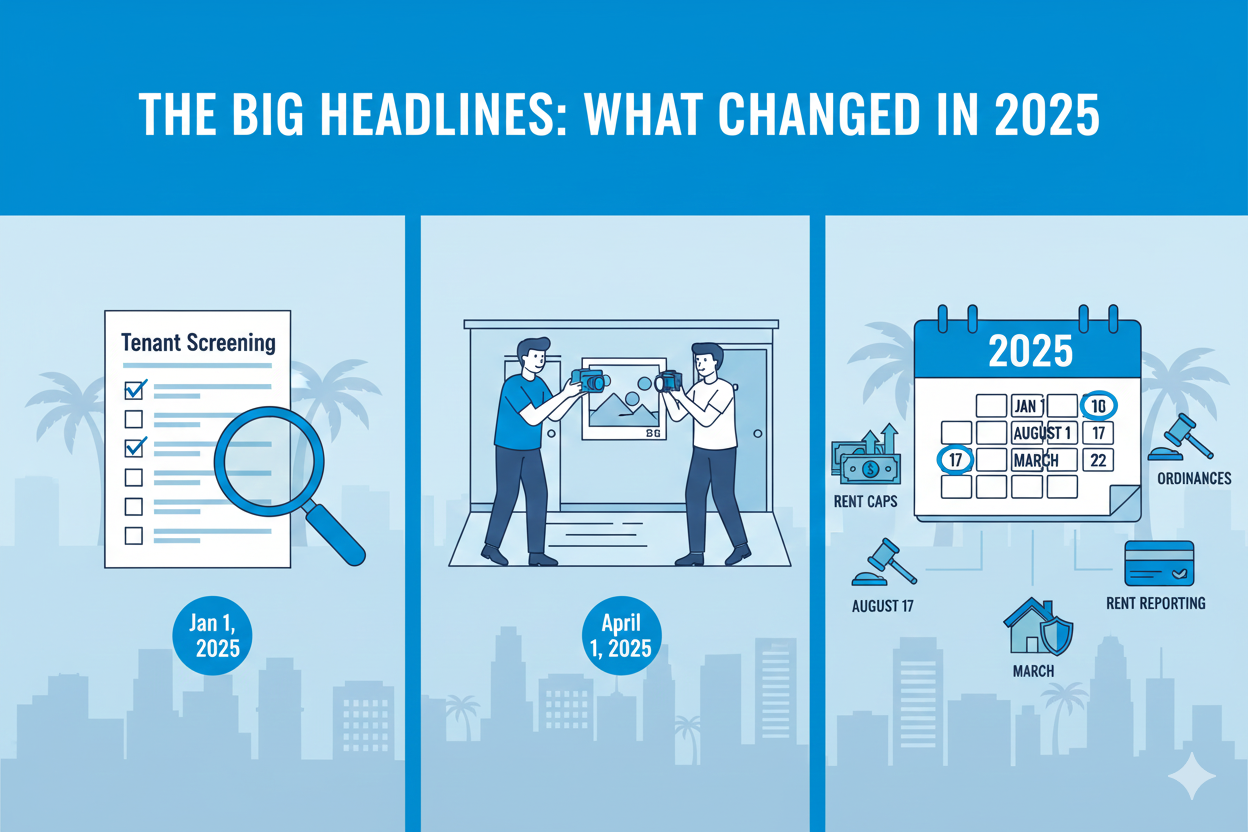
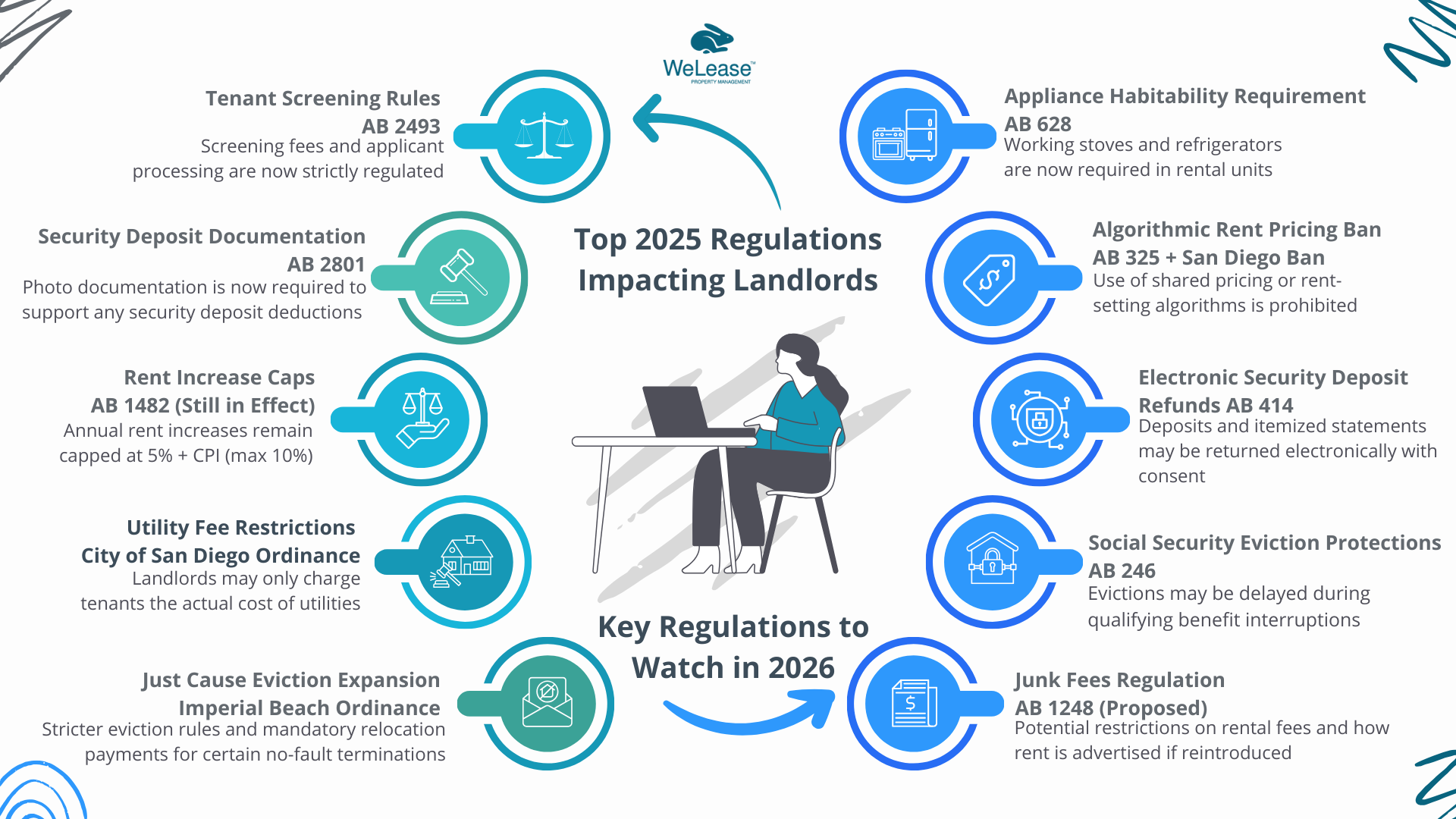
AB 2493: New Tenant Screening Rules (Effective January 1, 2025)
California decided that landlords were getting a little too creative with application fees, so AB 2493 came along to tighten things up.
Here’s what changed:
You can only charge screening fees if you have an actual available unit. No more collecting fees for waiting lists or “maybe available soon” situations. If there’s no real vacancy (or imminent vacancy), you can’t charge.
You must provide applicants with a copy of their credit report within 7 days. If you pulled their credit as part of screening, they get to see it. No exceptions.
You must accept reusable screening reports from applicants. If a tenant already paid for their own background check or credit report through an approved service, you have to accept it instead of running your own (and charging them again).
Oh, and screening must now be first-come, first-served if you’re charging fees. That means you can’t cherry-pick applicants and charge everyone along the way.
Bottom line: Update your application process. Train your leasing staff. Make sure you’re only charging fees when you have real vacancies, and keep documentation showing when units became available.
AB 2801: Security Deposit Photo Requirements (Effective April 1, 2025)
This one’s a game-changer for how you handle move-outs.
Starting April 1, 2025, if you plan to deduct anything from a tenant’s security deposit, you must take timestamped photographs of the unit at move-out, before you do any repairs or cleaning.
The law also clarifies what you can and can’t deduct:
- Allowed: Unpaid rent, cleaning beyond normal wear and tear, tenant-caused damage, replacement of furnishings or keys (if specified in the lease)
- Not allowed: Pre-existing defects, normal wear and tear
When you return the deposit (or what’s left of it), you have 21 days to provide an itemized statement with receipts and photos documenting the deductions.
However, if you don’t take those photos, your deductions might not hold up if the tenant disputes them. Courts now expect visual proof.
Bottom line: Create a move-out inspection checklist. Invest in a good camera (your phone works fine). Take photos of everything before you touch anything. Store them with timestamps. This isn’t optional anymore.
AB 2747: Rent Reporting to Credit Bureaus (Effective April 1, 2025)
This law requires larger landlords and corporate property owners to offer tenants the option to have their on-time rent payments reported to credit bureaus.
The idea is to help renters build credit history, especially those who’ve been paying rent reliably for years but have thin credit files.
If you’re a smaller landlord, this might not apply to you yet. But if you manage multiple properties or operate as a corporate entity, check whether you’re covered and start researching credit reporting services.
Bottom line: This is about tenant benefits, not landlord obligations (for now). But expect tenants to start asking about it. Be ready with an answer.
AB 325: Algorithmic Price-Fixing Ban (Effective January 1, 2026)
AB 325 is California’s response to concerns about rent-setting software like RealPage and other “revenue optimization” platforms that use data from multiple landlords to recommend rental prices.
The law updates California’s antitrust statute (the Cartwright Act) to prohibit the use of “common pricing algorithms” that process competitor data to set or recommend prices across multiple businesses or properties.
Translation: If your rent-pricing software collects non-public data from other landlords and uses it to tell you what to charge, that’s now illegal.
The law also makes it easier for plaintiffs to bring antitrust lawsuits. They no longer have to prove that independent action was impossible, just that collusion is plausible.
Here’s what this means for you:
If you’re using dynamic pricing tools, audit them now. Make sure they only use publicly available data (Zillow, Craigslist, published market reports) and not pooled competitor data.
If your software vendor can’t guarantee compliance, find a new vendor or switch to manual pricing based on your own costs, comps, and market research.
Bottom line: Algorithmic rent-setting is under fire both at the state level and locally (see San Diego’s ban below). If you’re using these tools, January 1, 2026 is your deadline to get compliant.
San Diego’s Algorithmic Rent Price-Fixing Ban (Ordinance O-2025-107)
San Diego didn’t wait for the state. The city passed its own ban on algorithmic rent-setting in 2025, prohibiting landlords from using software that incorporates non-public competitor data from multiple landlords to set or recommend rents.
The goal? Prevent artificially inflated rents and anti-competitive behavior.
If you manage properties in the City of San Diego and you’re using rent-setting algorithms, you need to either stop using them or verify they comply with this ordinance (and AB 325 when it takes effect in 2026).
Bottom line: San Diego means business on this one. Violating the ordinance exposes you to legal risk. Review your pricing tools immediately.
San Diego Residential Tenant Utility Fee Ordinance (Effective August 17, 2025)
On July 15, 2025, San Diego passed an ordinance regulating how landlords can charge tenants for city-provided utilities (water, sewer, stormwater, waste management).
The key rule: You can only charge tenants the actual cost you pay. No markups. No inflated “utility fees.”
If you were already charging tenants for utilities before August 17, 2025, you have 90 days to provide required lease disclosures and update your billing practices.
You also need to maintain documentation showing what you actually paid for utilities so you can prove you’re not overcharging.
Bottom line: If you manage rentals in San Diego, audit your utility billing practices. Update lease addenda. Keep utility bills on file. This ordinance has teeth.
San Diego County Tenant Protection Ordinance for Emergencies (Effective May 2025)
In response to recent wildfires and other disasters, San Diego County passed an ordinance protecting tenants affected by declared local emergencies.
Under this ordinance:
- Landlords cannot initiate eviction actions against tenants in areas affected by a declared emergency for at least 7 days following the declaration.
- Any pending evictions in the affected area are paused until the emergency ends.
This applies county-wide, including within incorporated cities, once the county’s chief administrative officer declares an emergency.
Bottom line: Track local emergency declarations. If your property is in an affected area, you cannot proceed with evictions during the protected window. Plan accordingly.
Imperial Beach Just Cause Eviction Ordinance (Effective March 22, 2025)
Imperial Beach decided to go above and beyond state law with its own just cause eviction ordinance (Ordinance 2025-1253).
The ordinance requires landlords to show “just cause” for eviction and imposes stricter relocation payment requirements than AB 1482, especially for substantial remodels or demolitions.
Relocation payments for no-fault evictions:
- General tenants: Two months’ relocation (one month at market rate + one month of current rent)
- Elderly or disabled tenants: Three months’ relocation (two months at market rate + one month of current rent)
These payments are required for substantial remodels or demolitions in multi-unit complexes of 15 or more units.
The ordinance also narrows what qualifies as a “substantial remodel.” Minor work like painting, flooring replacement, cabinet/counter replacement, or window replacement doesn’t count if it can be done safely without vacating the unit.
Landlords must also file required eviction notices with the city when proceeding with just cause terminations.
Bottom line: If you manage properties in Imperial Beach, especially larger complexes, this ordinance significantly increases your compliance burden. Document everything. Budget for relocation payments. Verify that remodel work qualifies as “substantial” before pursuing evictions.
AB 130: New HOA Fine Limits (Effective June 30, 2025)
If you manage HOA properties or deal with homeowners’ associations, AB 130 limits how much HOAs can fine residents.
Starting June 30, 2025:
- General fine cap: $100 per violation (unless it’s a health or safety issue)
- Health and safety exception: HOAs can impose higher fines only if they make a written finding during an open meeting that the violation creates a health or safety risk.
HOAs must also give homeowners a reasonable opportunity to cure violations before imposing fines. If the homeowner fixes the issue or submits proof of a financial commitment to fix it before the hearing, no fine can be imposed.
Boards must send written results of disciplinary hearings within 14 days, and homeowners can request Internal Dispute Resolution (IDR) if they disagree with the decision.
Bottom line: If you manage HOA properties, make sure your association’s fine policies comply with AB 130. Document health and safety findings properly if imposing fines above $100.
Rent Increase Caps: AB 1482 Still in Effect
AB 1482 (the California Tenant Protection Act) continues to cap annual rent increases at 5% plus the local Consumer Price Index (CPI), with a maximum of 10%.
For San Diego County, the CPI for April 2025 came in at around 3.8%, which means the maximum allowable rent increase for covered properties is approximately 8.8% for the period between August 1, 2025, and July 31, 2026.
(Los Angeles County sits at 8.0% for comparison.)
Keep in mind:
- AB 1482 applies to most residential properties over 15 years old.
- Single-family homes not owned by corporations, condos, and certain new construction are exempt.
- Local rent control ordinances with stricter limits override the state cap.
Bottom line: Verify your property is covered under AB 1482 or local ordinances. Calculate rent increases carefully. Use the correct notice period (30 days for increases of 10% or less, 90 days for anything above).
Updated Landlord Disclosure Requirements
California continues to require specific disclosures at lease signing and throughout tenancy. For 2025 and 2026, make sure your leases include:
- Material conditions or safety hazards (mold, structural defects, pests)
- Lead-based paint disclosure for pre-1978 properties
- Utility and RUBS cost-sharing notifications
- Ownership or exemption disclosure for single-family homes under AB 1482
- Local rent control or registration documents
Bottom line: Audit your lease templates and update them with all required disclosures. Failure to disclose properly can invalidate rent increases or exemptions.
What’s Coming in 2026: Get Ready Now
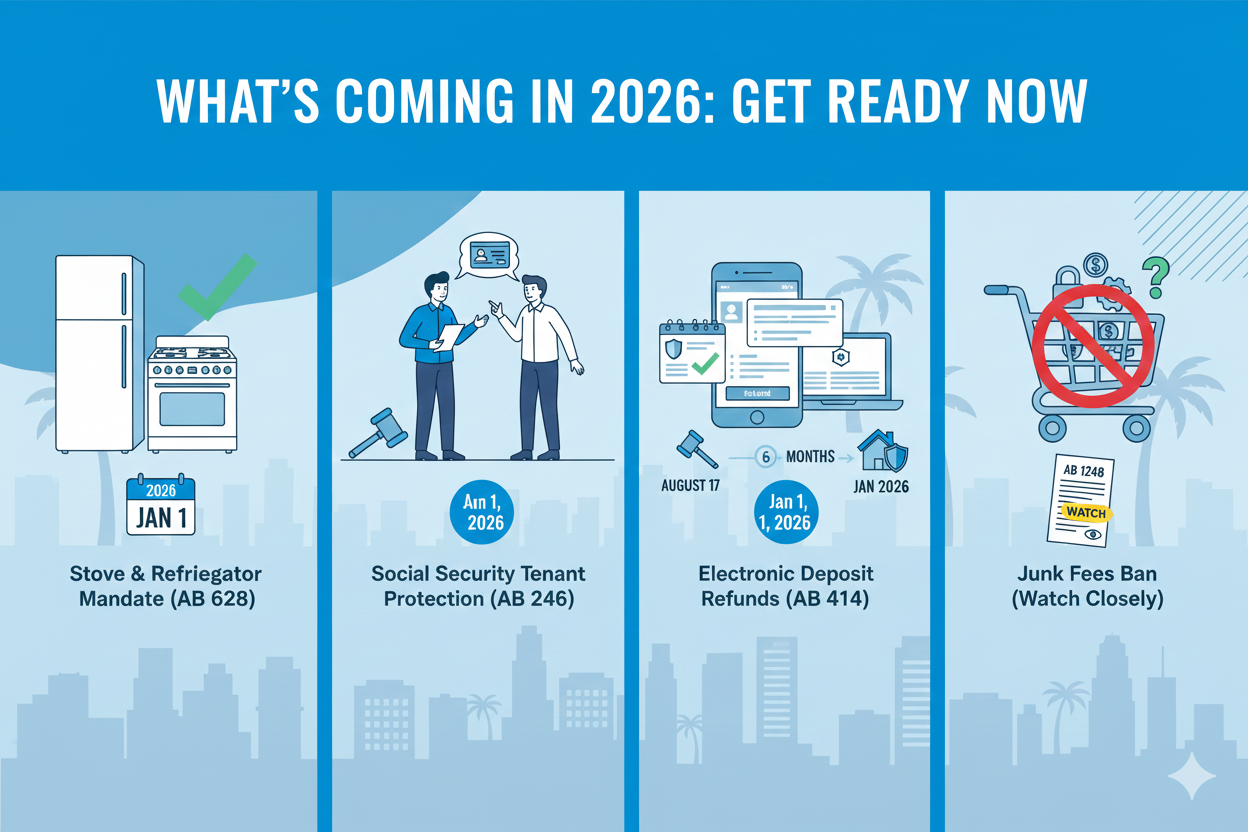
AB 628: Stove and Refrigerator Mandate (Effective January 1, 2026)
Starting January 1, 2026, California expands habitability standards to require landlords to provide and maintain working stoves and refrigerators.
What qualifies as “working”?
- A stove must be maintained in good working order and capable of safely generating heat for cooking.
- A refrigerator must be maintained in good working order and capable of safely storing food.
Tenants can bring their own refrigerator (but not their own stove) if the lease includes specific language acknowledging the arrangement:
“Under state law, the landlord is required to provide a refrigerator in good working order in your unit. By checking this box, you acknowledge that you have asked to bring your own refrigerator and that you are responsible for keeping that refrigerator in working order.”
The lease must also state that the tenant can give 30 days’ written notice if they change their mind, and the landlord must then install a working refrigerator within that 30-day period.
Bottom line: Inspect your appliances now. Budget for replacements if needed. Update your leases to include the required language. Come January 1, 2026, a broken fridge or stove is a habitability violation.
AB 246: Social Security Tenant Protection Act (Effective 2026, Sunsets 2029)
AB 246 allows tenants to assert “Social Security hardship” as an affirmative defense in eviction proceedings for non-payment of rent, but only if their household relied on Social Security (or related federal benefits) and those benefits were interrupted, delayed, or reduced due to no fault of the tenant (e.g., federal government action).
If a court finds the defense valid, it must stay the eviction until either:
- The benefits resume and stay in effect for 14 days, or
- Six months elapse (whichever comes first)
The tenant remains responsible for past-due rent. Once benefits resume, they must pay what’s owed or enter a payment plan with the landlord within 14 days. If they comply, the eviction is dismissed.
This law only applies to non-payment evictions. Other grounds (lease violations, nuisance, illegal activity) are unaffected.
The protections sunset on January 20, 2029.
Bottom line: If you have tenants who rely on Social Security and benefits are interrupted, expect potential delays in eviction proceedings. This doesn’t forgive rent, but it does create uncertainty and longer timelines.
AB 414: Electronic Security Deposit Refunds (Effective January 1, 2026)
AB 414 modernizes how landlords handle security deposit refunds and itemized deduction statements.
Starting January 1, 2026:
- If tenants paid their deposit electronically, landlords and tenants can agree to return the refund electronically.
- Itemized statements can be delivered by email or secure portal if the tenant consents.
- For units with multiple adult tenants, the default is one refund check payable to all tenants, with the statement sent to any one adult tenant (unless otherwise agreed in writing).
The 21-day refund timeline remains unchanged. Electronic delivery requires mutual agreement between landlord and tenant.
Bottom line: Update your lease templates and security deposit procedures to allow electronic refunds and statements (with tenant consent). Document agreements for multi-tenant units.
AB 1248: “Junk Fees” Ban (Not Yet Law, But Watch Closely)
AB 1248 was introduced in 2025 to crack down on “junk fees” and hidden housing-related charges beyond base rent.
The bill would have:
- Required landlords to include all required fees in advertised rent prices
- Prohibited most separate or additional “optional” fees
- Restricted ratio utility billing systems (except possibly for water/sewer under certain conditions)
- Required payments to be applied to rent first, before fees
On June 3, 2025, the bill was ordered to inactive file, meaning it did not become law. However, it’s a two-year bill and could be reintroduced in 2026.
Bottom line: AB 1248 isn’t law yet, but if it passes in 2026, it will require major changes to how you structure fees, advertise rentals, and bill for utilities. Keep an eye on this one.
How to Stay Compliant in 2026
California rental laws feel like a full-time job at this point. And if you manage multiple properties in San Diego, it basically is.
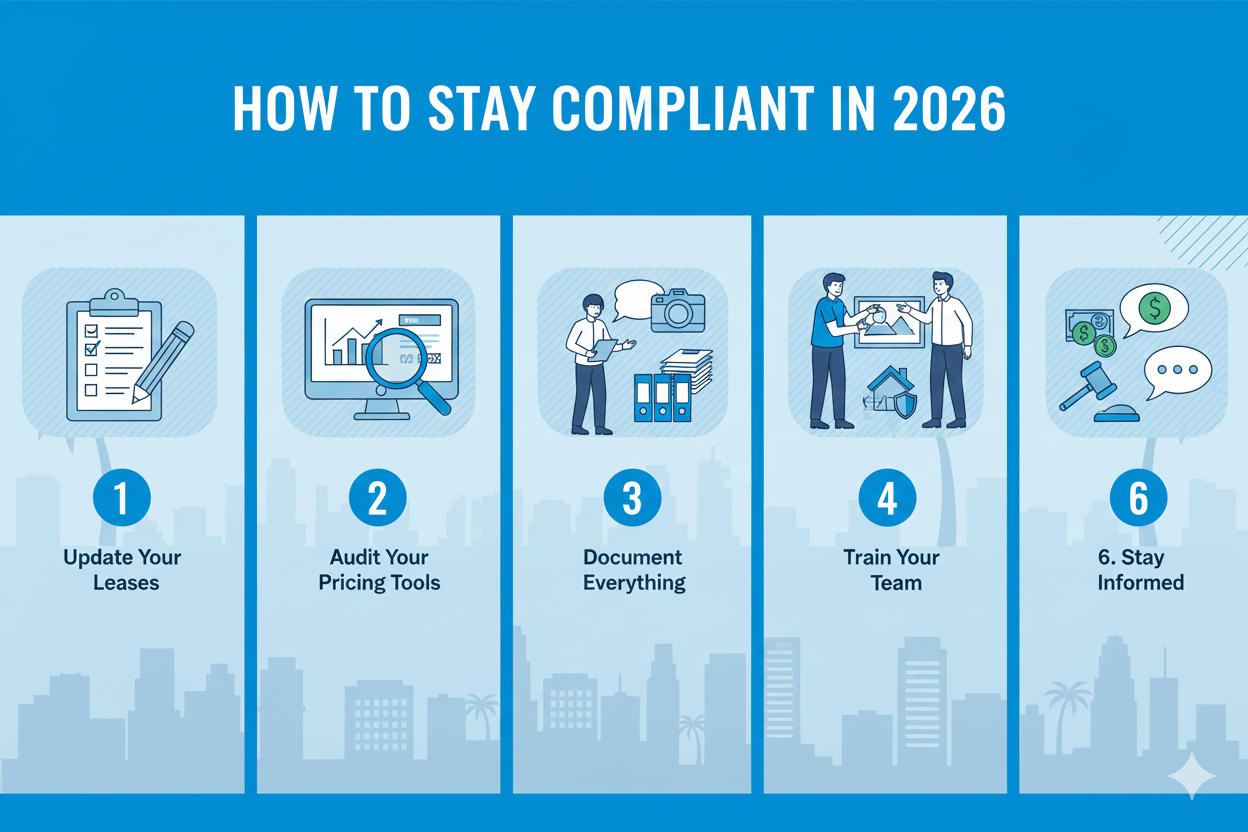
Here’s your game plan for staying compliant:
1. Update Your Leases Immediately
Make sure your lease agreements reflect:
- AB 2801 security deposit photo requirements
- AB 628 stove and refrigerator provisions
- AB 414 electronic refund language
- San Diego utility fee ordinance disclosures
- AB 1482 rent cap disclosures
- Imperial Beach just cause language (if applicable)
2. Audit Your Pricing Tools
If you’re using rent-setting software, verify it complies with AB 325 and San Diego’s algorithmic pricing ban. If it doesn’t, switch to manual pricing or find compliant alternatives.
3. Document Everything
Keep records of:
- Tenant screening processes and available units
- Move-in and move-out photos (timestamped)
- Utility bills and cost pass-throughs
- Rent increase calculations and CPI data
- Eviction notices and relocation payments
- Emergency declarations and eviction pauses
4. Train Your Team
Make sure anyone involved in property management (leasing agents, maintenance staff, administrative personnel) understands the new requirements. One mistake can cost you thousands.
5. Work with Professionals
Whether it’s a property manager, an attorney, or both, get help. The cost of professional guidance is nothing compared to the cost of a lawsuit or a denied eviction.
6. Stay Informed
Laws change constantly. Subscribe to updates from the California Apartment Association, local rental housing associations, or legal resources that track landlord-tenant law changes.
The Reality Check
San Diego’s rental regulations are among the strictest in California. And California’s regulations are among the strictest in the country.
But here’s the good news. Most landlords who run into trouble aren’t the ones trying to comply. They’re the ones who ignored the rules, hoped nobody would notice, or thought they could wing it.
If you stay informed, follow the law, document your actions, and treat tenants fairly, you’ll be fine.
Will it take more time than it used to? Yes.
Will you need to budget for things like photo documentation, appliance replacements, and relocation payments? Also yes.
But the alternative (legal disputes, fines, damaged reputation, lost rental income) is far worse.
Looking Ahead
As we head into 2026, expect more of the same. California isn’t backing off on tenant protections. If anything, the trend is toward stricter enforcement and more landlord obligations.
Keep an eye on:
- AB 1248 (if it’s reintroduced)
- Local ordinances in San Diego and surrounding cities
- The 2026-2027 rent cap announcement (due April 2026)
- Any new emergency protection measures
And remember, being a good landlord isn’t just about checking compliance boxes. It’s about maintaining properties people want to live in, communicating clearly, and solving problems before they become lawsuits.
Final Thoughts
2025 was a year of major adjustments. New screening rules. Photo requirements. Utility fee restrictions. Algorithmic pricing bans. Emergency eviction pauses. Imperial Beach creating its own rulebook.
But if you’ve made it this far in the article, you’re already ahead of most landlords. You’re paying attention. You’re staying informed. And that’s the difference between running a successful rental business and getting blindsided by a compliance issue.
So take a breath. Update your systems. Check in with your property manager or attorney. Inspect those appliances. Audit your software. And head into 2026 ready to comply with the rules while still running a profitable business.
Because yes, it’s possible to do both.
Need help navigating San Diego’s property management regulations?
Talk to Yesenia or Billy Before You Make Your Next Move

Call WeLease at (619) 866-3400 to connect with Yesenia or Billy. If you’re staring down a security deposit dispute, trying to figure out whether your rent-pricing software is compliant, or wondering how to handle a tenant affected by emergency declarations, they’ve been there and done that more times than they can count.
They’ve spent years helping San Diego landlords navigate the messy overlaps between state laws, county ordinances, and city-specific requirements. Whether you’re dealing with algorithmic pricing bans, Imperial Beach relocation payments, utility fee pass-throughs, or appliance habitability questions, Yesenia and Billy will give you straight answers about what applies to your property and how to stay compliant without tearing your hair out.
And if you’re feeling buried under all these new rules (completely understandable), they’ll help you focus on what actually matters for your specific situation, not just the noise you’re reading online.
DISCLAIMER: This article provides general information about California and San Diego property management laws and ordinances effective in 2025 and 2026. It is not intended as personalized legal, financial, or property management advice. Rental regulations change frequently, and your obligations may vary based on property location, age, ownership structure, exemption status, tenant circumstances, and local ordinances.
Before taking action on evictions, rent increases, security deposits, tenant screening, lease amendments, utility billing, relocation assistance, or compliance with algorithmic pricing bans, consult with a qualified attorney, financial professional, or an experienced property management specialist.
The information in this article is current as of December 2025 but may be subject to updates, amendments, or new legislation. Laws referenced include AB 628, AB 2493, AB 2801, AB 2747, AB 325, AB 246, AB 414, AB 130, AB 1482, and various San Diego city and county ordinances.
For property-specific guidance or help staying compliant with California, San Diego County, and City of San Diego regulations, contact WeLease at (619) 866-3400.
Reviewed by Yesenia Nogales Co-Founder & Commanding Officer, WeLease REALTOR® | DRE# 01487100: Yesenia Nogales is a licensed REALTOR® and Co-Founder of WeLease Property Management. She specializes in residential sales, investment properties, and property management. Yesenia served on the board of the NAHREP San Diego Chapter for four years and was President in 2017. She is an active member of both NAHREP and NARPM. She also leads the San Diego Women Real Estate Investors group and is a member of the Southern California Developers Creative Investors Association. In addition, she volunteers with Friends of Del Cerros; WeLease Credentials: NARPM® Member, BBB Accredited, MLS Participant, Equal Housing Opportunity. Recognized as San Diego’s Best Property Management Company – Union-Tribune Winner (2022, 2024); Finalist (2023, 2025). DRE: 02047533
References
California Legislative Information
- AB 628 (Stoves and Refrigerators): https://leginfo.legislature.ca.gov/faces/billNavClient.xhtml?bill_id=202520260AB628
- AB 2493 (Tenant Screening): https://leginfo.legislature.ca.gov/
- AB 2801 (Security Deposit Documentation): https://leginfo.legislature.ca.gov/
- AB 325 (Algorithmic Price-Fixing): https://leginfo.legislature.ca.gov/
- AB 246 (Social Security Tenant Protection): https://leginfo.legislature.ca.gov/
- AB 414 (Electronic Security Deposit Refunds): https://leginfo.legislature.ca.gov/
- AB 130 (HOA Fine Limits): https://leginfo.legislature.ca.gov/
- AB 1482 (Tenant Protection Act): https://leginfo.legislature.ca.gov/
San Diego City and County Resources
- City of San Diego Official Documents: https://www.sandiego.gov/
- San Diego County Ordinances: https://www.sandiegocounty.gov/
- Imperial Beach Municipal Code: https://www.imperialbeachca.gov/
Industry Resources
- California Apartment Association: https://caanet.org/
- Southern California Rental Housing Association: https://www.socalrha.org/
- California Department of Real Estate: https://www.dre.ca.gov/
Consumer Price Index Data
- U.S. Bureau of Labor Statistics (CPI Data): https://www.bls.gov/

Ivana M. Janakieva is a Property Management Marketer and SEO Content Manager who turns confusing real estate jargon into practical, actionable advice. She’s the type who reads maintenance reports like morning news and can make lease agreement clauses sound (almost) fun. With years of experience writing about everything from tenant turnover and landlord-tenant laws to climate risks and curb appeal ROI, Ivana creates content for people who want straight answers about protecting and profiting from their most valuable asset, their property.