Business Improvement Districts (BIDs) in San Diego: What Landlords Need to Know
Home / Business Improvement Districts (BIDs) in San Diego: What Landlords Need to Know
Business Improvement Districts (BIDs) in San Diego: What Landlords Need to Know
Do you own rental property in San Diego? Maybe it’s a small apartment near Hillcrest or a storefront space in North Park. And now you’re hearing whispers about Business Improvement Districts, BIDs for short. What are they? Why should you care? And more importantly, are they another expense dressed up as “community benefit”?
That last question, by the way, is one a lot of landlords quietly mutter under their breath. Fair enough.
But before you roll your eyes, let’s take a closer look. Because whether you like them or not, San Diego Business Improvement Districts have real-world implications for you, your tenants, and your bottom line. And yes, your property manager should already know how to navigate this, but it never hurts to understand the lay of the land yourself.
What Exactly Is a BID?
Think of a BID as a neighborhood’s version of crowdfunding, but with less GoFundMe sentimentality and more structured fees. Property owners and businesses in certain zones chip in financially. That pooled money then gets funneled back into the area for things like street cleaning, safety ambassadors, landscaping, or even splashy events that lure in customers.
San Diego currently has 18 BIDs, covering areas like Little Italy, North Park, Hillcrest, and Pacific Beach. Collectively, they generate millions of dollars annually for neighborhood improvement in San Diego. That’s not chump change.
If you’re a landlord, this matters because those fees can affect your operating costs. Your property manager should factor BID assessments into expense planning so you’re not blindsided by a bill you didn’t expect.
San Diego’s Current BIDs
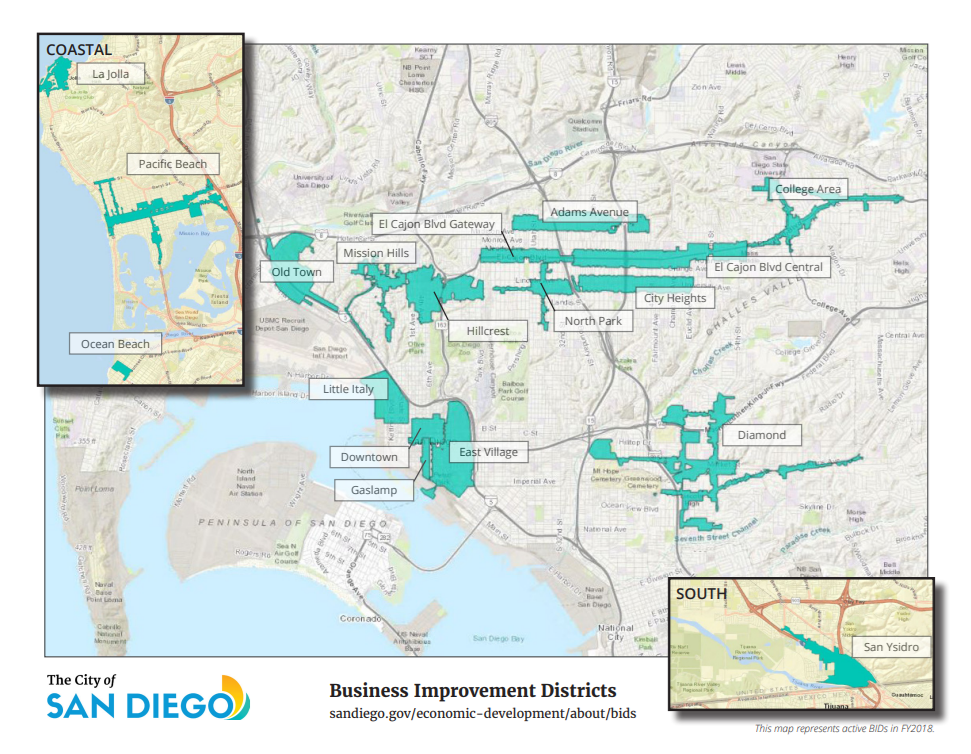
According to the City of San Diego (2018), there are 18 active Business Improvement Districts across the city. These districts range from coastal neighborhoods like La Jolla and Pacific Beach to urban hubs such as Downtown, North Park, and Hillcrest.
Here’s the full list of San Diego BIDs and their estimated business participation and annual assessments:
Figure 1. Active Business Improvement Districts in San Diego. Adapted from The City of San Diego, 2018.
| BID Name | Estimated Number of Businesses | Estimated Annual Assessments |
| Adams Avenue | 588 | $45,000 |
| City Heights | 490 | $40,000 |
| College Area | 470 | $65,000 |
| Diamond | 396 | $0 |
| Downtown | 909 | $97,000 |
| East Village | 500 | $140,000 |
| El Cajon Blvd Central | 686 | $64,000 |
| El Cajon Blvd Gateway | 322 | $32,000 |
| Gaslamp | 405 | $76,730 |
| Hillcrest | 1,081 | $115,000 |
| La Jolla | 1,176 | $130,000 |
| Little Italy | 683 | $82,500 |
| Midway | 1,202 | $0 |
| Mission Hills | 490 | $27,000 |
| Morena | 475 | $0 |
| North Park | 365 | $52,375 |
| Ocean Beach | 352 | $27,500 |
| Old Town | 428 | $35,000 |
| Pacific Beach | 1,247 | $155,000 |
| San Ysidro | 708 | $150,000 |
(Note: Assessments for Diamond, Midway, and Morena were not levied in FY2010.)
This breakdown shows just how significant BIDs are: not just in size but also in financial impact. Collectively, they funnel millions of dollars back into neighborhood improvements every year.
The Upside Nobody Tells You About
It’s easy to view BIDs as one more tax wearing a friendlier name. But pause for a second. Cleaner streets, better lighting, organized events, all of this makes a neighborhood more appealing. And what happens when a neighborhood feels safer, cleaner, and, well, cooler? Higher tenant demand.
If you’ve ever wondered why North Park is one of the hottest rental neighborhoods in San Diego, BIDs are part of the reason. Same story with Little Italy. Those areas didn’t just “naturally” glow up. Coordinated investment made a difference.
So yes, you pay into the pot. But you also benefit when rents go up or vacancies shrink.
The Hidden Costs
Now for the part where things get tricky. BID fees aren’t always transparent at first glance. They can vary depending on property type, square footage, or even how close you are to the BID’s central “action zone.” Some landlords absorb the costs. Others pass them to tenants. Both approaches can spark debate.
And if you’re already juggling rising insurance rates, new compliance requirements, or the latest round of San Diego Ordinance 2025 updates, that extra line item on your budget might sting.
That’s why it helps to keep a running tally of all expenses. You’d be surprised how many landlords only realize they’re bleeding money when it’s too late. (If you haven’t asked yourself lately, are you losing money as a landlord?, the answer might be hiding in plain sight.)
Where BIDs Collide With Bigger Issues
BIDs don’t exist in a vacuum. They overlap with other pressures in San Diego’s rental market. Take rent control under AB-1482, for example. If your ability to raise rent is capped but your expenses keep climbing, including BID fees, you’re in a tighter spot than you might like.
Same with tenant relations. If you’re passing BID assessments along in triple-net leases or commercial agreements, you’ll want to keep communication transparent. Nothing tanks a tenant relationship faster than a surprise charge labeled “community benefit fee.”
And if things spiral into nonpayment, well, now you’re staring down the complexities of evictions in 2025 in San Diego. Nobody wants to go there, but it happens.
Practical Advice: Don’t Just Sit Back
Here’s the thing. BIDs can be a headache if you ignore them. But if you engage, even a little, you can actually steer outcomes. Many BIDs have boards or committees that welcome landlord input. That’s your chance to influence how the money is spent. Want more security patrols and less “street art festivals”? Show up.
It also pays to compare. If you’re debating whether to hold onto your property or cash out in a hot market, factor BIDs into the decision. (In fact, if you’ve been weighing the whole keep or sell your rental property in 2025 dilemma, BID costs might tip the scale one way or the other.)
And if you’re testing different rental strategies, say, deciding between short-term vs. long-term rentals in San Diego, BIDs can shape tenant preferences. Tourists might love the nightlife events, while long-term tenants may value safety patrols more.
Why You Shouldn’t Overthink It
At the end of the day, BIDs aren’t going anywhere. San Diego’s been leaning into them for decades, and the trend is only growing. Whether you’re enthusiastic or skeptical, your best move is to stay informed, budget accordingly, and leverage the benefits where you can.
And honestly, that’s where having a good property manager (and yes, I’ll mention them one more time) really pays off. They’ll keep track of the fine print, stay on top of deadlines, and maybe even attend those BID meetings so you don’t have to.
Wrapping It Up
Owning property in San Diego already comes with enough curveballs. Rent caps, insurance hikes, ordinance changes, you name it. Business Improvement Districts are just another piece of that puzzle.
The difference is, they don’t have to work against you. If you play it right, they can actually make your investment more valuable. That’s why we always remind landlords: stay proactive, not reactive. And if you ever feel like you’re drowning in the alphabet soup of BIDs, AB-1482s, or city ordinances, that’s exactly what we’re here for at WeLeaseUSA.
We’ve sat through the endless meetings, translated the city jargon, and helped landlords adjust without losing sleep. So you don’t have to figure it out alone.

👉 Call WeLeaseUSA at (619) 866-3400 if you are still scratching your head about San Diego Business Improvement Districts. Or maybe you’re just wondering how those extra fees fit into your rental math. Call WeLeaseUSA at (619) 866-3400 and ask for Yesenia or Billy. They’re the kind of folks who won’t just toss jargon at you—they’ll actually pick up the phone, break down what a BID means for your property, and help you avoid the kind of landlord mistakes that get expensive fast.
Disclaimer: This article shares general insights about San Diego Business Improvement Districts and how they might affect landlords. It’s not personalized financial, legal, or investment advice. Rules change, BID fees vary, and outcomes depend on property type, location, and management style. For advice specific to your situation, talk to an attorney or experienced property management professionals. And if you’d rather skip the guesswork, you can always reach WeLeaseUSA at (619) 866-3400.
Key Takeaways
- Business Improvement Districts (BIDs) pool fees from property owners to fund neighborhood upgrades.
- Cleaner, safer, and more vibrant areas usually mean stronger tenant demand.
- BID fees vary by property type and location, so budget for them early.
- In hot rental spots like North Park and Little Italy, BIDs are part of what drives demand.
- Costs can sneak up on you if you’re not tracking expenses closely.
- Engaging with your BID gives you a say in how funds are spent.
- Property managers can help you navigate the fine print so you’re not stuck figuring it out alone.
FAQs About San Diego Business Improvement Districts
What is a Business Improvement District (BID)?
A: It’s a designated area where local property owners and businesses pay fees that go toward neighborhood improvements like cleaning, safety, and events.
Do landlords have to pay BID fees?
A: Usually, yes. The fees are based on factors like property type, square footage, or location. Some landlords absorb the costs, while others pass them on to tenants.
Are BIDs worth the money?
A: They can be. Cleaner streets and safer neighborhoods make rentals more attractive, which often means higher demand and lower vacancy rates.
Can landlords influence how BID money is spent?
A: Yes. Most BIDs have boards or committees where property owners can weigh in. Showing up to a meeting (or sending your property manager) gives you a say.
How do BIDs affect long-term vs. short-term rentals?
A: Tourist-friendly events may boost short-term rental appeal, while ongoing safety and upkeep tend to attract long-term tenants. It depends on your strategy.
What’s the biggest mistake landlords make with BIDs?
A: Ignoring them. If you don’t budget for fees or understand how they affect your property’s bottom line, you’re more likely to feel blindsided later.
Reference
The City of San Diego. (2018). Business Improvement Districts (BIDs) [Map and data chart]. Economic Development Department. Retrieved from https://www.sandiego.gov/economic-development/about/bids
Reviewed by Yesenia Nogales Co-Founder & Commanding Officer, WeLease REALTOR® | DRE# 01487100: Yesenia Nogales is a licensed REALTOR® and Co-Founder of WeLease Property Management. She specializes in residential sales, investment properties, and property management. Yesenia served on the board of the NAHREP San Diego Chapter for four years and was President in 2017. She is an active member of both NAHREP and NARPM. She also leads the San Diego Women Real Estate Investors group and is a member of the Southern California Developers Creative Investors Association. In addition, she volunteers with Friends of Del Cerros; WeLease Credentials: NARPM® Member, BBB Accredited, MLS Participant, Equal Housing Opportunity. Recognized as San Diego’s Best Property Management Company – Union-Tribune Winner (2022, 2024); Finalist (2023, 2025). DRE: 02047533

Ivana M. Janakieva is a Property Management Marketer and SEO Content Manager who turns confusing real estate jargon into practical, actionable advice. She’s the type who reads maintenance reports like morning news and can make lease agreement clauses sound (almost) fun. With years of experience writing about everything from tenant turnover and landlord-tenant laws to climate risks and curb appeal ROI, Ivana creates content for people who want straight answers about protecting and profiting from their most valuable asset, their property.