Eviction Process in San Diego: 9 Common Questions by Landlords
Home / Eviction Process in San Diego: 9 Common Questions by Landlords
Eviction Process in San Diego: 9 Common Questions by Landlords
Evictions are a landlord’s nightmare! For property owners and tenants, they are costly, time-consuming, and can drag on for several months. Due to the complexities and legal requirements involved, many property owners in San Diego opt to hire professional property managers.
Given these complex procedures, the best strategy for property owners is to partner with experts proficient in real estate law, San Diego property management regulations, negotiation skills, and tenant communications. In this article, I have compiled 9 common questions landlords ask during the eviction process. Our WeLease Property Management experts will also share some of their real-life experiences to provide further insight.
TABLE OF CONTENTS:
- What is the process for legally starting an eviction in San Diego, California?
- What are the specific reasons a landlord can evict a tenant under San Diego law?
- How long does the eviction process take from notice to removal?
- What are the rights of tenants during the eviction process?
- Can a tenant contest an eviction, and what is the process?
- What happens if a tenant leaves belongings behind after an eviction?
- Are there any specific San Diego regulations regarding evictions that differ from California state law?
- What are the implications of an eviction on a tenant’s future ability to rent?
- What resources are available for landlords to ensure they comply with eviction laws and regulations?
- Why Consider WeLease Property Management to take care of your property?
- A Look at Real-Life Scenarios with Yesenia Nogales: What key strategies or best practices have you found most effective in successfully resolving eviction cases?

9 Common questions during the eviction process by Landlords in San Diego:
1. What is the process for legally starting an eviction in San Diego, California?
Legal Starting of Evictions; Steps to legally initiate an eviction.
To legally start an eviction in San Diego, landlords must first have a valid reason, such as non-payment of rent or lease violations. The appropriate notice must be issued: 3-Day Notice to Pay Rent or Quit or lease violation notice. If non-compliance persists, landlords may file an unlawful detainer lawsuit in court or work with an attorney to initiate this process.
For no fault eviction property owner can issue a 30-Day or 60-Day Notice for tenancy termination, depending on tenancy duration.
2. What are the specific reasons a landlord can evict a tenant under San Diego law?
Grounds for Eviction; Specific reasons a landlord can legally evict a tenant.
In San Diego, a landlord can evict a tenant for specific reasons including non-payment of rent, violation of lease terms, causing substantial damage to the property, engaging in illegal activities on the premises, or if the landlord wishes to personally occupy the property. Additionally, evictions can occur if the landlord plans major renovations that cannot be safely completed with tenants present or if they intend to permanently remove the property from the rental market and if the resident does not comply with the move notice. Each scenario requires the landlord to provide appropriate notice and follow legal procedures.
3. How long does the eviction process take from notice to removal?
Duration of the Eviction Process; Timeline from notice to removal.
The eviction process duration in San Diego varies based on circumstances and tenant responses. Here’s a brief overview:
- Notice Period: 3 to 60 days, depending on eviction reason.
- Unlawful Detainer Filing: If unresolved, the landlord files in court. The tenant has 5 to 15 days to respond, excluding Saturday, Sundays, and court holidays. Tenant response time will depend on how the notice was served.
- Court Proceedings: The court will send a notification to the tenant via mail, detailing the court date. This date will typically be scheduled approximately 20 days after the landlord submits the Request for Eviction.
- Judgment and Writ of Possession: If the filing of an unlawful detainer is timely processed and served, the tenant does not respond to the lawsuit, and a clerk’s judgment for possession is entered a writ of possession is immediately issued and served by the Sheriff, the landlord might expect to receive possession within approximately 30 days from when the 3-Day Notice was originally served on the tenant. The 30-day possession is not common, on the contrary eviction cases take a while, the progress is slow, court backlogs, delays, and tenant responses contribute to cases that can take anywhere from 3 to 5 months.
- Enforcement: Sheriff enforces eviction shortly after.
Approximation: Uncontested evictions may take 4-6 weeks; contested cases can extend to 2-5 months or more.
4. What are the rights of tenants during the eviction process?
Tenant Rights During Eviction; Rights and protections afforded to tenants.
During the eviction process, tenants in San Diego have several key rights:
- Notice: Must receive proper notice detailing the reason and timeframe for eviction.
- Response Time: Allowed 5 days to respond to an unlawful detainer if served in person, 15 days if by mail.
Simple Tip: Make copies of the forms and any attachments. You’ll need the original for the court to keep, a copy for you, and a copy for every tenant or others you know live in the home.
- Court Hearing: Right to a court hearing to present defenses.
- Legal Representation: Can be represented by an attorney.
- Privacy and Protection: Landlords cannot forcibly evict, change locks, or cut utilities without a court order.
- Relocation Assistance: May be entitled to assistance for no-fault evictions.
- Anti-Retaliation: Protected against eviction as retaliation.
- Security Deposit: Entitled to a return within 21 days post-move-out, minus lawful deductions.
5. Can a tenant contest an eviction, and what is the process?
Contesting an Eviction; How a tenant can legally oppose an eviction.
Yes, a tenant can contest an eviction. To do so, they must file a written response to the eviction notice. After filing, a court hearing will be scheduled where the tenant can present their case, arguing against the eviction based on various legal defenses such as improper notice, retaliation, or habitability issues. If the court finds in favor of the tenant, the eviction is halted. If not, the eviction proceeds, and the court will issue a writ of possession, enforcing tenant removal through the sheriff.
6. What happens if a tenant leaves belongings behind after an eviction?
Handling Abandoned Belongings; Procedures for dealing with tenant’s belongings left behind.
If a tenant leaves belongings behind after an eviction, the landlord must follow specific procedures. In California, landlords must notify the tenant in writing, detailing how and where to reclaim the property. The tenant typically has 15 days to respond if the notice is mailed or 18 days if personally delivered. If the tenant does not claim the belongings within this period, the landlord can legally dispose of the items if their value is less than $700. For items worth more, the landlord must conduct a public auction. Proceeds from the sale, after deducting costs, are turned over to the county.
7. Are there any specific San Diego regulations regarding evictions that differ from California state law?
Local vs. State Eviction Regulations; Differences between San Diego and California eviction laws.
San Diego’s eviction laws are more generous compared to the rest of California. State law mandates that landlords cover only a month’s rent as relocation assistance for no-fault evictions. Below is a chart with what is considered no-fault evictions.

8. What are the implications of an eviction on a tenant’s future ability to rent?
Impacts on Future Renting; Effects of eviction on a tenant’s ability to rent in the future.
An eviction can significantly impact a tenant’s future ability to rent. In San Diego, California, an eviction record can deter landlords from renting to a person, as it typically appears on rental history and credit reports. This history can make securing future housing more challenging, as landlords may perceive evicted tenants as high-risk. Additionally, an eviction can affect a tenant’s credit score, which is often considered by landlords during the application process.
Bonus question: How can an eviction affect a tenant’s credit score?
An eviction can affect a tenant’s credit score if the landlord obtains a court judgment for unpaid rent or damages. This judgment becomes part of the public record and is then reported to the credit bureaus. Additionally, if a debt associated with an eviction, like unpaid rent or fees, is sent to a collection agency, the collection account can also be reported to the credit bureaus. Both judgments and collections negatively impact credit scores, which can make it more challenging for the tenant to secure housing and other credit-related services in the future.
9. What resources are available for landlords to ensure they comply with eviction laws and regulations?
Compliance Resources for Landlords; Tools and support available to landlords for legal compliance.
Local Housing Authority: Provides guidance on eviction procedures and tenant rights specific to San Diego.
California Department of Consumer Affairs: Offers detailed information on statewide eviction laws and tenant-landlord rights.
Real Estate Attorneys: Specialize in local property law and can offer tailored advice and representation.
Landlord Associations: Such as the Southern California Rental Housing Association, offer resources, training, and updates on legislation affecting landlords.
Online Resources: Websites like the California Courts’ official site provide tools and forms required for filing evictions.
Useful websites examples:
Superior Court of California. County of San Diego
WeLease Property Management: Employing a professional property management service like WeLease can streamline your property management needs. WeLease is well-versed in San Diego’s regulations, ensuring compliance with eviction laws so landlords can avoid the legal complexities of managing evictions themselves.
Why Consider WeLease Property Management to take care of your property?
- Legal Expertise: Our property managers stay updated on all changes in rental laws and ensure compliance.
- Efficiency: We handle the process from start to finish, including paperwork and court appearances.
- Stress Reduction: Property owners can avoid the emotional and time-consuming eviction process.
- Protecting Investments: By ensuring a legal and efficient eviction process, our property managers help minimize the vacancy period and potential damage to the property.
A Look at Real-Life Scenarios with WeLease Property Management
What key strategies or best practices have you found most effective in successfully resolving eviction cases?
 Answer by: Yesenia Nogales
REALTOR®, Owner, investor, and entrepreneur. Her strengths lie in innovative problem-solving and a strong commitment to the community. DRE:148710
At WeLease our Commitment is to Avoiding Evictions as much as possible. At WeLease, we firmly believe that eviction is a situation that should be avoided whenever possible. We understand that it is not a favorable outcome for either party involved – neither the property owner nor the tenant. As such, our primary goal is to foster positive landlord-tenant relationships and mitigate issues before they escalate to the point of eviction.
Proactive Communication: By maintaining regular contact and promptly addressing any concerns or issues that arise, we strive to prevent misunderstandings and minimize the likelihood of eviction-related disputes.
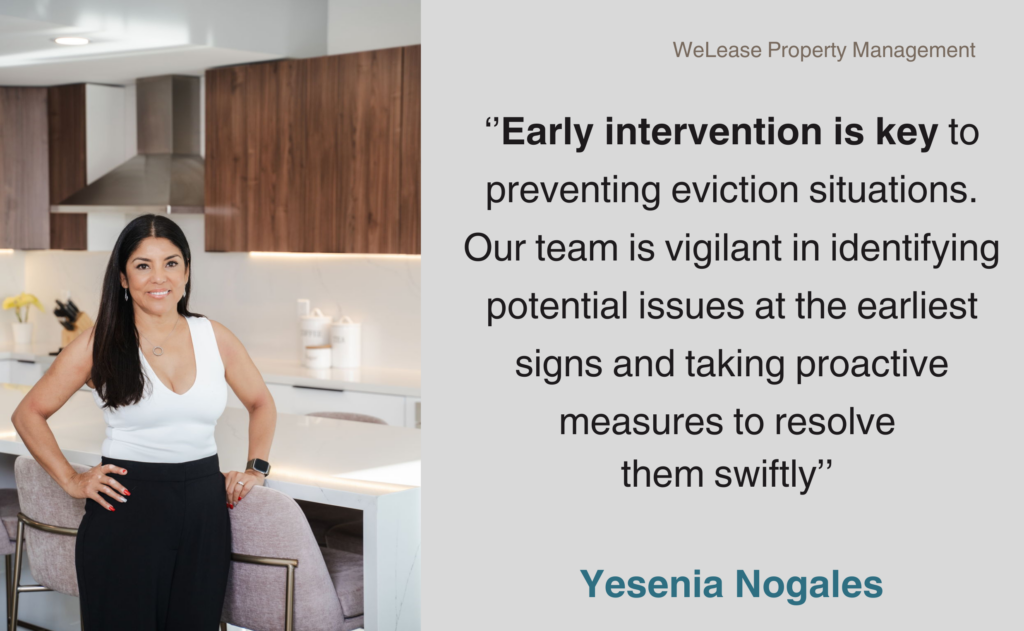
Early Intervention: Early intervention is key to preventing eviction situations. Our team is vigilant in identifying potential issues at the earliest signs and taking proactive measures to resolve them swiftly. Whether it’s addressing maintenance issues, mediating disputes, or providing support to tenants facing financial difficulties, we are committed to finding constructive solutions to prevent eviction proceedings.
Fair and Equitable Practices:We believe that by treating everyone with respect and fairness, we can foster trust and cooperation, reducing the likelihood of eviction-related conflicts.
Collaborative Problem-Solving: When challenges arise, we approach them as opportunities for collaborative problem-solving. Our team works closely with property owners and tenants to identify underlying issues, explore potential solutions, and reach mutually beneficial agreements.
Continuous Improvement: We are committed to continuously improving our property management practices to better serve our clients and tenants. Through ongoing training, feedback mechanisms, and staying abreast of industry best practices, we strive to enhance our ability to prevent evictions and promote positive landlord-tenant relationships.
At WeLease, we recognize that eviction is a last resort that can have significant repercussions for all parties involved. That’s why we are dedicated to employing proactive, fair, and collaborative approaches to property management, with the goal of avoiding evictions whenever possible. By prioritizing communication, early intervention, equitable practices, and continuous improvement, we aim to create a positive and harmonious rental experience for everyone.
Conclusion
Evictions are a challenging aspect of rental property management in San Diego. Understanding the legal framework and having a structured process in place are key to handling evictions effectively.
You may need legal assistance with any eviction process. Evictions are very detail-oriented; you can lose your case if you make even a small mistake, such as counting days incorrectly or accidentally demanding too much in past-due rent. If you lose, you must start the entire case over. Keep in mind that you might do research using the California Court Self-Help Guide or any trustworthy San Diego attorney’s website. However, your case might differ in detail from others, and such a delicate matter should ideally be handled by a professional San Diego attorney or your preferred property management company.
DISCLAIMER: Do not take this article as customized advice. Consult with your trusted lawyer or property manager for advice and evaluation of your individual eviction case. For more information don’t hesitate to contact us at (619) 866-3400, WeLease Property Management San Diego.
Related articles:
-
How to Evict a Problem Tenant in California
-
What is Just Cause for an Eviction in California in 2021?
-
What to do when your California tenants pay rent late?
-
Property Tips for Rental Owners
-
Working With Tenants
-
How To Make Your Rent Payment
-
How To Raise Rents
-
California Security Deposits | Everything You Need to Know

HAVE ANY QUESTIONS?
Let us know, we’d love to help:
Call: (619) 787 – 4066
or Click: www.WeLeaseUsa.com/contact
WeLease Property Management Company

Eviction Process in San Diego. Edited by: Yuliana Nogales,
Operations Manager at WeLease Property Management, San Diego.

Noelia Ortega Inoa is a project manager with 5+ years of experience in property management and real estate marketing. She takes a data-driven approach and strives to deliver value in every piece she creates for property owners, tenants, real estate agents, and investors.